
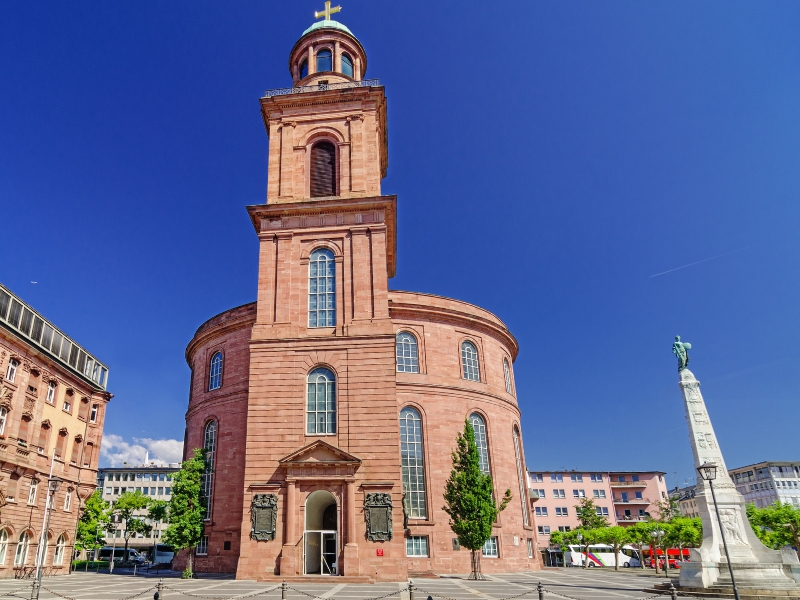
The Paulskirche (St Paul's Church) is an oval red sandstone building a short walk from Frankfurt's Römerberg. Built as a Lutheran church, it became famous in 1848–49, when the first freely elected all-German parliament met inside and drafted a constitution for a united, democratic Germany.
The Paulskirche at a glance
- Where: Paulsplatz in Frankfurt's old town, a couple of minutes' walk north of the Römerberg
- Built: begun in 1789, completed 1829–1833; rebuilt after the war and reopened on 18 May 1948
- By: Johann Andreas Liebhardt (original design) and Johann Friedrich Christian Hess (completion); post-war rebuilding led by Rudolf Schwarz
- What it is today: no longer a church but a memorial and venue for exhibitions, ceremonies and prize-givings
- Time needed: 30–45 minutes for the hall and the exhibition below it
From church to Germany's first parliament
Work on the church started in 1789 on the site of a medieval Franciscan church, but war and lack of money held it up, and it was only finished in 1833. Its oval plan made it a natural meeting hall. After the revolutions of spring 1848, a preliminary parliament met here from 31 March to 3 April, and on 18 May 1848 the elected National Assembly opened in the church. Over the following year it debated a catalogue of basic rights and a constitution for a united Germany. Prussia, Austria and several smaller states opposed it, the Prussian king refused the imperial crown it offered him, and the assembly was dissolved in 1849.
In March 1944 Allied bombs burnt the building out. It was one of the first buildings in Frankfurt to be rebuilt, in a simplified form under the architect Rudolf Schwarz, and reopened on the 100th anniversary of the National Assembly. Schwarz inserted a floor: a low entrance level below and a bright, bare assembly hall above. US President John F. Kennedy spoke here in 1963, and a full restoration is now being planned, with a team appointed in 2026; check whether the building is open before you go.
What to look for
- The oval outline and the tower on Paulsplatz, unusual shapes for a Protestant church of the time.
- Johannes Grützke's long circular mural on the lower level, unveiled in 1991, showing the delegates walking to the Paulskirche.
- The plain, bright upper hall lit from a skylight in the roof, where the ceremonies are held today.
- The permanent exhibition on the history of democracy and unity in Germany, on the lower level.
- The red sandstone of the walls, the same stone used for Frankfurt's cathedral and many of its historic buildings.
A stage for the Peace Prize
Every October, during the Frankfurt Book Fair, the Peace Prize of the German Book Trade is presented in the Paulskirche, and the city's Goethe Prize is awarded here too. The speeches given in the hall are broadcast nationally and often spark debate, so the building still plays a public role in German life, not only as a museum of 1848.
Tips for your visit
- Combine it with the Römerberg and the reconstructed New Old Town between the cathedral and the town hall.
- Come on a weekday morning; the hall is sometimes closed for events and ceremonies, especially around the Book Fair in October.
- For the best photo of the oval shape, stand on the far side of Paulsplatz.
- Be quiet in the upper hall if a rehearsal or event is being prepared.
Nearby
- Römerberg: Frankfurt's old town square with the Römer town hall and its row of rebuilt timber-framed houses.
- Frankfurt Cathedral (Kaiserdom): the red sandstone church where Holy Roman Emperors were elected and later crowned.
- Goethe House: the family home where Johann Wolfgang von Goethe was born in 1749, rebuilt after the war; a few minutes' walk.
- New Old Town (Neue Altstadt): a district of reconstructed and new houses on the old street plan between the Römer and the cathedral.
See Frankfurt with World City Trail
Our Frankfurt scavenger hunt turns the old town into a game you play on your phone. The route links 10 stops and takes around two hours, with about 24 minutes of walking. It includes places such as the Römerberg.
If you prefer a different format, Frankfurt also has a self-guided walking tour and an outdoor escape game.
Play the Frankfurt scavenger hunt →
Take the self-guided walking tour of Frankfurt →
Play the outdoor escape game in Frankfurt →
Facts checked in October 2026.