
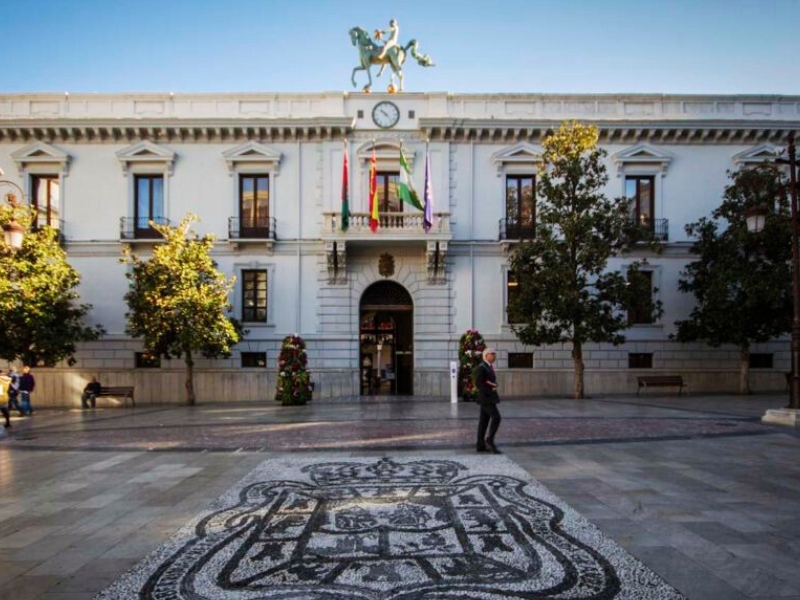
Granada City Hall (Ayuntamiento de Granada) is the long grey building on Plaza del Carmen, just off Calle Reyes Católicos in the city centre. The council has met here since 1851, in what is left of a 17th-century Carmelite convent. Look up at the roof: since 2002 a naked, blindfolded rider has been balancing there on a horse that stands on spheres.
Granada City Hall at a glance
- Where: Plaza del Carmen, between Calle Reyes Católicos and Calle Mariana Pineda, a few minutes' walk from the Cathedral and Puerta Real.
- Opened: as the city hall in 1851, in the former convent of the Calced Carmelites, which was completed in 1627.
- By: the façade was remodelled in the 20th century by the architects Modesto Cendoya and Ángel Casas; the rooftop sculpture was designed by the painter Guillermo Pérez Villalta and modelled by the sculptor Ramiro Megías.
- What it is today: the working seat of Granada's city council and mayor, with Plaza del Carmen as its forecourt.
- Time needed: 10–15 minutes from the square.
From a Nasrid school to a Carmelite convent
Granada's city council is older than its building. It was set up by royal charter of the Catholic Monarchs on 20 September 1500, with 24 councillors, and its first home was the Madraza, the Islamic college built in 1349 by the Nasrid sultan Yusuf I, which the monarchs handed over to the council in 1500. The councillors met there in the Hall of the Twenty-Four under a coffered wooden ceiling that still survives.
The Calced Carmelites arrived in 1552 in a house on Cuesta de Gomérez, moved in 1572 to a hermitage on this site and finished their convent and church in 1627. After Mendizábal's confiscation of church property in the 1830s, the city bought the convent. Short of money to restore it, the council demolished the church and the old cloister, and Plaza del Carmen was laid out on the empty ground in works that ran from 1848 to 1858; the council itself moved into the surviving wing in 1851. The façade was redone several times in the 20th century, and for the council's 500th anniversary in 2000 it was given its present classical look, repainted from pink to grey.
What to look for
- El instante preciso (The Precise Instant): the bronze group on the roof, about 4 metres high, unveiled on 13 December 2002. A naked, blindfolded rider sits on the horse's rump, the horse balances on spheres, and the rider holds one more sphere, the world.
- The clock on the façade, which carries a line by the Granada poet Antonio Carvajal about happiness and the passing hours.
- The main patio, a survivor of the convent, with Tuscan columns of grey Sierra Elvira stone. If the door is open you can glimpse it from the entrance.
- On the north side, facing Calle Mariana Pineda, a stone doorway under a relieving arch: the last piece of the old convent's outer stonework.
- The 2000 façade itself: grey walls with friezes over the windows, where until then the building had been pink and carried a large scallop shell.
What the rider means
The design comes from a 1991 painting by Guillermo Pérez Villalta, and the bronze was cast by Miguel Ángel Moliné. According to the city's own description, the balance of horse and rider stands for a brief moment of perfect harmony and happiness. The blindfold suggests that we do not notice such a moment while it is happening and only recognise it afterwards. The rider is meant to be everyone, and the group expresses a hope for shared happiness and good civic government. Not everyone in Granada was convinced: the sculpture drew mixed reactions when it went up.
Tips for your visit
- Stand at the far end of Plaza del Carmen to see the sculpture properly. From the doorway it is almost straight above you and hard to make out.
- This is a working town hall, not a museum. If you want to look into the patio, do it quietly and ask the staff at the door first.
- Pair it with the Madraza: seeing the council's first and present homes on the same walk tells the story of Granada after 1492 in two buildings.
Nearby
- Corral del Carbón: a 14th-century Nasrid merchants' inn with a horseshoe-arched gateway, just round the corner on Calle Mariana Pineda.
- Palacio de la Madraza: the council's first seat, opposite the Royal Chapel, with a Nasrid prayer room and its mihrab.
- Granada Cathedral and the Royal Chapel, where Isabella and Ferdinand, the Catholic Monarchs, are buried, a few minutes' walk away.
- Basílica de la Virgen de las Angustias: the church of Granada's patron saint, on Carrera de la Virgen.
See Granada with World City Trail
Our Granada scavenger hunt turns the old town into a game you play on your phone. The route links 10 stops and takes around 2 hours, with about 31 minutes of walking. Along the way it includes the Fuente de las Granadas and the Basílica de la Virgen de las Angustias. You can play in English, German, French, Italian, Spanish or Dutch.
If you prefer a different format, there is also a self-guided walking tour and an outdoor escape game in Granada.
Play the Granada scavenger hunt →
Take the self-guided walking tour of Granada →
Play the outdoor escape game in Granada →
Facts checked in October 2026.