
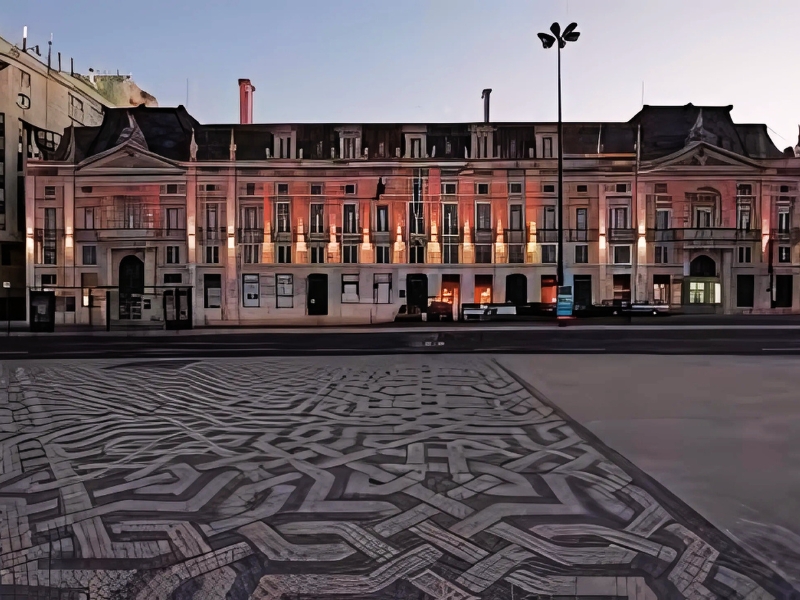
The Palácio Foz is the long neoclassical palace on the west side of Praça dos Restauradores, the square at the foot of Avenida da Liberdade in Lisbon. It took about eight decades to finish, from 1777 to 1858, and then lived several lives in a row: aristocratic home, rented space for a restaurant, shops and a cinema, headquarters of the Estado Novo regime's propaganda office, and today offices, exhibitions and a children's cinema.
Palácio Foz at a glance
- Where: on the west side of Praça dos Restauradores, between Rossio and Avenida da Liberdade, at the bottom of Calçada da Glória.
- Built: begun in 1777 and completed in 1858; remodelled from 1889 for the Marquis of Foz.
- By: the Italian-born architect Francisco Xavier Fabri directed works from 1792; José António Gaspar remodelled the palace for the Marquis of Foz.
- What it is today: a state-owned building, classified as a property of public interest, used for offices, exhibitions and events; it also houses the Cinemateca Júnior and the National Sports Museum.
- Time needed: 10 minutes for the façade and the square; longer if you can join one of the occasional guided visits of the interior.
From the Castelo Melhor palace to the propaganda office
The site belonged to the Counts of Castelo Melhor from 1711, and their house here was badly damaged in the 1755 earthquake. Rebuilding dragged on for generations: a new palace was begun in 1777, Francisco Xavier Fabri directed further works from 1792, and the building was only completed in 1858, after a last campaign ordered by the fourth Marquis of Castelo Melhor. That is why many people in Lisbon still call it the Palácio Castelo Melhor, and why its regular façade follows Italian neoclassical taste rather than the Baroque.
In 1889 the palace was sold to Tristão Guedes de Queirós Correia Castelo Branco, the first Marquis of Foz, who gave it its current name and had José António Gaspar redecorate the interiors in the lavish revival styles of the day. His fortune did not last: the palace was mortgaged, its contents were sold at auction, and from 1910 to 1939 its rooms were let to businesses, among them the Abadia restaurant, a pastry shop and the Central cinema. In 1940 the state bought the building and made it the headquarters of the Secretariat of National Propaganda, the propaganda office of Salazar's Estado Novo. It was classified as a property of public interest in 1972, and after the 1974 revolution it passed to the state's media institute.
What to look for
- The main façade: a long, symmetrical front with even rows of windows, closer to Italian neoclassicism than to Lisbon's Baroque palaces.
- The Monument to the Restorers: the obelisk in the middle of the square, inaugurated in 1886, commemorates Portugal's restoration of independence from Spain in 1640, which gave the square its name.
- Calçada da Glória: the steep street beside the palace, where the Glória funicular climbs to Bairro Alto. It has been out of service since a fatal accident in September 2025, and a new system is planned, so check before you count on it.
- The Éden building: across the square stands the former Éden Teatro, with its 1930s Art Deco façade by the architect Cassiano Branco.
- The paving: the square is laid with calçada portuguesa, the black and white limestone mosaic used on pavements all over Lisbon.
Behind the façade
The interiors from the Marquis of Foz's time are the palace's real surprise: richly decorated salons in 19th-century revival styles, among them a room of painted panels and a gallery of busts. The Palácio Foz is not a museum you can simply walk into, though. Parts of it are offices, photography inside is generally not allowed, and the interior mostly opens for exhibitions, events and occasional guided visits, so check what is on before you go.
Tips for your visit
- Come in the morning: the palace faces east, so the façade gets the best light early in the day.
- For the full picture, stand by the obelisk in the middle of the square: from there you see the palace, the Éden façade and the start of Avenida da Liberdade together.
- If you go inside for an exhibition, remember that the building is a workplace: keep your voice down and ask before taking photos.
- Combine it with Rossio just to the south or a walk up Avenida da Liberdade.
Nearby
- Rossio Square: Lisbon's main square for centuries, with its wave-patterned paving and the Teatro Nacional D. Maria II, a few minutes' walk south.
- Rossio station: the neo-Manueline railway station with two large horseshoe-shaped doorways, between Restauradores and Rossio.
- Avenida da Liberdade: the broad, tree-lined boulevard laid out in the late 19th century, which starts at the top of the square.
- São Pedro de Alcântara viewpoint: at the top of Calçada da Glória, with one of the best views over the Baixa to the castle; while the funicular is closed, it is a steep climb on foot.
See Lisbon with World City Trail
Our Lisbon scavenger hunt turns the old town into a game you play on your phone. The route links 10 stops and takes around two hours, with about 49 minutes of walking. The Palácio Foz is one of the stops, and the route also includes Rossio Square. You can play in English, German, French, Italian, Spanish, Dutch or Portuguese.
If you prefer a different format, there is also a self-guided walking tour and an outdoor escape game in Lisbon.
Play the Lisbon scavenger hunt →
Take the self-guided walking tour of Lisbon →
Play the outdoor escape game in Lisbon →
Facts checked in October 2026.