
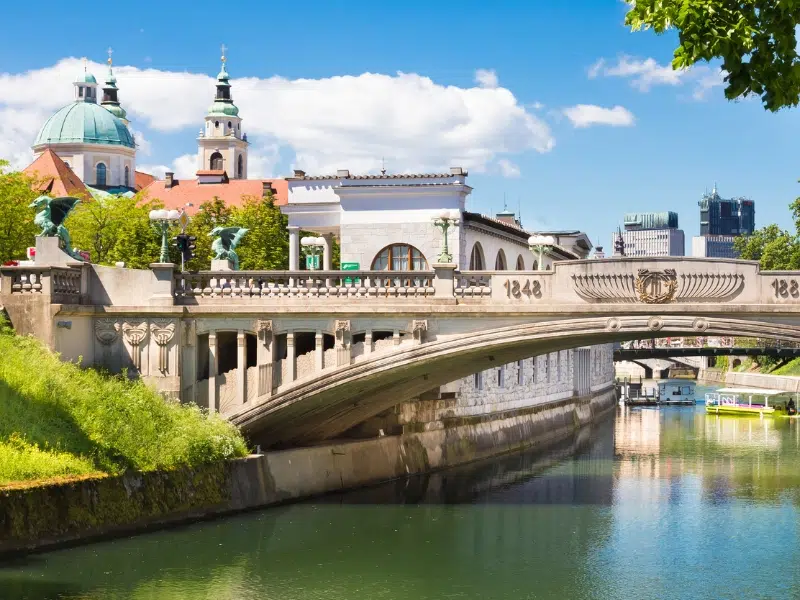
The Dragon Bridge (Zmajski most) carries traffic over the Ljubljanica river in Ljubljana, just north of the Central Market. When it opened in 1901 it was one of the first reinforced concrete bridges in Europe, but what everyone comes to see are the four copper dragons on its corners, the animal that has stood for the city on its coat of arms for centuries.
The Dragon Bridge at a glance
- Where: over the Ljubljanica, linking Resljeva cesta and Kopitarjeva ulica, at the end of Vodnik Square and the Central Market.
- Built: 1900–1901; opened to traffic on 4 October 1901.
- By: the architect Jurij Zaninović (Giorgio Zaninovich), a pupil of Otto Wagner, with the Vienna firm Pittel+Brausewetter, using Josef Melan's patented building system.
- What it is today: a working road bridge and a protected technical monument, often called the finest Vienna Secession bridge anywhere.
- Time needed: 10–15 minutes to walk across, look at the dragons and take photos.
From the Butchers' Bridge to the Dragon Bridge
Before 1900 the river was crossed here by the Butchers' Bridge, an oak bridge built in 1819. The great earthquake of 1895 damaged it, and the rebuilding of Ljubljana under mayor Ivan Hribar included a modern bridge on the spot. Work began on 1 July 1900, and on 4 October 1901 the bishop of Ljubljana, Anton Bonaventura Jeglič, opened it to traffic. It was named the Jubilee Bridge of Emperor Franz Joseph I, to mark the 40 years of his reign from 1848 to 1888.
The engineering was as new as the style. In the Melan system, iron truss arches carry the load while the concrete is poured around them, so no scaffolding is needed in the river, and the iron then stays inside as reinforcement. The single three-hinged arch spans 33.34 metres, at the time the third-largest arch of its kind in Europe, and the bridge was the first in Slovenia to be paved with asphalt. After Austria-Hungary collapsed, the emperor's name went and the bridge officially became the Dragon Bridge in July 1919. It was renovated in 1983–1984 and celebrated its centenary in 2001.
What to look for
- The four large dragons on their pedestals at the corners: they are made of sheet copper, designed by Zaninović and made by the Beschorner factory in Vienna. Walk round them to see the wings, claws and curled tails.
- The sixteen smaller dragons that decorate the rest of the bridge. Try counting them as you cross.
- The arch itself: from the riverside embankment you can see how flat and wide the single concrete span is, with no pier in the water.
- The Secession style: clean lines and geometric ornament typical of Otto Wagner's Vienna school, very different from the Baroque churches of the old town.
- The city's coat of arms, with a dragon sitting on top of a castle tower. Look for it on Ljubljana's city signs and buildings and compare it with the dragons on the bridge.
Jason, the Argonauts and the dragon
Why dragons? According to legend, Jason and the Argonauts, fleeing with the Golden Fleece, sailed up the Danube and its tributaries to the marshes where Ljubljana now stands, and Jason killed a dragon that lived there. A later joke says the bridge's dragons wag their tails whenever a virgin walks across. Neither story can be checked, but both are told on almost every walk through the city.
Tips for your visit
- Come in the morning or late afternoon, when the light is soft, and photograph a dragon in the foreground with the castle hill behind it.
- This is a road bridge with traffic: stay on the pavements and do not climb the pedestals for photos.
- Combine it with a market morning: the Central Market starts at the southern end of the bridge, and the stalls are busiest early in the day.
Nearby
- Central Market: Jože Plečnik's long riverside colonnade from the 1930s, with fresh produce outside and food stalls under the arcades.
- Butchers' Bridge (Mesarski most): the footbridge opened in 2010, known for its love padlocks and bronze sculptures by Jakov Brdar.
- Ljubljana Cathedral (St Nicholas): the Baroque cathedral behind the market, with bronze doors made for Pope John Paul II's visit in 1996.
- Funicular to Ljubljana Castle: the lower station on Krekov trg is a few minutes' walk away, a quick way up to the castle and its views.
See Ljubljana with World City Trail
Our Ljubljana scavenger hunt turns the old town into a game you play on your phone. The route links 10 stops and takes around 2 hours, with about 27 minutes of walking. The Dragon Bridge is one of the stops, along with the Franciscan Church and the Ursuline Church.
If you prefer a different format, there is also a self-guided walking tour and an outdoor escape game in Ljubljana.
Play the Ljubljana scavenger hunt →
Take the self-guided walking tour of Ljubljana →
Play the outdoor escape game in Ljubljana →
Facts checked in October 2026.