
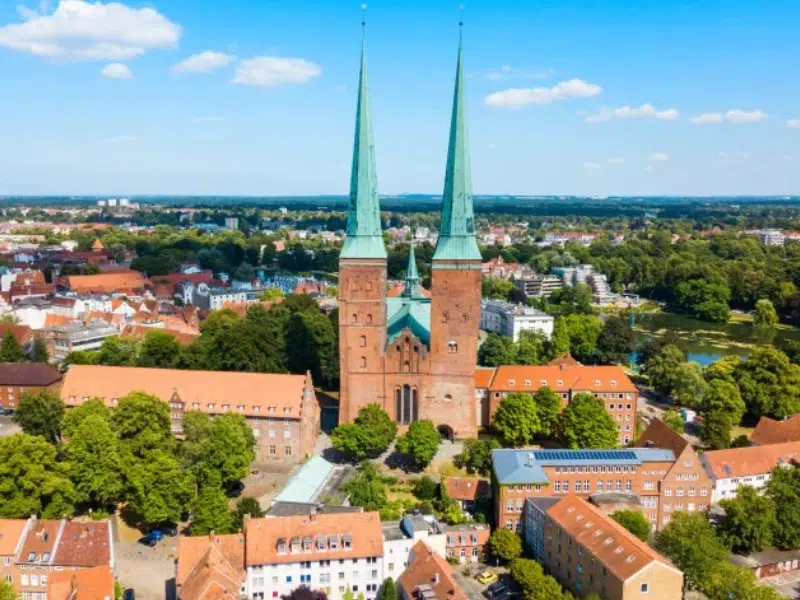
Lübeck Cathedral (Dom zu Lübeck) is the long brick church with two slender green spires at the southern tip of Lübeck's old town island. Henry the Lion laid its foundation stone in 1173, which makes it the oldest large church in the city. Inside hangs one of the great works of late Gothic art in northern Europe: Bernt Notke's triumphal cross, about 17 metres high.
Lübeck Cathedral at a glance
- Where: Domkirchhof, at the southern end of the old town island, beside the Mühlenteich pond and the Museum of Nature and Environment.
- Built: begun in 1173 as a Romanesque basilica, consecrated in 1247, and extended with a Gothic choir completed in 1341.
- What it is today: a Lutheran parish church and part of the Lübeck old town UNESCO World Heritage Site, with services, concerts and visitors welcome during the day.
- Time needed: 30–45 minutes inside, longer if you want to study the cross and the side chapels.
From bishop's church to Palm Sunday ruin
Henry the Lion, Duke of Saxony and Bavaria, moved the bishopric of Oldenburg to Lübeck in 1160 and first built a wooden church here. In 1173 he and Bishop Henry I laid the foundation stone of a stone cathedral, completed as a Romanesque brick basilica and consecrated in 1247. From 1266 the church was rebuilt as a Gothic hall church, and between about 1317 and 1341 Bishop Heinrich Bochholt paid for the long Gothic choir that brought the church to about 130 metres in length. The cathedral became Lutheran during the Reformation in Lübeck around 1530.
In the night before Palm Sunday, 28–29 March 1942, British bombers set much of Lübeck's old town on fire. The cathedral roof burned, the spires collapsed, the organ and all the stained glass were lost, and several vaults fell in during the following years. Notke's cross and most of the medieval altarpieces had been saved. Rebuilding started in 1949 and ended in 1982 with the restoration of the Paradise, the north porch. Today the two west towers, just under 115 metres high, face a long restoration of eight to ten years, so expect scaffolding on parts of the outside.
What to look for
- The triumphal cross: Bernt Notke carved this 17-metre group in 1477 for Bishop Albert Krummediek. Christ hangs between Mary, John, Mary Magdalene and Adam and Eve, and the kneeling bishop himself appears at the foot.
- The rood screen and clock: below the cross, the screen carved by Notke's workshop carries an astronomical clock from 1628 on its south end.
- The font: a bronze baptismal font cast by Lorenz Grove in 1455, standing in a baptismal chapel since the war.
- The pulpit: a Renaissance pulpit of 1586 with alabaster reliefs of the life of Christ, closed off by a wrought-iron grille from 1572.
- Bishop Bochholt's tomb: in the middle of the choir, his brass grave slab shows him holding a model of the Gothic choir he paid for.
- The Paradise: the richly decorated north porch, begun in the 1250s, which nearly collapsed after the war and was the last part to be rebuilt.
The bishop's church and the merchants' church
Lübeck has two great medieval brick churches, and the rivalry between them tells the story of the city. The cathedral at the southern end belonged to the bishop and the cathedral chapter. At the highest point of the town, next to the market, the merchants and the city council built St Mary's Church as their own, and it is often said they made it larger and taller on purpose to outshine the bishop's church. Visit both and compare: the cathedral feels older, longer and quieter, with fewer visitors.
Tips for your visit
- Walk the whole length of the nave: from the west door, the cross seems to float in the middle of the church, and the choir only opens up once you pass beneath it.
- For the classic view of the two spires, cross to the far side of the Mühlenteich pond, especially in the late afternoon light.
- It is a working church: check before you go if a service or concert is on, and keep quiet during prayers.
Nearby
- Museum of Nature and Environment: the natural history museum right next to the cathedral, good for families.
- St Annen Museum: the medieval art museum in a former convent, a short walk north, which now holds Hans Memling's Passion altarpiece, painted for a chapel in the cathedral.
- Malerwinkel: the 'painters' corner' on the Obertrave, with gardens and old warehouses reflected in the river, a short walk west.
- Holsten Gate: the brick city gate with its two round towers, about 15 minutes' walk away.
See Lübeck with World City Trail
Our Lübeck scavenger hunt turns the old town into a game you play on your phone. The route links 10 stops and takes around 2 hours, with about 44 minutes of walking. It includes St Mary's Church, the cathedral's great rival, as well as the Holsten Gate and the Town Hall.
If you prefer a different format, there is also a self-guided walking tour and an outdoor escape game in Lübeck.
Play the Lübeck scavenger hunt →
Take the self-guided walking tour of Lübeck →
Play the outdoor escape game in Lübeck →
Facts checked in October 2026.