
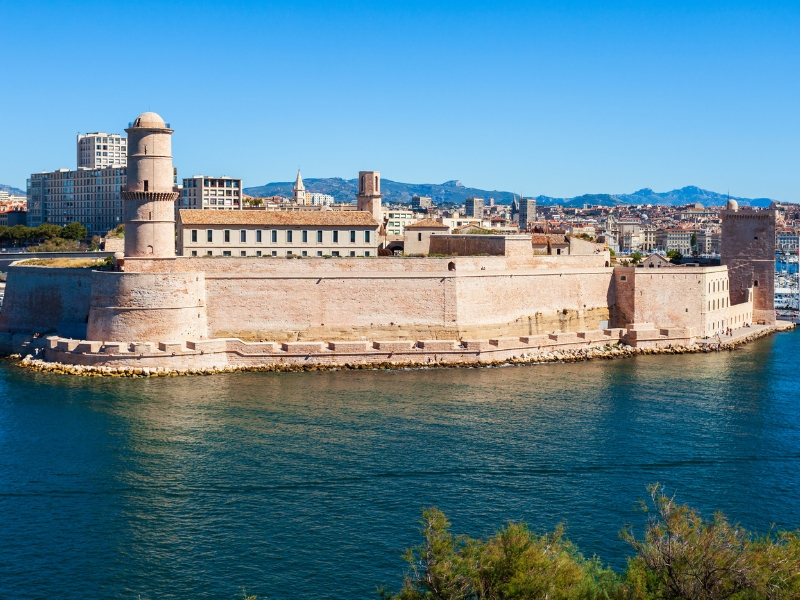
Fort Saint-Jean guards the northern side of the entrance to Marseille's Old Port, facing Fort Saint-Nicolas across the water. Louis XIV had both forts built after Marseille rebelled against royal authority, and their guns were meant as much for the restless city as for enemies at sea. Since 2013 the fort has been part of the Mucem, and footbridges tie it to Le Panier and to the museum's modern building.
Fort Saint-Jean at a glance
- Where: at the mouth of the Old Port, at the south-western tip of the Le Panier district.
- Built: ordered by Louis XIV after 1660; the main works ran from 1668 to 1671, and Vauban strengthened the fort from 1679. Older towers from the 15th and 17th centuries are built into it.
- By: the military engineer Louis Nicolas de Clerville, with later works directed by Vauban.
- What it is today: part of the Mucem (Museum of European and Mediterranean Civilisations), with gardens, ramparts and exhibition spaces open to visitors.
- Time needed: about an hour to walk the ramparts and gardens; longer if you add the museum.
From royal citadel to museum
The promontory was occupied long before the fort: remains from the first Greek settlement of the 6th century BC have been found here. At the end of the 12th century the Knights Hospitaller of St John set up a commandery on the site, which gave the fort its name. In the mid-15th century King René of Anjou built a strong square tower to watch the harbour entrance, and a round lantern tower, the Tour du Fanal, followed in 1644. After besieging rebellious Marseille in 1660, Louis XIV had the area turned into a citadel, expropriating the Hospitallers and many houses.
During the Revolution the fort was stormed in 1790 and later served as a prison, holding Philippe Égalité, Duke of Orléans, and two of his sons; in June 1795 royalists massacred Jacobin prisoners held there. For much of the 19th and 20th centuries it was a barracks, and recruits for the Foreign Legion passed through on their way to North Africa. In August 1944 an ammunition depot left by the German army exploded and destroyed several old buildings. Listed as a historic monument in 1964 and restored, the fort opened to the public as part of the Mucem in 2013.
What to look for
- The King René Tower: the square 15th-century keep that once watched over ships entering the port.
- The Tour du Fanal: the slimmer round tower of 1644, which carried a light to guide ships at night.
- The two footbridges: a 115-metre bridge links the fort to the Mucem's modern building on the J4 pier, and a 70-metre one crosses to the Saint-Laurent church square in Le Panier.
- The Garden of Migrations: a planted walk on the upper terraces with Mediterranean flowers and aromatic plants.
- The pink limestone walls, quarried at La Couronne on the coast west of Marseille, which glow in the late afternoon light.
Cannons that faced the town
Unlike most harbour forts, Fort Saint-Jean and Fort Saint-Nicolas were not mainly built to keep out enemy fleets. They were a royal answer to a local uprising, designed to let the king's garrisons control the city and, if needed, bombard it. Standing on the ramparts today, you can see how closely the fort overlooks the quays and the old streets it was meant to keep in check.
Tips for your visit
- The outdoor areas of the fort can be walked freely; arrive from Le Panier over the Saint-Laurent footbridge for the most scenic approach.
- Come in the late afternoon for soft light on the stone and the sunset over the harbour entrance.
- Some entrances and parts of the garden are only partly accessible for wheelchairs, so check the route in advance.
- Bring water and a hat in summer: the ramparts have little shade.
Nearby
- Mucem J4 building: Rudy Ricciotti's museum wrapped in a concrete lattice, reached by the footbridge.
- Le Panier: Marseille's oldest district, with steep lanes, street art and the Vieille Charité.
- Fort Saint-Nicolas: the fort's twin on the opposite side of the harbour entrance.
- Cathédrale de la Major: the striped 19th-century cathedral on the waterfront, a few minutes' walk north.
See Marseille with World City Trail
Our Marseille scavenger hunt turns the old town into a game you play on your phone. The route links 10 stops and takes around 3 hours, with about 51 minutes of walking. It includes the Old Port (Vieux-Port) and Le Panier.
If you prefer a different format, there is also a self-guided walking tour and an outdoor escape game in Marseille.
Play the Marseille scavenger hunt →
Take the self-guided walking tour of Marseille →
Play the outdoor escape game in Marseille →
Facts checked in October 2026.