
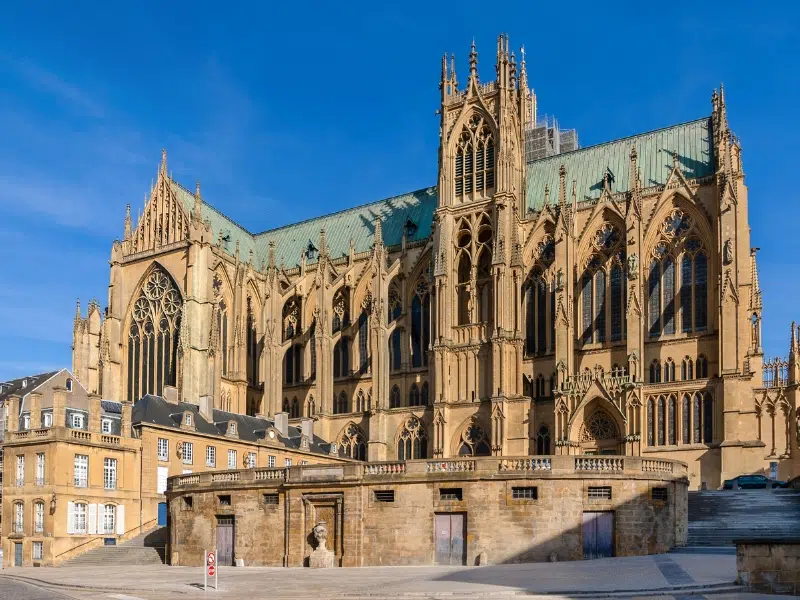
Saint-Étienne Cathedral in Metz is the Gothic cathedral of golden-yellow stone that rises over the old town on the Place d'Armes. Its vaults reach 41.41 metres, among the highest of any Gothic nave in France, and its windows hold about 6,500 square metres of stained glass, from the 13th century to Marc Chagall and beyond. That is why the people of Metz call it the Lanterne du Bon Dieu, God's Lantern.
Metz Cathedral at a glance
- Where: Place d'Armes, at the top of the old town, a short walk above the Moselle.
- Built: the Gothic cathedral was begun around 1220 and largely finished in the early 16th century.
- What it is today: the Catholic cathedral of the diocese of Metz, with one of the largest areas of stained glass of any French cathedral, a crypt and a treasury.
- Time needed: 45 minutes to an hour inside, longer if you visit the crypt and treasury.
Two churches under one roof
A Romanesque cathedral stood here by the 11th century. In 1220 Bishop Conrad of Scharfenberg launched a new Gothic building, and over the next three centuries the builders did something unusual: they joined the cathedral to a neighbouring collegiate church, Notre-Dame-la-Ronde, so that two churches became one long nave. Inside you can still tell where one ended, because the floor of Notre-Dame-la-Ronde was lowered to match the cathedral's. The pale Jaumont limestone, quarried near Metz, contains iron and gives the walls their warm yellow colour.
Metz was part of the German Empire from 1871 to 1918, and the cathedral shows it. On the night of 7 May 1877, after fireworks were set off from the roof during a visit by Emperor Wilhelm I, the medieval oak roof burned down; the stone vaults held and saved the nave. The Germans then replaced the 18th-century classical west entrance with a neo-Gothic portal, inaugurated in 1903 in the presence of Wilhelm II. After 1945 the cathedral turned to modern artists for new windows, and it is still commissioning them today.
What to look for
- The great west rose: made by the master glazier Hermann von Münster at the end of the 14th century. He worked in Metz from at least 1381 and was buried in the cathedral in 1392.
- The Renaissance windows of Valentin Bousch in the south transept, finished in the early 1520s, full of figures and bright colour.
- Chagall's windows: installed mainly in the 1960s in the north transept and the ambulatory, mostly scenes from the Hebrew Bible, in deep blues and reds.
- More modern glass: windows by Jacques Villon (1957) in the Chapel of the Blessed Sacrament, abstract windows by Roger Bissière (1959), and windows by the Korean artist Kimsooja in the Saint-Nicolas Chapel, inaugurated in 2022.
- The prophet Daniel: on the neo-Gothic Portal of the Virgin, the statue of Daniel was given the features of Kaiser Wilhelm II. Look for the emperor's face among the prophets.
- The Tour de la Mutte: the tower of about 90 metres on the side facing Place d'Armes, which served as the city's belfry. Its great bell, La Mutte, was cast in 1605 and rings again since 2015 after restoration.
The Graoully
According to legend, a dragon called the Graoully lived in the ruins of the Roman amphitheatre and terrorised Metz with its poisonous breath, until Saint Clement, the first bishop of the city, tamed it with his stole and drove it into the river. The dragon became a symbol of Metz: an old effigy of the Graoully is kept in the cathedral crypt, which was refurbished and reopened in 2026, and a dragon hangs above Rue Taison in the old town.
Tips for your visit
- Come on a sunny day, ideally in the morning or late afternoon, when light comes through the windows on the east or west side. On a grey day the glass looks much darker.
- Bring binoculars or use your phone's zoom: many of the best panels are high up in the clerestory.
- Mass and services take place regularly; move quietly and avoid the central aisle during services.
- Walk round the outside too: the view from the Place d'Armes shows the length of the double church and the Tour de la Mutte.
Nearby
- Place d'Armes: the 18th-century square in front of the cathedral, designed by Jacques-François Blondel, with the town hall on its far side.
- The covered market: begun as a bishop's palace before the Revolution and turned into a food market instead, right beside the cathedral.
- Temple Neuf: the Protestant church on an island in the Moselle, built in the early 20th century under German rule, a few minutes' walk down the hill.
- Centre Pompidou-Metz: the modern art museum under a huge woven roof, opened in 2010, a longer walk south past the railway station.
See Metz with World City Trail
Our Metz scavenger hunt turns the old town into a game you play on your phone. The route links 10 stops and takes around 2 hours, with about 47 minutes of walking. Saint-Étienne Cathedral is one of the stops, along with the Temple Neuf and the Porte des Allemands.
If you prefer a different format, there is also a self-guided walking tour and an outdoor escape game in Metz.
Play the Metz scavenger hunt →
Take the self-guided walking tour of Metz →
Play the outdoor escape game in Metz →
Facts checked in October 2026.