
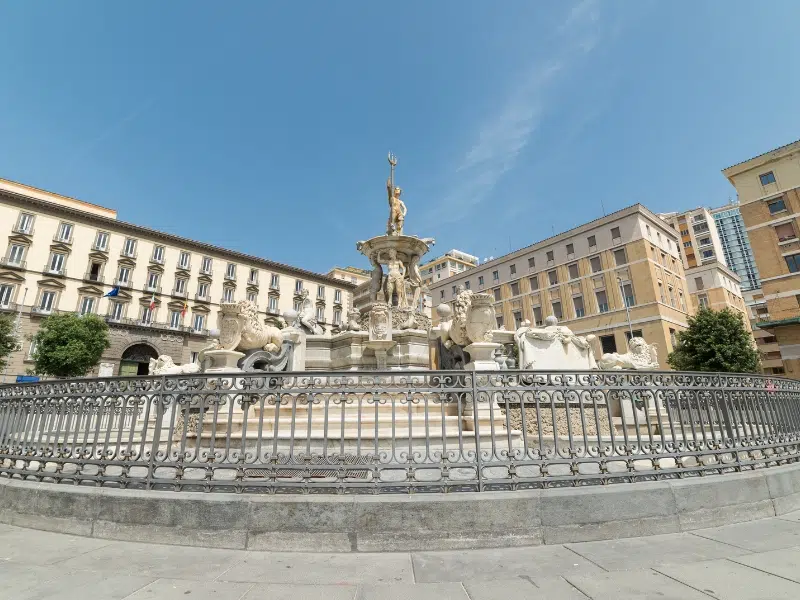
The Fountain of Neptune (Fontana del Nettuno) is a large marble fountain from the early 1600s that now stands in Piazza Municipio, in front of Naples' town hall. Its most unusual feature is its history of travel: it has been taken apart and rebuilt in at least seven different places across the city, and only reached its current spot in 2015.
The Fountain of Neptune at a glance
- Where: Piazza Municipio, in front of Palazzo San Giacomo (the town hall) and facing Castel Nuovo, next to Municipio metro station.
- Built: 1600–1601, commissioned under the Spanish viceroys.
- By: designed under the direction of Domenico Fontana, with sculpture by Michelangelo Naccherino, Pietro Bernini and Angelo Landi; later additions by Cosimo Fanzago.
- What it is today: a working public fountain in the middle of a pedestrian square, free to see at any time.
- Time needed: 10–15 minutes, or longer if you sit on the square and watch the water.
A fountain on the move
The fountain was commissioned by the viceroy Enrique de Guzmán, Count of Olivares, and completed in 1600–1601 near the arsenal in the port. The spot had too little water, so in 1628 it was moved to the square in front of the Royal Palace, today Piazza del Plebiscito. It got in the way of public festivities there, and in 1634 it went to Santa Lucia, where Cosimo Fanzago added new sculpture. Around 1639 the viceroy Duke of Medina de las Torres had it moved again, to the street that took his name, Via Medina, and the fountain is still also called Fontana Medina.
It was damaged during Masaniello's revolt of 1647–1648, plundered by a viceroy in 1672 and repaired several times. In 1886 the great clearance works known as the Risanamento sent it into storage in caves under Pizzofalcone. It reappeared in 1898 in Piazza della Borsa (today Piazza Bovio) and stayed there until 2000, when metro works moved it back to Via Medina. After restoration in 2014 it was rebuilt in Piazza Municipio and unveiled in May 2015, together with the new metro station designed by Álvaro Siza and Eduardo Souto de Moura.
What to look for
- Neptune at the top: the sea god with his trident, carved by Michelangelo Naccherino, standing on a basin held up by figures on a central rock.
- The nymphs and satyrs: two of each, carrying the basin on their heads.
- The sea monsters, dolphins and tritons in the main basin, spouting water: this part is the work of Pietro Bernini, father of the famous Gian Lorenzo Bernini.
- The four lions on the balustrade: each spouts water and holds a coat of arms, including the arms of the city and of the viceroy Medina, added during Fanzago's reworking.
- The setting: line up the fountain with the dark towers of Castel Nuovo on one side and the town hall on the other.
Why it has two names
Many Neapolitans still call it Fontana Medina, after the viceroy who installed it on Via Medina in the 17th century. The name stuck to both the street and the fountain, even though the fountain has since moved several times. Its current location is the result of the redesign of Piazza Municipio above the new metro station, which opened the square up as a long pedestrian space between the town hall and the port.
Tips for your visit
- Morning light falls nicely on the sculpture; in the evening the fountain is lit and the square is livelier.
- For a wider view, walk a little towards the port: you can frame the fountain with the whole front of the town hall behind it.
- The fountain is a monument, not a paddling pool: don't climb on the balustrade or step into the basin.
- Arrive by metro: Municipio station (Line 1) opens right onto the square.
Nearby
- Castel Nuovo (Maschio Angioino): the medieval castle facing the square, with a white marble triumphal arch between its towers.
- Teatro di San Carlo: the historic opera house, a few minutes' walk away.
- Galleria Umberto I: a 19th-century shopping arcade with a glass and iron dome, just behind the opera house.
- Piazza del Plebiscito and the Royal Palace: the vast square where the fountain once stood, a short walk south-west.
See Naples with World City Trail
Our Naples scavenger hunt turns the historic centre into a game you play on your phone. The route links 10 stops and takes around 2 hours, with about 46 minutes of walking, and includes places such as the National Archaeological Museum and the Sansevero Chapel with the Veiled Christ.
If you prefer a different format, there is also a self-guided walking tour and an outdoor escape game in Naples.
Play the Naples scavenger hunt →
Take the self-guided walking tour of Naples →
Play the outdoor escape game in Naples →
Facts checked in October 2026.