
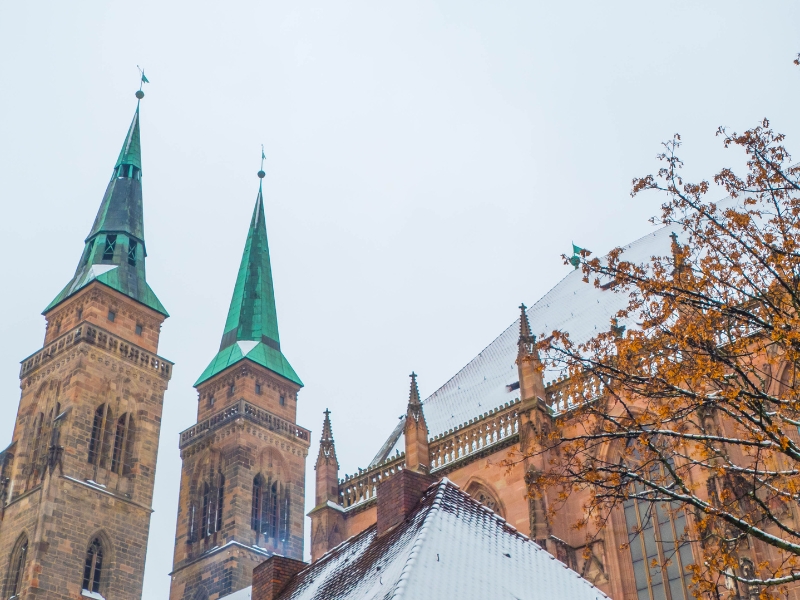
The Sebalduskirche (St Sebald's Church) is Nuremberg's oldest parish church, on the slope below the castle in the northern half of the Old Town. Begun in 1225, it holds the bronze tomb of the city's patron saint, cast by Peter Vischer and his sons between 1508 and 1519, and Vischer added a small bronze figure of himself to it, work apron and all.
The Sebalduskirche at a glance
- Where: Albrecht-Dürer-Platz 1, in the Sebald quarter north of the river Pegnitz, opposite the Old Town Hall.
- Built: begun in 1225 as a Romanesque basilica with two choirs, completed around 1273–1275; the Gothic hall choir followed in 1358–1379 and the towers were raised in the 15th century.
- What it is today: a Lutheran parish church open to visitors and, with St Lorenz and the Frauenkirche, one of Nuremberg's three most important churches.
- Time needed: 30–45 minutes, including a walk round the outside.
From the city's saint to the city's council church
The church is named after Sebaldus, a medieval hermit and missionary who became Nuremberg's patron saint. The city council promoted his cult, had him canonised in 1425 and drew pilgrims to his relics; the Sebalduskirche was also the council's own church. The Romanesque basilica of the 13th century was steadily rebuilt: the aisles were widened in the 14th century, and in 1358–1379 a tall, light-filled Gothic hall choir was added at the east end. The church has been Lutheran since the Reformation, and its organist's post was one of the most prestigious in the city. Johann Pachelbel, the composer of the famous Canon, held it from 1695 until his death in 1706.
Allied air raids between 1940 and 1945 largely destroyed the roof and vaults, and the great organ built by Heinrich Traxdorf in 1440–1441 was lost in January 1945. Much of the art survived because it had been taken away or walled in behind masonry. After years of rebuilding, the church was rededicated on 22 September 1957, and a new organ was installed in 1975.
What to look for
- The tomb of St Sebald in the choir: a bronze canopy on slender columns by Peter Vischer the Elder and his sons Peter and Hermann, cast in 1508–1519 around a silver-covered reliquary shrine of 1397.
- Peter Vischer himself: at one end of the tomb, look low down for the small bronze self-portrait of the founder in his leather apron, holding his tools.
- The Schreyer-Landauer epitaph by Adam Kraft (1492) on the outside of the east end: three sandstone reliefs of Christ carrying the Cross, the Entombment and the Resurrection.
- The Bridal Door on the north side, from about 1320–1330, with the Wise and Foolish Virgins. Weddings were once held here, at the church door.
- Works by Veit Stoss inside, among them the Volckamer epitaph of around 1499 with three reliefs of the Passion.
- The stained-glass windows of around 1500 made by Veit Hirsvogel, some of them to designs by Albrecht Dürer and Hans Süß von Kulmbach.
A difficult detail
High on the outside wall, about seven metres up, is a sculpture from the 1380s of a type known as a Judensau, an antisemitic image meant to mock Jews. It belongs to the same century in which Nuremberg's Jewish quarter, a few streets away, was destroyed in 1349 and replaced by the Hauptmarkt. The sculpture is still in place, and it is worth knowing what it is before you notice it.
Tips for your visit
- Walk all the way round the outside first: the Bridal Door is on the north side and Adam Kraft's epitaph is on the east end, facing the parsonage.
- Look across the street from the east end at the parsonage, the Sebalder Pfarrhof: its little Gothic oriel window is a 1898–1902 copy of a 14th-century original now in the Germanisches Nationalmuseum.
- It is a working church. Avoid sightseeing during services and keep your voice down at the shrine, which is still a place of prayer.
Nearby
- Old Town Hall (Altes Rathaus): directly opposite the church, with medieval cells and passages beneath it.
- Hauptmarkt: Nuremberg's main square, a short walk downhill, with the Schöner Brunnen fountain and the Frauenkirche, whose clock shows the Männleinlaufen figures at noon.
- Imperial Castle (Kaiserburg): the castle on the rock above the church, a short, steep walk uphill, with views over the roofs of the Old Town.
- Albrecht Dürer's House: the half-timbered house near the Tiergärtnertor where Dürer lived and worked from 1509 until his death in 1528.
See Nuremberg with World City Trail
Our Nuremberg scavenger hunt turns the old town into a game you play on your phone. The route links 10 stops and takes around 2 hours, with about 41 minutes of walking. It includes the Frauentor, St Lorenz Church and the Schöner Brunnen on the Main Market.
If you prefer a different format, there is also a self-guided walking tour and an outdoor escape game in Nuremberg.
Play the Nuremberg scavenger hunt →
Take the self-guided walking tour of Nuremberg →
Play the outdoor escape game in Nuremberg →
Facts checked in October 2026.