
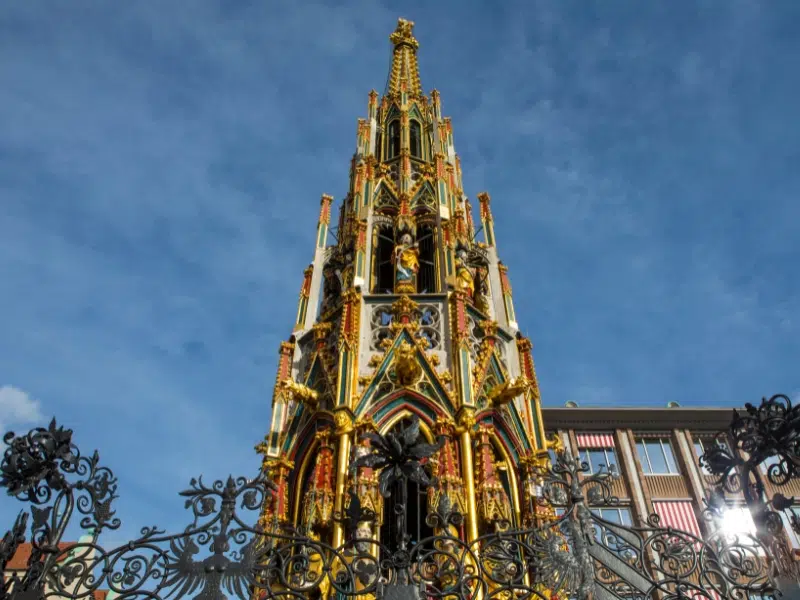
The Schöner Brunnen (Beautiful Fountain) is the Gothic fountain on the Hauptmarkt, Nuremberg's main market square. Built in 1385–1396 and about 17 metres tall, it looks more like a church spire than a fountain, and its 40 stone figures, arranged in tiers, set out the medieval picture of the world from the philosophers to the prophets. Most visitors, though, are looking for something much smaller: the gold-coloured ring in the railing that you turn for luck.
The Schöner Brunnen at a glance
- Where: on the Hauptmarkt in the old town, the square in front of the Frauenkirche.
- Built: 1385–1396, in High Gothic style.
- By: the master builder Franz Pfintzing, with the stonemason Heinrich Beheim the Elder in charge of the work from 1389.
- What it is today: a working fountain whose figures are copies made in 1902–1903 in weather-resistant shell limestone; the last major restoration took place in 2015–2016.
- Time needed: 10–15 minutes, longer if you want to identify all the figures.
Six centuries of repairs
The fountain was built of soft reed sandstone and painted in bright colours. That made it beautiful and fragile, and its history is a long list of repairs. In 1490 it was repainted by Michael Wolgemut, the painter in whose workshop the young Albrecht Dürer trained. Georg Pencz led a first major restoration in 1540–1541, and in 1586–1587 the fountain got the Renaissance railing with arabesques that still surrounds it, made by a locksmith from Augsburg.
In 1821–1824 the pyramid was taken down and rebuilt, and between 1898 and 1903 the architect Heinrich Wallraff returned the fountain to its original Gothic form, replacing the weathered figures with the copies you see today. During the Second World War, from 1942 to 1945, the fountain was walled in to protect it from bombs, and it came through the raids that destroyed much of the old town. The latest restoration, in 2015–2016, fitted a stainless-steel corset inside the spire and added LED lighting, switched on for the first time on 16 November 2016.
What to look for
- The lower tier: philosophy and the seven liberal arts (eight figures, including Aristotle, Pythagoras, Euclid and Cicero), the four evangelists and the four Church Fathers.
- The middle tier: the seven prince-electors of the Holy Roman Empire, and the Nine Worthies, three pagan heroes (Hector, Alexander the Great, Julius Caesar), three Jewish heroes (Joshua, David, Judas Maccabeus) and three Christian ones (King Arthur, Charlemagne, Godfrey of Bouillon).
- The top tier: Moses and seven prophets, among them Isaiah, Jeremiah and Daniel.
- The small heads: eight little heads on the round pillars are said to show enemies of Nuremberg. Two have been identified as robber knights, one of them the notorious Eppelein von Gailingen.
- The water spouts: fabulous creatures and a stork, with lion masks around the base of the basin.
The ring in the railing
Set into the railing is a gold-coloured brass ring, first mentioned in records several centuries ago, which visitors turn while making a wish. According to legend, a locksmith's apprentice worked it so skilfully into the railing that no seam could be found, to prove his talent to his master, whose daughter he hoped to marry. It is only a legend, and the ring you touch is not old either: the present one was made in 1950 for Nuremberg's 900th anniversary and repaired in 1956–1957 after repeated attempts to steal it.
Tips for your visit
- Come in the morning, before the market stalls on the Hauptmarkt get busy, if you want a clear view of the whole fountain.
- Be at the Frauenkirche at noon: the mechanical clock on its facade, the Männleinlaufen, shows the seven electors parading around the emperor.
- In Advent the Hauptmarkt fills with the Christkindlesmarkt, from late November until Christmas Eve. Expect crowds, and a queue for the ring.
Nearby
- Frauenkirche: the 14th-century church on the east side of the Hauptmarkt, built on the site of the synagogue destroyed in the pogrom of 1349.
- St Sebaldus Church: Nuremberg's oldest parish church, a few minutes' walk north, with Peter Vischer's bronze shrine of St Sebald.
- St Lorenz Church: the twin-towered Gothic church across the Pegnitz, with Veit Stoss's carved Angelic Salutation hanging in the choir.
- Imperial Castle: the castle above the old town, an uphill walk of about ten minutes, with views over the roofs of Nuremberg.
See Nuremberg with World City Trail
Our Nuremberg scavenger hunt turns the old town into a game you play on your phone. The route links 10 stops and takes around 2 hours, with about 41 minutes of walking. The Schöner Brunnen on the Hauptmarkt is one of the stops, along with St Lorenz Church and the Frauentor gate.
If you prefer a different format, there is also a self-guided walking tour and an outdoor escape game in Nuremberg.
Play the Nuremberg scavenger hunt →
Take the self-guided walking tour of Nuremberg →
Play the outdoor escape game in Nuremberg →
Facts checked in October 2026.