
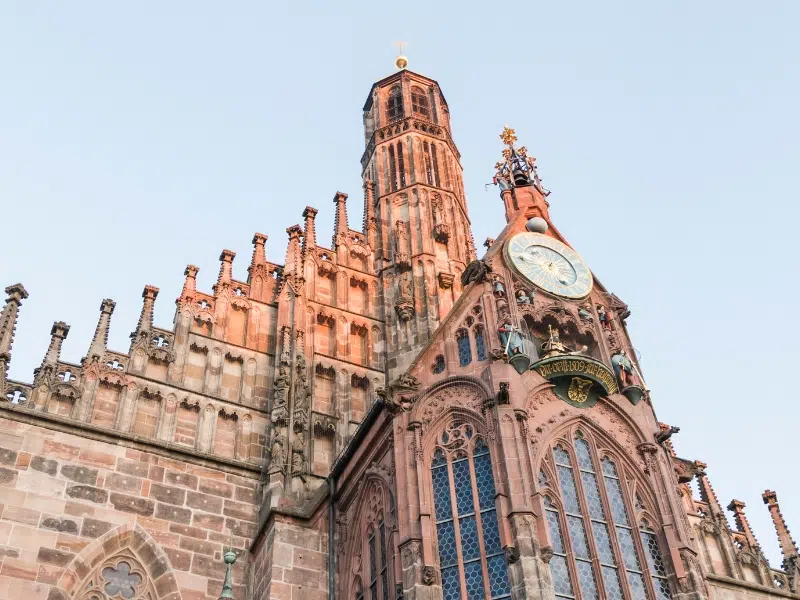
The Hauptmarkt is Nuremberg's main market square, the open space between the Sebald and Lorenz halves of the old town, with the Gothic Frauenkirche on its east side and the Schöner Brunnen fountain in its north-west corner. Every day except Sunday it fills with market stalls, and every Advent with the Christkindlesmarkt. Few visitors realise that the square only exists because the city's Jewish quarter was destroyed in 1349.
The Hauptmarkt at a glance
- Where: in the centre of the old town, just north of the river Pegnitz, between St Sebald's and St Lorenz's parishes.
- Created: 1349, after the Jewish quarter on this site was destroyed; the Frauenkirche followed in the 1350s.
- What it is today: Nuremberg's main square, with a market from Monday to Saturday selling fruit, vegetables, flowers and Rostbratwurst, and the setting for the Christkindlesmarkt from late November to 24 December.
- Time needed: 20–30 minutes; plan to be here at noon to see the clock on the Frauenkirche.
From Jewish quarter to market square
In the Middle Ages the low, marshy ground beside the Pegnitz was home to Nuremberg's Jewish community, with houses and a synagogue. In 1349, in the wave of persecution that swept through Europe during the Black Death, the city council wanted the land for a large market square. Emperor Charles IV gave his approval in advance, including for the demolition of the synagogue, and in December 1349 a mob attacked the quarter: several hundred Jews were murdered and the survivors were driven out. The houses were torn down, and the Frauenkirche was built on the site of the synagogue as an imperial chapel, consecrated in 1358.
The square went on to become the stage of city life: markets, festivals and imperial visits. In the Nazi era it was renamed Adolf-Hitler-Platz, a reminder of how closely the regime tied itself to Nuremberg, the city of its party rallies. Bombing in the Second World War destroyed most of the old town; on 2 January 1945 the Frauenkirche burned out, leaving only its walls and facade, while the Schöner Brunnen, walled in for protection, survived. The church was repaired by 1953, and the square got back its old name, Hauptmarkt, after the war.
What to look for
- The Männleinlaufen: the mechanical clock on the Frauenkirche facade, built in 1506–1509. Every day at noon the seven prince-electors file past the seated Emperor Charles IV, a scene that recalls the Golden Bull of 1356, the imperial law that set out how the emperor was elected.
- The Frauenkirche facade: a stepped Gothic gable with a small balcony, from which the Christkind opens the Christmas market each year, a tradition dating back to 1948.
- The Schöner Brunnen: the 14th-century Gothic fountain shaped like a spire, with 40 figures and a brass ring set into its railing that visitors turn for luck.
- The market stalls: fruit, vegetables, flowers and grilled Nürnberger Rostbratwurst, the small finger-sized sausages served three in a bun.
- The shape of the square itself: a large, almost empty space in a city of narrow lanes, the clearest trace of the quarter that once stood here.
Remembering 1349
Very little on the square itself points to its origin. Apart from the Frauenkirche, built where the synagogue stood, there is no large memorial here, and the Hauptmarkt has been described as a blank space in the city's Jewish history. That makes it worth pausing in the middle of the square: the open space around you is not the result of planning for beauty but of the murder and expulsion of a whole community.
Tips for your visit
- Be in front of the Frauenkirche a few minutes before 12 noon and stand back towards the fountain: the clock is high up, and you see the electors best from the middle of the square.
- Buy a Drei im Weggla (three sausages in a roll) from one of the stalls or nearby grill houses and eat it standing, as locals do.
- During the Christkindlesmarkt the square is very crowded, especially on weekend evenings. Come on a weekday morning for a calmer look at the stalls.
Nearby
- St Sebald's Church: Nuremberg's oldest parish church, a few minutes' walk north, with Peter Vischer's bronze shrine of St Sebald.
- Old Town Hall: the Renaissance town hall just north-west of the square, with medieval dungeons in its cellars.
- Fleischbrücke: the single-arch stone bridge over the Pegnitz from the late 16th century, a minute south of the square, with a stone ox above its gateway.
- St Lorenz Church: the twin-towered Gothic church across the river, with Veit Stoss's carved Angelic Salutation hanging in the choir.
See Nuremberg with World City Trail
Our Nuremberg scavenger hunt turns the old town into a game you play on your phone. The route links 10 stops and takes around 2 hours, with about 41 minutes of walking. The Hauptmarkt, with the Schöner Brunnen, is one of the stops, along with St Lorenz Church and the Frauentor gate.
If you prefer a different format, there is also a self-guided walking tour and an outdoor escape game in Nuremberg.
Play the Nuremberg scavenger hunt →
Take the self-guided walking tour of Nuremberg →
Play the outdoor escape game in Nuremberg →
Facts checked in October 2026.