
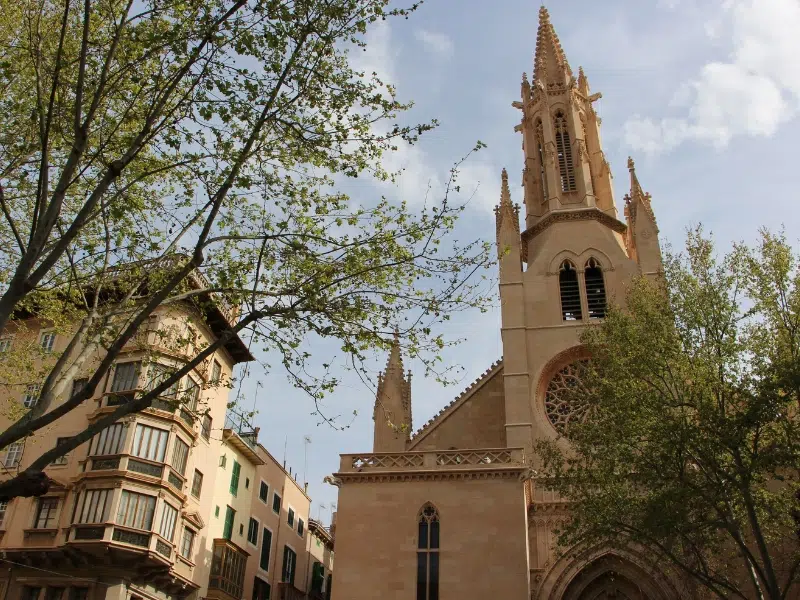
Santa Eulàlia is a Gothic parish church on the square of the same name in the old town of Palma, a few steps from the City Hall. It was begun in the 13th century, soon after the Christian conquest of Mallorca, and was the city's largest parish church at the time. Jaume II was crowned King of Mallorca here, and in 1435 the last Jewish community of Palma was baptised inside its walls.
Santa Eulàlia at a glance
- Where: Plaça de Santa Eulàlia, in the old town of Palma, a short walk from Plaça de Cort and the City Hall.
- Built: from the 13th century, with work going on through the 14th and 15th; the Neo-Gothic façade and bell tower date from 1894–1903.
- What it is today: a working parish church and a protected monument since 1931.
- Time needed: 20–30 minutes inside, a few more to look at the façade from the square.
From conquest to conversion
Jaume I of Aragon conquered Mallorca from its Muslim rulers in 1229. The new parish was dedicated to Saint Eulàlia, the patron saint of Barcelona, a natural choice for the Catalan settlers who came with him. The church was built in the Catalan Gothic style, and it became a stage for the new kingdom: according to tourist sources, Jaume II was crowned King of Mallorca here in 1276, at a time when the cathedral was still far from finished.
Santa Eulàlia also stands at the centre of one of the darkest episodes in Mallorca's history. After the attacks on the Jewish quarters of 1391 and decades of pressure, in 1435 the whole remaining Jewish community of Palma was baptised in this church, many under threat of violence. Their descendants, the Xuetes, lived around the nearby streets and went on worshipping here for centuries, despite discrimination. In the 19th century an earthquake in 1851 damaged the old front, and between 1894 and 1903 the church was given the Neo-Gothic façade and tall bell tower you see today.
What to look for
- The Neo-Gothic bell tower and façade, finished in 1903. Compare their crisp stonework with the older, plainer walls along the sides of the church.
- The nave: a single tall space of six bays with lower side aisles and chapels set between the buttresses, typical of Catalan Gothic.
- The ambulatory behind the high altar, a walkway around the apse lined with small chapels, unusual for a parish church.
- The medieval paintings: a Salvator Mundi signed by the 14th–15th-century painter Francesc Comes, and an altarpiece attributed to Gabriel Mòger.
- The Christ of the Conquest, a crucifix that tradition says was given by Jaume I himself.
The church of the conversos
After 1435 Santa Eulàlia became known as the church of the converts. For generations the Xuetes, Mallorcans of Jewish descent, were kept out of many trades and positions and married mostly among themselves, and many attended this parish. Standing in the square, it helps to remember that the streets to the south, around the Call, were once the Jewish quarter of Palma.
Tips for your visit
- The church opens to visitors before services rather than all day, so plan your visit around Mass times and check before you go.
- Dress modestly and keep quiet inside: it is a working parish church, not a museum.
- Step back to the far side of the square for a photo of the whole façade and bell tower; from up close the tower is too tall to fit in the frame.
Nearby
- Plaça de Cort: the square in front of Palma's City Hall, with its old olive tree and 17th-century façade, a couple of minutes away.
- Basílica de Sant Francesc: the Franciscan church a short walk east, where the medieval philosopher Ramon Llull is buried.
- Can Rei: an early 20th-century Modernista building on Plaça del Marquès del Palmer, with colourful tiles and a grinning face on its façade.
- Palma Cathedral (La Seu): the great Gothic cathedral above the sea wall, about ten minutes' walk downhill.
See Palma with World City Trail
Our Palma scavenger hunt turns the old town into a game you play on your phone. The route links 10 stops and takes around 2 hours, with about 38 minutes of walking, and includes places such as Plaça d'Espanya, the Sóller train station and Plaça Major. You can play in English, German, French, Italian, Spanish and Dutch.
If you prefer a different format, there is also a self-guided walking tour and an outdoor escape game in Palma.
Play the Palma scavenger hunt →
Take the self-guided walking tour of Palma →
Play the outdoor escape game in Palma →
Facts checked in October 2026.