
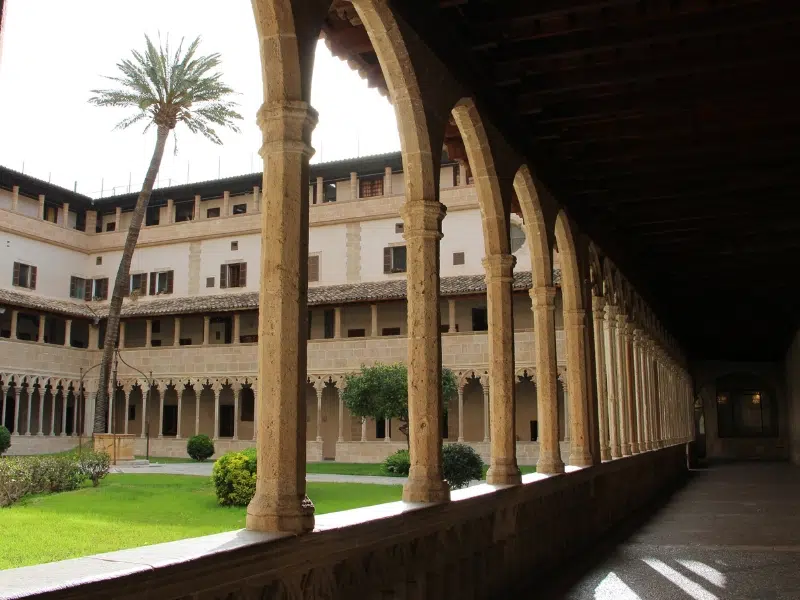
The Basílica de Sant Francesc is the great Gothic church of the Franciscan friars in Palma's old town, begun in 1281, with a massive sandstone Baroque façade and one of the most beautiful cloisters on Mallorca. Inside lies its most famous resident, the medieval philosopher and mystic Ramon Llull, in an alabaster tomb from 1487. Outside stands a statue of another Mallorcan Franciscan who lived in this convent: Junípero Serra, founder of the first missions in California.
Sant Francesc at a glance
- Where: on Plaça de Sant Francesc in the old town of Palma, a few minutes' walk east of Plaça de Cort and the town hall.
- Built: begun in 1281; the Gothic church dates from the late 13th and 14th centuries, the Baroque façade from the second half of the 17th century.
- By: the façade was rebuilt by Francesc de Herrera and Pere Horrach after lightning destroyed the original in 1580.
- What it is today: a working Franciscan church and basilica that visitors can enter, together with the cloister, outside service times.
- Time needed: 30–45 minutes for the church and the cloister.
Friars, lightning and a philosopher
The Franciscans reached Mallorca in 1232, only three years after the Christian conquest of the island, and first settled near the gate of Santa Margalida. In 1281 they began the convent and church on this site, in the district that had been the island's commercial heart. The church grew through the 14th century: its single wide nave, lined with side chapels, was first roofed in wood, and the stone rib vault you see now was completed in 1384.
In 1580 a lightning strike destroyed the original façade. It was rebuilt in the second half of the 17th century as the flat, fortress-like wall of golden sandstone that faces the square today, with a carved Baroque portal and a large rose window. The interior was refurnished in Baroque style too: the main altarpiece, by Joan d'Aragó, dates from 1739. The top of the façade was redone in 1861.
What to look for
- The rose window and portal: the round window high in the plain sandstone façade and the richly carved Baroque doorway below it.
- Ramon Llull's tomb: in a side chapel near the high altar, an alabaster sarcophagus of 1487 by the sculptor Francesc Sagrera, with a recumbent figure of Llull; the seven empty niches below were meant for figures of the seven liberal arts.
- The main altarpiece: a towering Baroque retable from 1739, gilded and crowded with carved figures.
- The cloister: a Gothic cloister on an irregular, trapezoid plan, with pointed, lobed arches on slender columns, a painted wooden ceiling, and orange and lemon trees around a central well. The north gallery, from the 14th century, is the oldest.
- Junípero Serra's statue: in front of the church, a monument to the friar from Petra, Mallorca, who founded missions in California in the 18th century.
Who was Ramon Llull?
Ramon Llull was born in Palma in the 1230s, soon after the conquest, and lived as a courtier until, as he later told it, a religious conversion changed his life. He became one of the most prolific writers of the Middle Ages, producing works in Catalan, Latin and Arabic on philosophy, theology, logic and mysticism, and is often counted among the founders of Catalan literature. He travelled widely to preach and argue for missionary schools, and died around 1316. His burial here makes Sant Francesc a place of pilgrimage for his admirers.
Tips for your visit
- Visit in the morning, when the cloister is at its quietest and the light falls softly through the arches.
- Dress respectfully and avoid visiting during Mass; the church is still in active use.
- Step back to the far side of the square for a photo of the whole façade, with Junípero Serra's statue in front.
Nearby
- Palma Cathedral (La Seu): the vast Gothic cathedral above the sea wall, with interior work by Antoni Gaudí, about ten minutes' walk away.
- Arab Baths (Banys Àrabs): a small surviving bathhouse from the Islamic period, with a domed room on columns, in a garden a few minutes' walk south.
- Church of Santa Eulàlia: one of Palma's oldest Gothic churches, on its own square just west of Sant Francesc.
- Plaça de Cort: the square of the town hall, with a centuries-old olive tree in the middle.
See Palma de Mallorca with World City Trail
Our Palma de Mallorca scavenger hunt turns the old town into a game you play on your phone. The route links 10 stops and takes around two hours, with about 38 minutes of walking. It includes Plaça Major, Plaça d'Espanya and the Sóller train station. You can play in English, German, French, Italian, Spanish or Dutch.
If you prefer a different format, there is also a self-guided walking tour and an outdoor escape game in Palma de Mallorca.
Play the Palma de Mallorca scavenger hunt →
Take the self-guided walking tour of Palma de Mallorca →
Play the outdoor escape game in Palma de Mallorca →
Facts checked in October 2026.