What is the Palma self-guided walking tour?
The Palma self-guided walking tour is a walk through Mallorca's capital at your own speed, narrated in your ear by the audio on your phone rather than by a guide. Set aside about 3 hours: 38 minutes of that is walking, the route adds up to 3 km, and there are 10 stops where you stand and listen. No departure time, no group to keep up with.
At the Sóller Train Station the narration opens with the narrow-gauge line of 1912 and the wooden carriages that still cross the Serra de Tramuntana. On Plaça Major you hear that the arcades went up where the Inquisition once had its headquarters, and in front of the Basilica of Sant Francesc that the medieval philosopher Ramon Llull lies buried inside. Under La Seu comes the cathedral begun on the site of the city's main mosque after 1229 and the interior Antoni Gaudí reworked in the early 20th century, while at La Llotja the talk turns to Guillem Sagrera's spiral columns, which open overhead like palm trees.
- Durationabout 3 hours
- Walkingabout 38 min · 3 km
- Stops10
- LanguagesEnglish, German, French, Italian, Spanish, Dutch
What you do on the walking tour
Listen
Every stop brings the history of the place, the legends around it and the carved detail you would otherwise walk past. The same text is on the screen if you would rather read.
Stroll the lanes
From stop to stop Google Maps does the navigating, at a pace you set: 38 minutes on foot and 3 km in all.
Break off
Sit down for a coffee, give an hour to a museum, then take the walk up again later or on another day.
Eat and browse
Tips for food and shops near the route arrive with the stops. The opening point and the order are yours to rearrange in the app.
See the route and attractions →
How it works
- Book online Choose the number of people. Your booking reference arrives by email straight away.
- Get the app Download the World City Trail app from the App Store or Google Play and enter your booking reference.
- Walk when you like Start whenever you are ready, walk at your own pace and pause any time. No guide, no fixed schedule.
Who the walking tour is for
A first visit
One walk lines up the Moorish city, the Gothic one and modern Palma, and explains what you are standing in front of.
Anyone who avoids groups
Nobody to follow and no head count: you stay as long as something holds you and move on when you decide to.
A day away from the beach
3 hours covers the old town, so the rest of the day is free for the coast or for the Tramuntana.
Good to know
- Bring a charged smartphone with mobile data; a power bank helps.
- No entry tickets needed: everything happens outside the buildings. Going inside is optional and paid separately.
- Family friendly; children must be accompanied by an adult.
- Not suitable for wheelchair users and difficult with strollers.
- Groups of up to 5 work best; larger groups split up, one ticket per person.
- Every purchase helps support stray cats and dogs in Greece.
The walk stop by stop: Plaça d'Espanya, Plaça Major, La Seu, Sa Feixina
10 stops · about 38 min walking · start: Sóller Train Station · finish: Sa Feixina Park
The first stop is the Sóller Train Station on Plaça d'Espanya, at the edge of the old town. From the square the route turns into the lanes towards Plaça Major, then takes in Santa Eulàlia Church, the Basilica of Sant Francesc and Montision Church before the climb up to Palma Cathedral. Plaça de la Reina then marks where the Passeig des Born begins, La Llotja stands between the lanes and the water, and Sa Feixina Park brings the walk to its end. Another opening stop, or another order, is a setting in the app, and no stop asks for an entry ticket.
Open the route map ↗
1Sóller Train StationStart
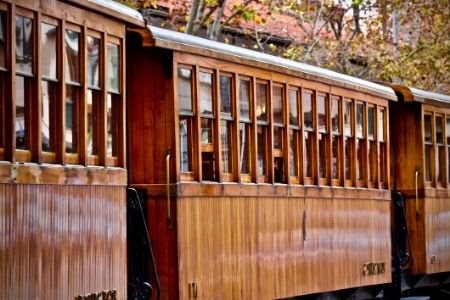
Palma's terminus of the Ferrocarril de Sóller, a narrow-gauge railway opened in 1912, stands on Plaça d'Espanya. Its vintage wooden carriages still run through the Serra de Tramuntana mountains to the town of Sóller. The line was built to connect Sóller, long cut off from the capital by the mountains, with Palma.
2Plaça d'Espanya
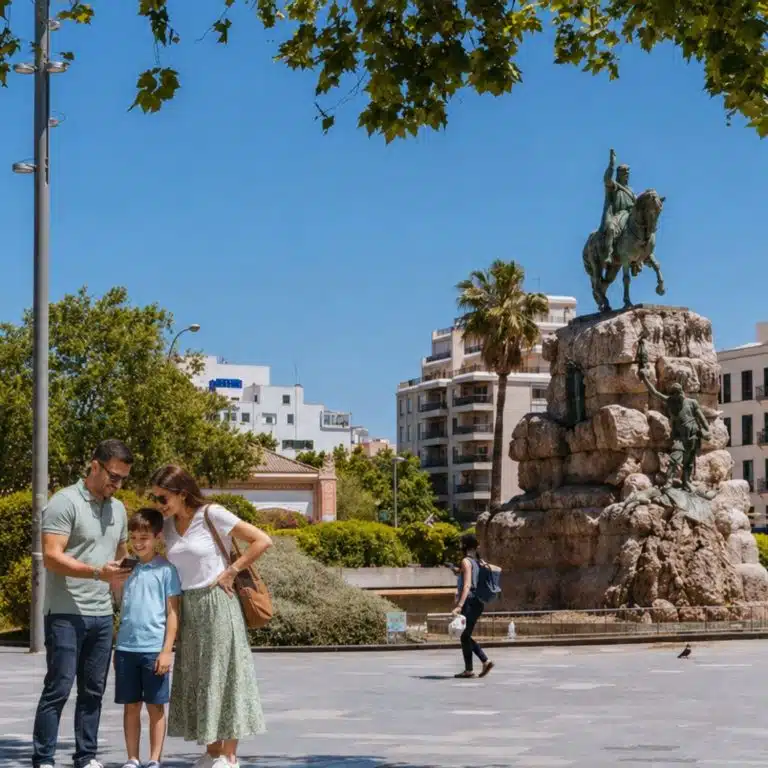
Plaça d'Espanya is Palma's main transport hub, where trains and buses arrive at the edge of the old town. In its gardens stands an equestrian statue of King James I of Aragon, who conquered Mallorca from the Moors in 1229. The square lies just outside the line of the old city walls, most of which were pulled down in the early 20th century.
3Plaça Major
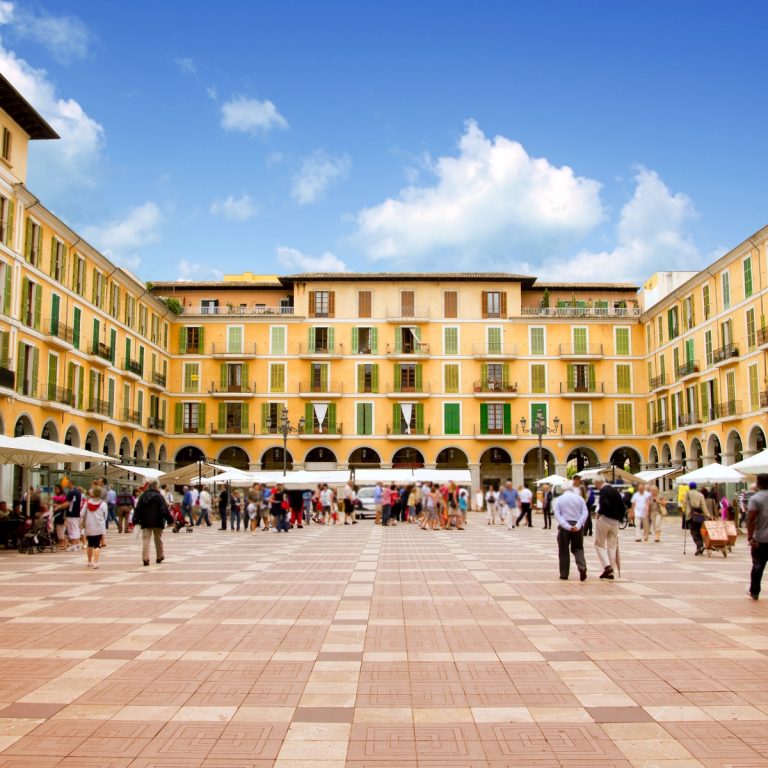
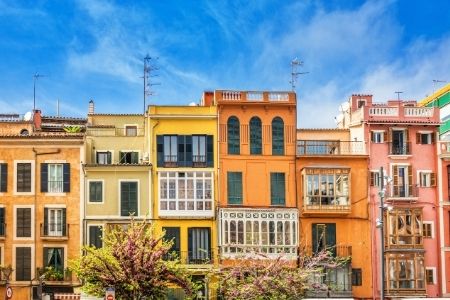
Plaça Major is a rectangular square enclosed by uniform arcaded houses, laid out in the 19th century on the site of the former headquarters of the Inquisition. Its ochre façades and green shutters are typical of old Palma. Carrer de Sant Miquel, one of the old town's main shopping streets, leads off from here.
4Santa Eulàlia Church
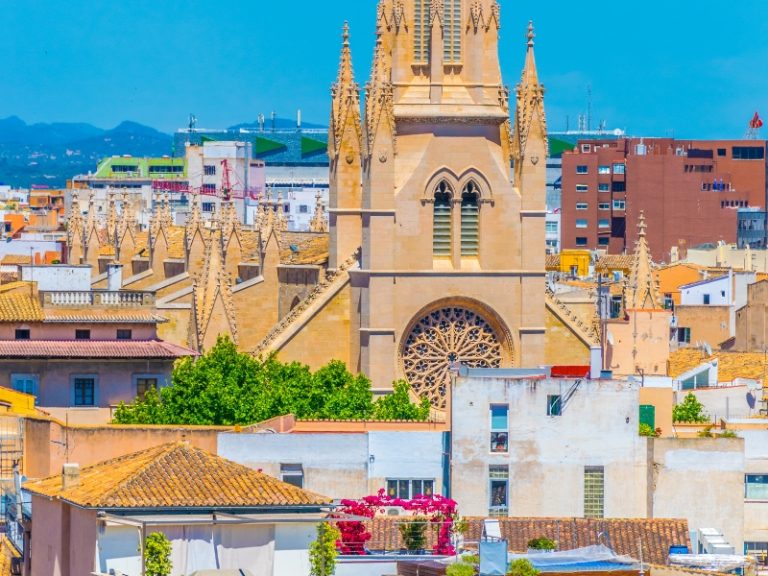
The Church of Santa Eulàlia was one of the first parish churches built after the Christian conquest of 1229, and its Gothic nave dates largely from the late Middle Ages. The neo-Gothic façade and tall bell tower were added in the 19th century. Look up at the narrow façade rising above the small square in front of it.
Read the full story →
5Basilica of Sant Francesc
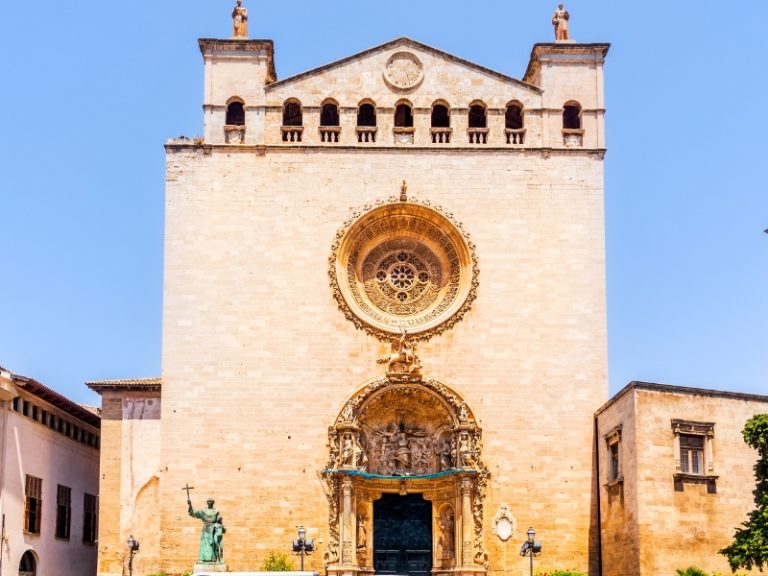
This basilica belonged to a Franciscan friary founded soon after the Christian conquest, and its Gothic church was begun in the late 13th century. Its plain façade has a huge rose window above a richly carved baroque portal added in the 17th century. The medieval philosopher Ramon Llull is buried inside, and a statue of the missionary Junípero Serra stands in front.
Read the full story →
6Montision Church
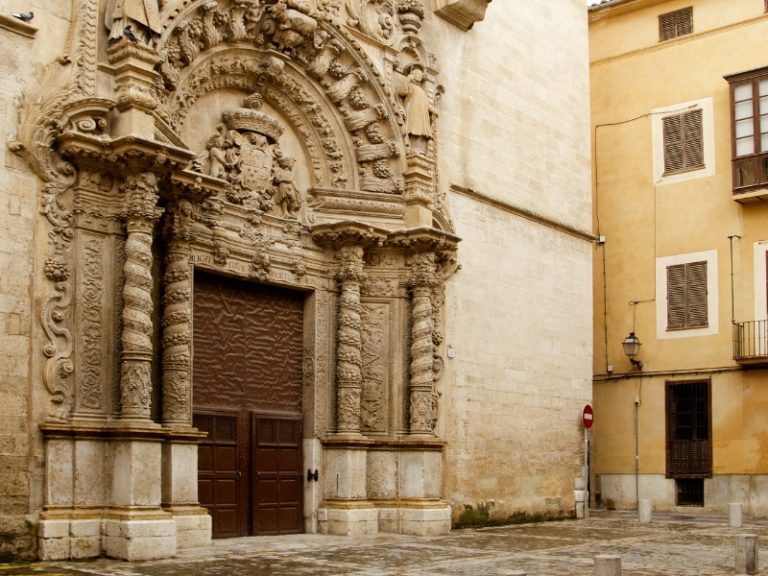
The Church of Montision was built by the Jesuits from the late 16th century in the old Jewish quarter of Palma, known as the Call. Its baroque portal, crowded with carved figures and ornament, is one of the most elaborate in the city. According to tradition, the church stands on the site of a former synagogue.
7Palma Cathedral (La Seu)
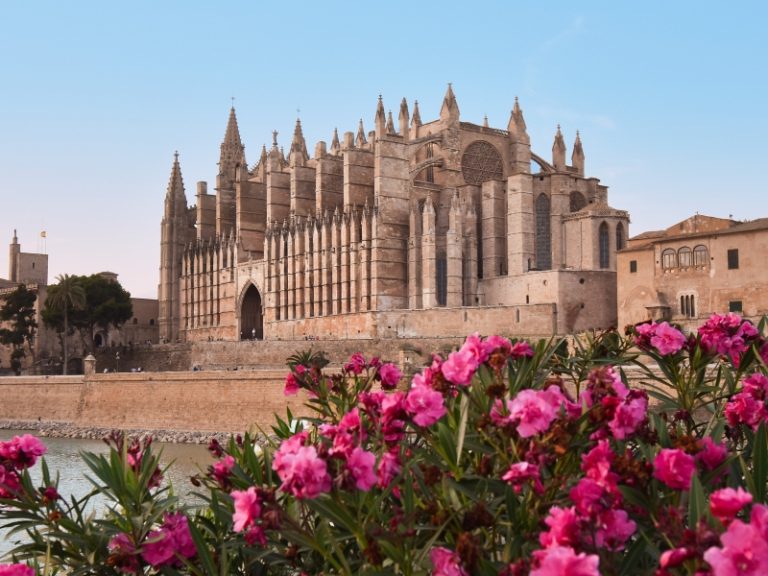
Palma's Gothic cathedral, La Seu, was begun after King James I conquered Mallorca in 1229, on the site of the city's main mosque, and was only completed in the early 17th century. Its great rose window is one of the largest in Gothic architecture. In the early 20th century Antoni Gaudí redesigned parts of the interior.
Read the full story →
8Plaça de la Reina
This small square, whose name means Queen's Square, marks the lower end of the Passeig des Born, Palma's tree-lined promenade. It sits at the foot of the Almudaina Palace and the cathedral. From here the stepped lane Costa de la Seu climbs up towards the cathedral.
9La Llotja
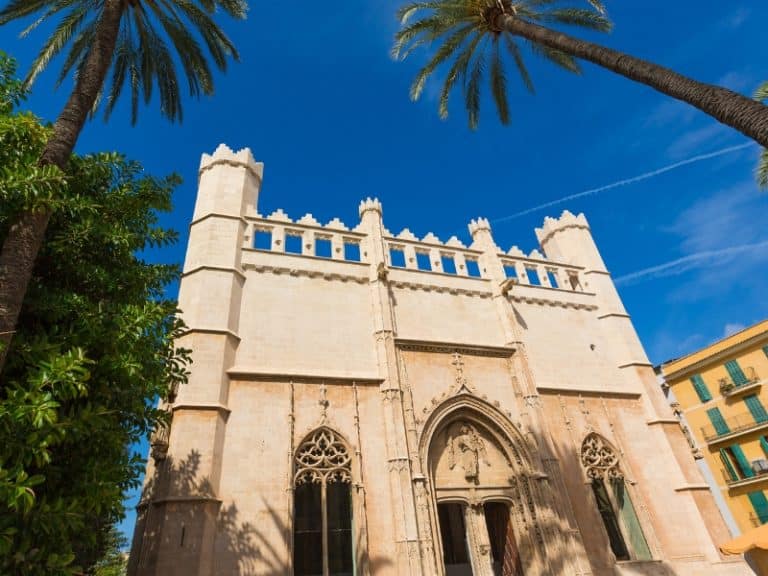
La Llotja was Palma's merchants' exchange, built in the 15th century by the Mallorcan architect Guillem Sagrera. Its corner turrets and battlements make it look like a small castle, while inside slender spiral columns rise like palm trees. Above the main door an angel watches over the building.
Read the full story →
10Sa Feixina ParkFinish
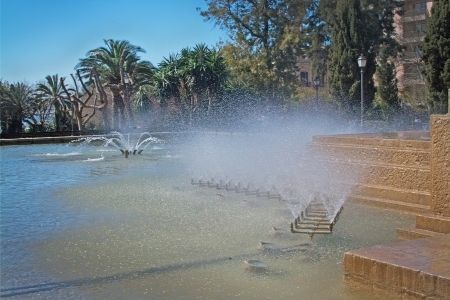
Sa Feixina is a green park just west of the old town, beside the Santa Catalina district and close to the seafront. In the middle rises a tall monument to the sailors of the cruiser Baleares, sunk in 1938 during the Spanish Civil War, whose future has long been debated in Palma.
Only logged in customers who have purchased this product may leave a review.



United States –
Collected on GetYourGuide
Recommended
Germany –
Collected on GetYourGuide
France –
Collected on GetYourGuide
Très bien pour une escale afin de découvrir la ville sans se perdre. A recommandé
France –
Collected on GetYourGuide
France –
Collected on GetYourGuide
Facile à utiliser, ludique et permet de découvrir des lieux et des histoires. Parfait