
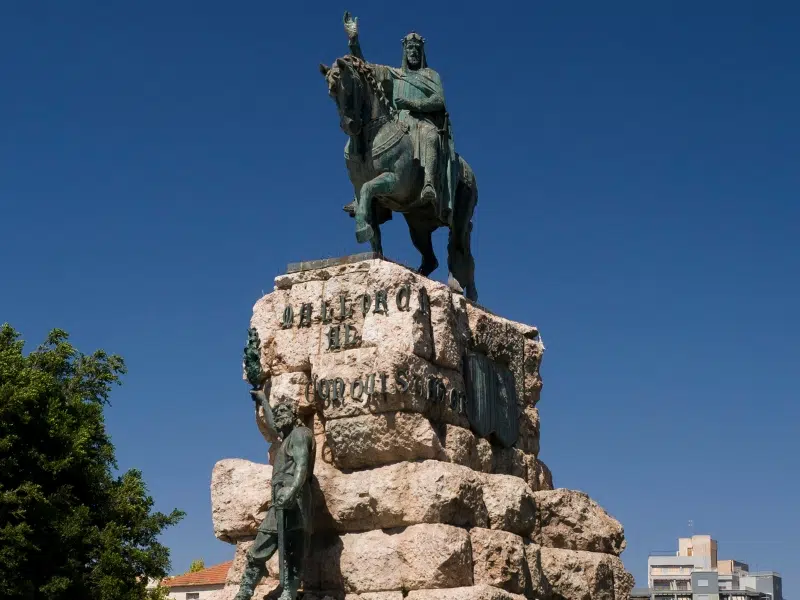
Plaça d'Espanya is the busy square on the northern edge of Palma's old town, where the city walls once stood and where most people arriving by train or bus first come up into daylight. In the middle, a bronze Jaume I, the king who conquered Mallorca in 1229, rides above a fountain. On one side, the vintage wooden trains of the Sóller railway have been leaving for the mountains since 1912.
Plaça d'Espanya at a glance
- Where: on the northern edge of Palma's old town, where Carrer de Sant Miquel begins, beside the Parc de ses Estacions.
- Created: from 1905, after the city walls were pulled down; the equestrian statue was unveiled in 1927.
- By: the monument to Jaume I is by the Catalan sculptor Enric Clarasó.
- What it is today: Palma's main transport hub, with the Estació Intermodal (island trains, metro and buses) underground and the Sóller railway station on its edge. After more than a year of works, the renovated square reopened in September 2024.
- Time needed: 10–15 minutes for the square, longer if you are catching the Sóller train.
From city gate to station square
For centuries this was the edge of the walled city, and a gate, the Porta Pintada or Porta de Santa Margalida, opened in the walls here. Tradition holds that the army of Jaume I of Aragon broke into the Muslim city of Madina Mayurqa near this gate on 31 December 1229. Palma still marks that date every year with the Festa de l'Estendard.
Palma began demolishing its walls in 1902, and from 1905 a modern square was laid out where the old boundary had been. The gate disappeared too, but parts of it came to light again during building works in 2023. The statue of Jaume I, which Enric Clarasó worked on from 1916, was unveiled in 1927 at this new entrance to the city. The Sóller railway already had its Palma terminus here, and in 2007 the Estació Intermodal opened underground. Island trains and the metro arrive there today, and since 2009 the intercity buses do too, all beneath the park beside the square.
What to look for
- The equestrian statue in the middle of the fountain: the conqueror sits on a heavy, rounded warhorse, built to look steady rather than fast. Both statue and fountain were cleaned and restored in the 2024 works.
- The Sóller railway station: a small brown-brick building on the edge of the square, part of it a little museum, where vintage wooden trains set off across the plain and into the Serra de Tramuntana.
- The Parc de ses Estacions: the park built over the underground station, where old railway buildings, including one with a tall brick chimney, survive among the paths and lawns.
- The new paving and benches: the 2024 renovation replaced the old slate with non-slip tiles, added seating and removed a cycle lane that was considered dangerous.
- Carrer de Sant Miquel: the pedestrian shopping street that starts by the square and runs south into the old town towards Plaça Major.
A railway paid for by oranges
The Sóller railway was built from 1911 with money from the orange and lemon trade of the Sóller valley, which until then had been cut off from Palma by the mountains. The line climbs through the Serra de Tramuntana and passes through 13 tunnels. It started with steam locomotives, was electrified in the late 1920s and still runs with carriages that look much as they did a century ago. At Sóller a tram continues down to the port.
Tips for your visit
- If you want to ride the Sóller train, come early: it is one of the island's most popular excursions and the platforms fill up well before departure in high season.
- For a photo of the statue with the fountain, stand on the old-town side of the square and shoot towards the park.
- Buses and taxis circle the square, so cross at the traffic lights rather than cutting across.
- Walk on into the old town down Carrer de Sant Miquel and you reach Plaça Major in about ten minutes.
Nearby
- Mercat de l'Olivar: Palma's main covered food market, a few minutes' walk away, good for a snack of Mallorcan cheese, sobrassada or fresh seafood.
- Església de Sant Miquel: one of the oldest parish churches in the city, on Carrer de Sant Miquel.
- Plaça Major: the arcaded main square of the old town, with cafés under the arches and stalls of local craftspeople.
See Palma de Mallorca with World City Trail
Our Palma scavenger hunt turns the old town into a game you play on your phone. The route links 10 stops and takes around 2 hours, with about 38 minutes of walking. Plaça d'Espanya is one of the stops, along with the Sóller train station and Plaça Major. You can play in English, German, French, Italian, Spanish or Dutch.
If you prefer a different format, there is also a self-guided walking tour and an outdoor escape game in Palma de Mallorca.
Play the Palma de Mallorca scavenger hunt →
Take the self-guided walking tour of Palma de Mallorca →
Play the outdoor escape game in Palma de Mallorca →
Facts checked in October 2026.