
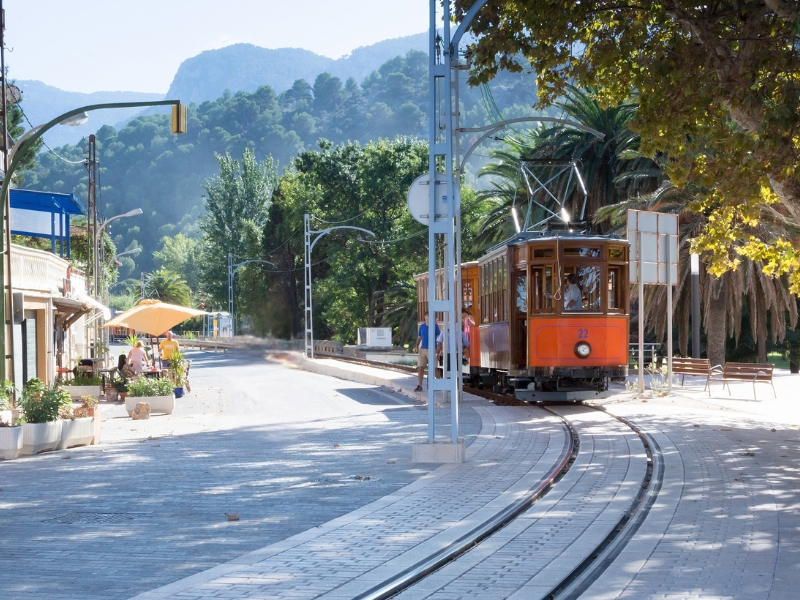
The Sóller train is a narrow-gauge railway that has linked Palma with the town of Sóller, on the other side of the Serra de Tramuntana mountains, since 1912. Its varnished wooden carriages still leave from a small station just off Plaça d'Espanya in Palma and climb through 13 tunnels to the valley of orange groves on the far side. It was built with money from the orange and lemon trade, which is why it is sometimes called the Orange Express.
The Sóller train at a glance
- Where: the Palma terminus is just off Plaça d'Espanya, next to the park above the Intermodal transport hub; the other end is Sóller station, with a tram on to Port de Sóller.
- Opened: April 1912; electrified in 1929; the tram from Sóller to the port followed in 1913.
- What it is today: a heritage railway run by a private company whose shares are mostly held by local people, used above all by visitors.
- Time needed: around an hour each way; allow most of a day to see Sóller and the port.
Built by an orange-growing town
Sóller sits in a fertile valley closed off from Palma by the Tramuntana range. Before the railway, the easiest way out for the valley's oranges and lemons was by sea, often to France, and the road over the mountain pass was slow. Local growers and merchants decided to build their own railway. Construction began in 1911, the line opened in 1912, and it pushed through the mountains with 13 tunnels instead of climbing over the pass.
Steam struggled on the steep gradients, so in the 1920s the company chose to electrify the line, and the electric service started in 1929 with new motor coaches. The company remained private and locally owned: hundreds of residents of Sóller hold most of its shares. Today the train runs mainly for visitors, and many of the wooden carriages and fittings date from the early days of the line.
What to look for
- The Palma station near Plaça d'Espanya: a small terminus with a platform that feels far older than the busy square outside.
- The wooden carriages with brass fittings, open platforms and windows that slide down for photos on the mountain section.
- The run through the Serra de Tramuntana: tunnels follow one after another, with glimpses of terraced slopes and stone farmhouses between them.
- The descent into the Sóller valley, where the line curves above orange and lemon groves with the town and its church below.
- At the far end, the wooden Sóller tram, which runs from the station through the town centre and along the bay to Port de Sóller.
The Orange Express
The nickname is not just marketing. The money that paid for the railway came largely from the citrus trade that had made Sóller unusually prosperous and outward-looking, with close ties to France. The line was the valley's way of connecting itself to Palma on its own terms. The fact that local shareholders still own most of the company keeps that story alive: when an outside investor tried to take it over in 2019, it became news across the island.
Tips for your visit
- Buy your ticket at the station and arrive early in summer: the first departures fill up quickly with tour groups.
- For the best views of the valley on the way down, sit on the right-hand side when travelling from Palma to Sóller.
- Combine the train with the tram to Port de Sóller and return to Palma by bus or boat for a round trip without doubling back.
- The line often pauses or runs a reduced service in winter for maintenance, so check the timetable before you go.
Nearby
- Plaça d'Espanya: Palma's main transport square, with the statue of King Jaume I and the station entrances.
- Plaça Major: an arcaded square in the old town, a short walk south.
- Palma Cathedral (La Seu): the Gothic cathedral on the seafront, reached on foot through the old town.
- Sóller and Port de Sóller: at the other end of the line, a market town with a Modernista church front and a sheltered harbour.
See Palma de Mallorca with World City Trail
Our Palma scavenger hunt turns the old town into a game you play on your phone. The route links 10 stops and takes around 2 hours, with about 38 minutes of walking. The Sóller train station is one of the stops, together with Plaça d'Espanya and Plaça Major. You can play in English, German, French, Italian, Spanish or Dutch.
If you prefer a different format, there is also a self-guided walking tour and an outdoor escape game in Palma.
Play the Palma de Mallorca scavenger hunt →
Take the self-guided walking tour of Palma de Mallorca →
Play the outdoor escape game in Palma de Mallorca →
Facts checked in October 2026.