
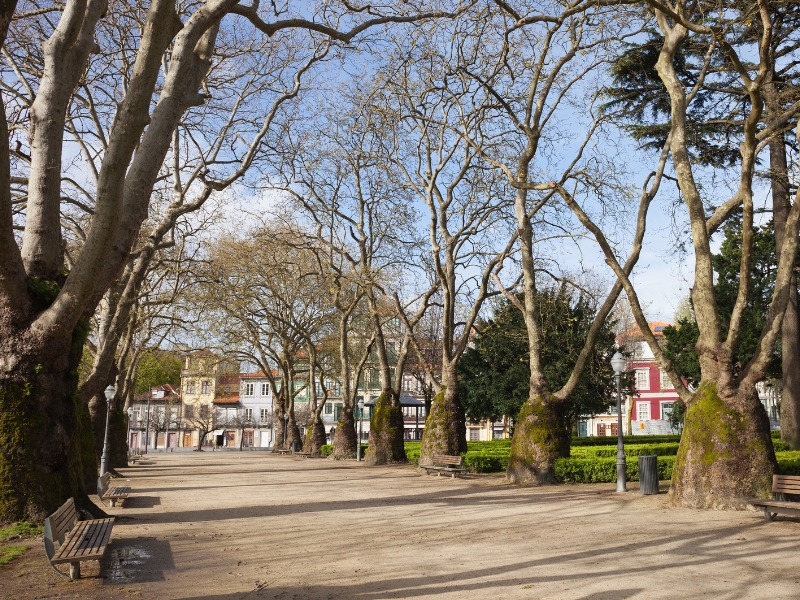
The Jardim da Cordoaria is a leafy 19th-century garden in central Porto, between the Clérigos Tower and the old city prison. Its official name is Jardim de João Chagas, but everyone still calls it Cordoaria, after the rope makers who worked here for some two hundred years. Its most surprising residents are thirteen bronze figures by the Spanish sculptor Juan Muñoz, all laughing at one another.
Jardim da Cordoaria at a glance
- Where: Campo dos Mártires da Pátria, between the Clérigos Tower, the University of Porto's main building and the old prison that now houses the Portuguese Centre of Photography.
- Created: 1865–1866 as a public garden; remodelled in 2001.
- By: the German landscape gardener Émile David; the 2001 sculptures are by Juan Muñoz.
- What it is today: a public park with old trees, a small lake, statues of Porto writers and modern sculpture, used by students, families and anyone needing shade in the city centre.
- Time needed: 20–30 minutes, longer if you stop for a break on a bench.
From rope walk to romantic garden
Before it was a garden, this open ground was a workplace. Rope makers (cordoeiros) twisted their ropes here for about two centuries, and the area kept their name. In the 19th century the city turned the square into a public space, and in 1865–1866 the German landscape gardener Émile David laid it out as a romantic garden, with winding paths, trees and a small lake. Many of the trees planted then are now well over a century old.
In 1924 the garden was officially renamed after João Chagas, the republican journalist and politician, though the old name never went away. For Porto 2001, when the city was European Capital of Culture, the garden was remodelled, and Juan Muñoz created the group of thirteen bronze figures that has become its trademark. It was one of the last works of the sculptor, who died that same year.
What to look for
- Thirteen laughing at each other (Treze a rir uns dos outros): Juan Muñoz's 13 bronze figures, doubled over with laughter as if at a joke only they understand. Walk round them and look at their faces.
- The statue of Ramalho Ortigão, the Porto-born writer and critic, one of the leading names of 19th-century Portuguese literature.
- The statue of António Nobre, the Porto-born poet best known for his collection Só.
- The Abduction of Ganymede (O Rapto de Ganímedes): a sculpture of the Greek myth in which Zeus, as an eagle, carries off the youth Ganymede.
- The old trees and the small lake: the garden's 19th-century layout is still there under the canopy, with paths that curve between the lawns.
The thirteen who laugh
Juan Muñoz (1953–2001) was known for groups of grey, life-like figures that seem to share a private moment. In the Cordoaria he put thirteen of them in the middle of everyday city life, laughing at everything and nothing. He reportedly wanted even people with no interest in art to feel sympathy for them, and most passers-by do stop, smile and take a picture.
Tips for your visit
- Come on a hot afternoon: the trees give some of the best shade in the city centre.
- Photograph the laughing figures in the soft light of the morning or late afternoon, and remember they are artworks, not climbing frames.
- Visit the Clérigos Tower and Livraria Lello early in the day, when queues are shortest, then come back to the garden for a rest.
Nearby
- Clérigos Tower: the Baroque bell tower by Nicolau Nasoni from the mid-18th century, with a panoramic view over the city from the top.
- Livraria Lello: the bookshop opened in 1906, famous for its curving red staircase and stained-glass ceiling.
- Portuguese Centre of Photography: housed in the old prison of the Relação court, where the novelist Camilo Castelo Branco was once held; you can still see the bars on the windows.
- Carmo Church: the church on Praça de Gomes Teixeira with a side wall covered in blue-and-white azulejo tiles.
See Porto with World City Trail
Our Porto scavenger hunt turns the old town into a game you play on your phone. The route links 10 stops and takes around 2 hours, with about 34 minutes of walking. It includes São Bento station and the Clérigos Tower, just beside the garden. You can play in English, German, French, Italian, Spanish, Dutch and Portuguese.
If you prefer a different format, there is also a self-guided walking tour and an outdoor escape game in Porto.
Play the Porto scavenger hunt →
Take the self-guided walking tour of Porto →
Play the outdoor escape game in Porto →
Facts checked in October 2026.