
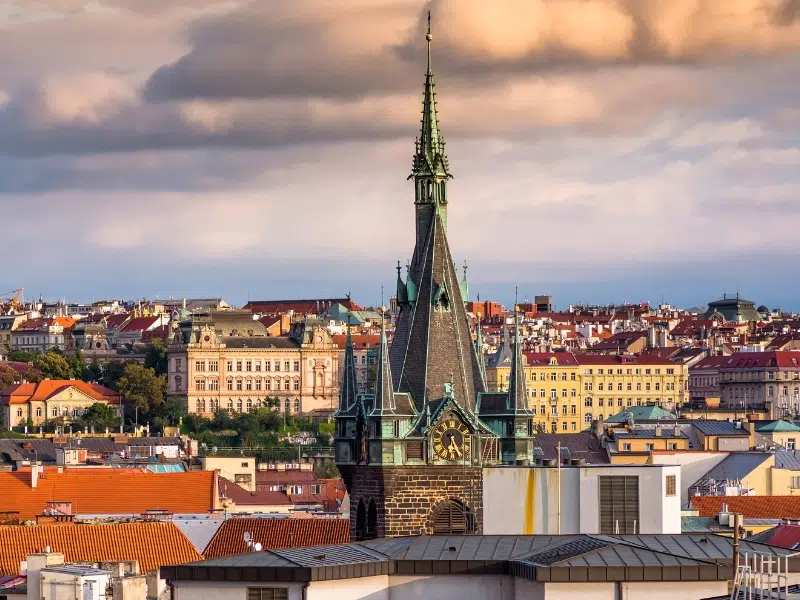
Jindřišská věž (Henry's Tower) is the slim sandstone tower with green corner spires at the corner of Jindřišská and Jeruzalémská streets in Prague's New Town, a few minutes from Wenceslas Square. At 65.7 metres it is the tallest free-standing bell tower in Prague. Unusually for a medieval belfry, you can ride a lift to the top, past a restaurant that displays a bell cast in 1518.
Jindřišská Tower at a glance
- Where: Jindřišská 33, Prague 1 (Nové Město), next to the Church of St Henry and St Kunhuta, between Wenceslas Square and the Main Railway Station.
- Built: a wooden belfry in 1472–1476; the present stone tower in the late 16th century; rebuilt in neo-Gothic style in 1876–1880.
- By: the 19th-century neo-Gothic look is the work of the architect Josef Mocker, who also restored the neighbouring church.
- What it is today: a ten-floor tower with an observation deck, the Zvonice (Belfry) restaurant, a café, a bar, exhibition space and a carillon. It belongs to the Archdiocese of Prague and is run by a tenant on a long lease.
- Time needed: 10 minutes to look at it from the street; about an hour if you go up to the viewing floor.
From parish belfry to lookout tower
Charles IV founded Prague's New Town in 1348, and the Church of St Henry and St Kunhuta was built as one of its parish churches. Its bells first hung in a wooden belfry put up in 1472–1476, and the stone tower you see today replaced it in the late 16th century, on what was then the church cemetery. A tower that tall was also useful to soldiers: after 1648 it served as a watch tower, and it was hit by Swedish guns in 1648 and during the Prussian sieges of 1757.
A fire in 1745 led to a Baroque remodelling, and a storm in 1801 destroyed the roof. Between 1876 and 1880 Josef Mocker, the architect behind much of Prague's 19th-century Gothic revival, gave the tower its present neo-Gothic shape with the steep slate roof and the four corner turrets. Over time ten bells hung here, but wartime confiscations melted them down, except the oldest. The interior was later rebuilt with a reinforced-concrete frame that does not touch the historic stone walls, and the tower opened to the public in 2002. In 2026 the Archdiocese dropped its plan to sell the tower; the lease runs until 2044.
What to look for
- The outline: a square tower faced with sandstone, with small octagonal spires at each corner around the tall central roof. It is easiest to read from the far side of Jeruzalémská street.
- The clock faces on all four sides of the gallery near the top.
- The Maria bell: the only original bell left, cast in 1518 by Bartholomew of the New Town, weighing 723 kg. It is displayed in the restaurant on the upper floors.
- The carillon: ten bronze bells installed under the roof in 2003 and named after the bells that were lost. They are meant to be heard inside the tower, not across the city.
- The view from the tenth floor: the domes and spires of the Old Town to one side and the long slope of Wenceslas Square to the other.
Why the tower stands alone
In Bohemia it was common for a parish church to have a separate bell tower, and St Henry's is a clear example: the church kept its own small tower with an onion dome, while the big bells went next door. The church itself is worth a look on the way in. Its floor is set with old tombstones, the largest group of grave slabs in the New Town, a reminder that the tower now stands on what was once the parish cemetery.
Tips for your visit
- Go up in the late afternoon: the low sun lights the Old Town roofs and the Powder Tower, and the viewing floor is rarely crowded.
- The tower has a lift as well as stairs, so it is one of the few Prague viewpoints that works for people who cannot manage hundreds of steps.
- Walk round the outside before you go in. From directly below, the corner spires are hard to see; from across the street the whole silhouette makes sense.
Nearby
- Jubilee Synagogue: the striped red, white and yellow synagogue on Jeruzalémská street, opened in 1906, practically next door.
- Mucha Museum: a small museum on Panská street devoted to Alphonse Mucha, the Czech master of Art Nouveau posters, a few minutes' walk away.
- Wenceslas Square: the long boulevard where Czechoslovakia's turning points were played out, at the end of Jindřišská street.
- Prague Main Railway Station: look for the Art Nouveau Fanta building with its domed hall, the older half of the station.
See Prague with World City Trail
Our Prague scavenger hunt turns the old town into a game you play on your phone. The route links 10 stops and takes around 2 hours, with about 53 minutes of walking. Jindřišská Tower is one of the stops, along with the Astronomical Clock and the Church of Our Lady before Týn.
If you prefer a different format, there is also a self-guided walking tour and an outdoor escape game in Prague.
Play the Prague scavenger hunt →
Take the self-guided walking tour of Prague →
Play the outdoor escape game in Prague →
Facts checked in October 2026.