
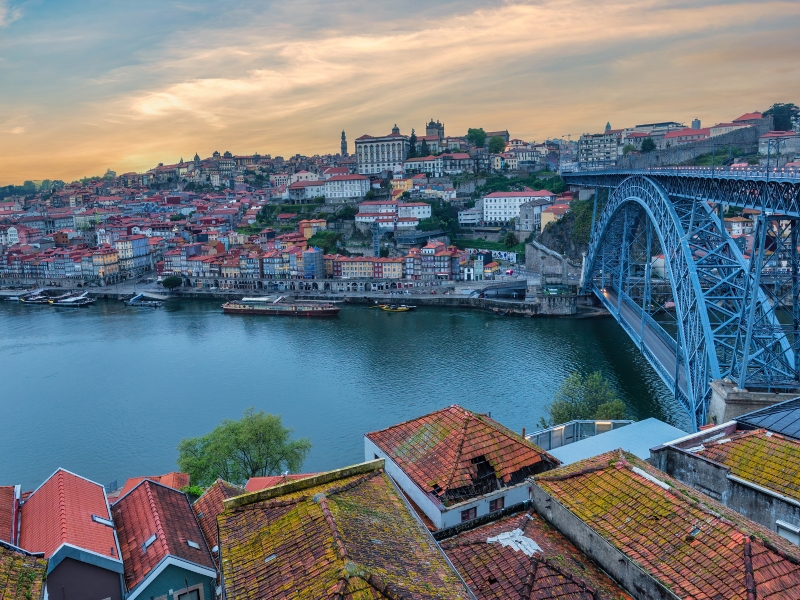
The Luís I Bridge is the iron double-deck bridge that joins Porto to Vila Nova de Gaia across the Douro, right next to the old town. When it opened in 1886 its 172-metre arch was the longest of its kind in the world, and today you can cross it twice: on the lower deck at river level, and on the upper deck high above, next to the metro.
The Luís I Bridge at a glance
- Where: between the Ribeira waterfront and the Avenida Vímara Peres in Porto and the Gaia riverfront and Serra do Pilar on the south bank.
- Opened: upper deck on 31 October 1886; lower deck in 1887.
- By: designed by the engineer Théophile Seyrig, a former partner of Gustave Eiffel, and built by the Belgian Société de Willebroek.
- What it is today: the upper deck carries metro line D and pedestrians; the lower deck carries buses, taxis, cyclists and people on foot.
- Time needed: 10 minutes to cross each deck; an hour or more if you combine both with the Gaia riverfront.
From toll bridge to metro bridge
In 1879 Gustave Eiffel proposed a single high deck over the Douro, but the city wanted a bridge that could serve both the riverside and the upper town. A competition in 1880 drew projects from across Europe, and in 1881 the contract went to the Société de Willebroek with a design by Seyrig, who had also designed the nearby Maria Pia railway bridge built by Eiffel's company. That is why the two bridges look like relatives. The new bridge rose beside the towers of an older suspension bridge, the Ponte Pênsil, which was then taken down; its stone pillars still stand on the Porto bank.
The upper deck was finished on 30 October 1886 and opened the next day, with a toll of a few réis per person; the lower deck followed in 1887. Trams crossed the upper deck from 1908 to 1959 and trolleybuses until 1993, and the toll was dropped in 1944. In 2003 the upper deck closed to cars so it could be adapted for the metro, which has run across it since 2005. After repairs, the lower deck reopened in April 2023 for public transport, cyclists and pedestrians only. The historic centre of Porto, including the bridge, has been a UNESCO World Heritage Site since 1996.
What to look for
- The great iron arch, 172 metres wide, carrying the upper deck on top and hanging the lower deck from its middle.
- The two levels: the lower deck almost touching the water, the upper deck high above it, level with the old town on the hill.
- The granite pillars of the old Ponte Pênsil on the Porto side, all that remains of the suspension bridge that came before.
- The metro trains gliding across the upper deck, with pedestrians walking right beside them.
- The rabelo boats moored along the Gaia bank, the flat-bottomed boats that once carried port wine down the river.
The best view in Porto
From the upper deck you look straight down onto the roofs of the Ribeira, the cathedral on its hill and the port wine lodges on the Gaia side. Climb a little further on the Gaia end to the terrace of the Serra do Pilar Monastery and you get the classic postcard view of the bridge and the whole old town. At sunset the terrace and the upper deck fill with people; on the lower deck, the riverfront cafés on both banks are only a few steps away.
Tips for your visit
- Walk across the upper deck and back along the lower deck: you see the bridge from two completely different angles.
- The upper deck is narrow on the pedestrian side and shared with metro tracks; keep to the walkway and do not stand on the rails.
- If you have no head for heights, the lower deck is the gentler option.
- Save energy with the Guindais Funicular on the Porto side or the Gaia cable car on the south bank.
Nearby
- Cais da Ribeira: Porto's riverfront of colourful houses and terraces, at the north end of the lower deck.
- Serra do Pilar Monastery: a domed monastery with a round cloister and a viewing terrace above the Gaia end of the upper deck.
- Porto Cathedral: the fortress-like cathedral on the hill, a few minutes' walk from the upper deck.
- Port wine lodges of Vila Nova de Gaia: cellars along the south bank where you can learn how port is made.
See Porto with World City Trail
Our Porto scavenger hunt turns the old town into a game you play on your phone. The route links 10 stops and takes around two hours, with about 34 minutes of walking, and it includes places such as São Bento station and the Clérigos Tower. You can play in English, German, French, Italian, Spanish, Dutch or Portuguese.
If you prefer a different format, Porto also has a self-guided walking tour and an outdoor escape game.
Play the Porto scavenger hunt →
Take the self-guided walking tour of Porto →
Play the outdoor escape game in Porto →
Facts checked in October 2026.