
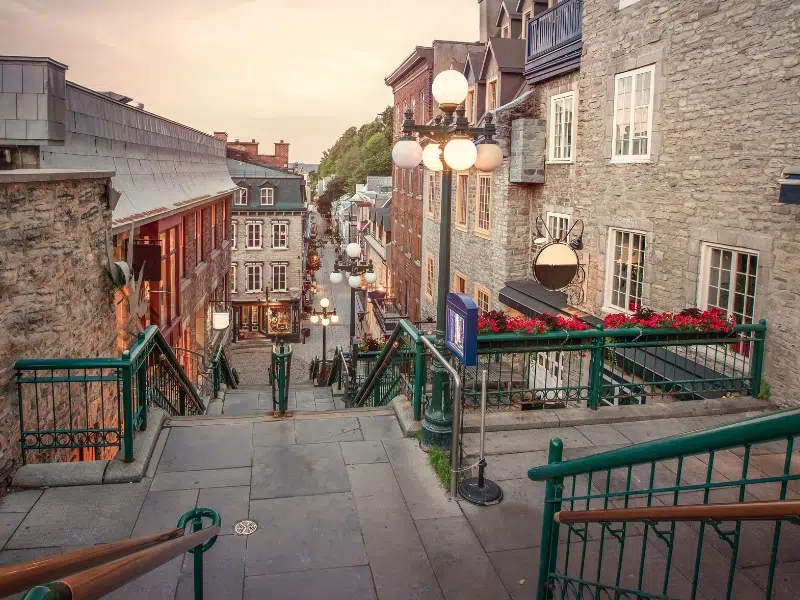
The Escalier Casse-Cou, the Breakneck Stairs, is the steep stairway that drops from Côte de la Montagne in Quebec City's Upper Town to Rue du Petit-Champlain in the Lower Town. Its 59 steps follow a shortcut that people have used since the 17th century, and it is generally described as the oldest staircase in the city.
Escalier Casse-Cou at a glance
- Where: in Old Quebec, between Côte de la Montagne (Upper Town) and the corner of Rue du Petit-Champlain and Rue Sous-le-Fort (Lower Town).
- Created: a steep path in the 17th century; tourism sources date the first stairs to 1635, while the city's heritage notes say steps were added around 1680.
- Rebuilt by: Charles Baillairgé, the city's architect and engineer, who replaced the old wooden stairs with a wider iron structure at the end of the 19th century.
- What it is today: a public stairway of 59 steps in four flights, with shops on its landings and the Petit-Champlain quarter at its foot.
- Time needed: five minutes to climb or descend, longer if you stop in the shops on the landings.
From goat path to city stairway
When Samuel de Champlain founded Quebec in 1608, the settlement grew in two parts: the Lower Town by the river, where ships docked and merchants traded, and the Upper Town on the cliff, home to the fort, the churches and the institutions. Côte de la Montagne, laid out in Champlain's time, was the main road between them, but it winds. Residents soon wore a direct path down the slope, and by the later 17th century this shortcut had steps, which makes it very likely the oldest stairway in Quebec.
In the 19th century, as the population of the Champlain quarter below grew, the wooden stairs were heavily used and in poor shape. They were officially called the Champlain stairs and nicknamed the beggars' stairs, but around 1880 they were dangerous enough that guidebooks for London readers called them the Breakneck Steps. The city replaced them with a wider iron structure designed by Charles Baillairgé. During the restoration of the Place Royale area in the 1960s the stairs were renovated again and took their present shape, with terraced landings, and the name Casse-Cou became official.
What to look for
- The view down the stairs onto the narrow Rue du Petit-Champlain, one of the most photographed street scenes in Quebec City.
- The four flights and the small landings, each with a shop door on its western side.
- From the bottom, the Château Frontenac rising above the cliff, a reminder of how high the Upper Town sits above the river.
- The stone houses of the Lower Town at the foot of the stairs, many of them restored in the second half of the 20th century.
- The meeting of Rue du Petit-Champlain and Rue Sous-le-Fort, where the stairs end and the old Lower Town begins.
Breakneck, but harmless
Despite its name, the city's heritage records mention no deaths or serious injuries linked to the path or the stairs. The name comes from the steepness and from the poor state of the old wooden steps, which made such an impression on visitors that the nickname stuck in English first and later in French as Casse-Cou.
Tips for your visit
- Walk down rather than up if you can, so the view of Rue du Petit-Champlain opens in front of you.
- Come early in the morning for photos without crowds; by midday in summer the stairs are busy.
- In winter the steps can be icy: wear shoes with a good grip and use the handrails.
- If you don't want to climb back up, the funicular nearby links Rue du Petit-Champlain with Dufferin Terrace.
Nearby
- Rue du Petit-Champlain: the narrow pedestrian street of boutiques and cafés at the foot of the stairs.
- Place Royale: the small square where Champlain built his first settlement, with the stone church of Notre-Dame-des-Victoires, a few minutes' walk away.
- Old Quebec Funicular: in service since 1879, it climbs the cliff at a 45-degree angle to Dufferin Terrace.
- Dufferin Terrace and the Château Frontenac: the boardwalk on the cliff top with wide views over the St. Lawrence.
See Quebec City with World City Trail
Our Quebec City scavenger hunt turns the old town into a game you play on your phone. The route links 10 stops and takes around 2 hours, with about 35 minutes of walking. It includes City Hall and the Notre-Dame de Québec Basilica-Cathedral in the Upper Town.
If you prefer a different format, there is also a self-guided walking tour and an outdoor escape game in Quebec City.
Play the Quebec City scavenger hunt →
Take the self-guided walking tour of Quebec City →
Play the outdoor escape game in Quebec City →
Facts checked in October 2026.