
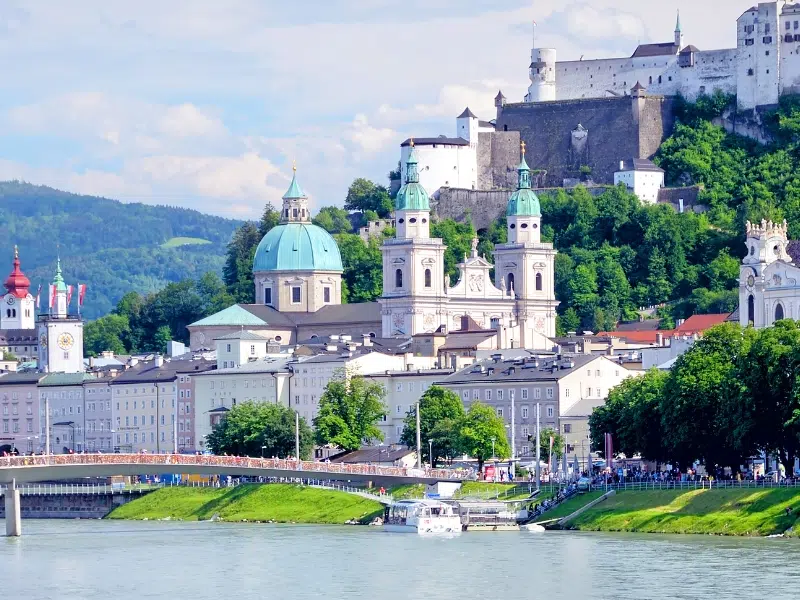
The Marko-Feingold-Steg is the footbridge across the Salzach that links Salzburg's Old Town with Makartplatz on the right bank, and its railings are hung with thousands of padlocks left by couples. Until 2021 it was called the Makartsteg. It now carries the name of Marko Feingold, a Holocaust survivor who led Salzburg's Jewish community for decades and died in 2019 at the age of 106.
The Marko-Feingold-Steg at a glance
- Where: across the Salzach between the Old Town side (Hanuschplatz) and Makartplatz on the right bank, in the middle of the city.
- Opened: the present bridge in 2001, the third on this spot after footbridges of 1905 and 1967; renamed Marko-Feingold-Steg on 27 May 2021.
- What it is today: one of the busiest crossings in the city, for pedestrians and cyclists only, with love locks along its railings and memorial plaques at both ends.
- Time needed: 10 minutes to cross and look around; longer if you stop for photos of the Old Town and the fortress.
From Makartsteg to Marko-Feingold-Steg
The first footbridge here opened in 1905, in Art Nouveau style, and was named after Hans Makart, the Salzburg-born painter who became a star of 19th-century Vienna; the square on the right bank bears his name too. In 1967 it was replaced by a new bridge that soon became known for swinging under the feet of the crowds, something its designers had not intended. With around 20,000 people crossing on an average day it wore out quickly, and it was demolished in 2000. The present bridge opened in 2001 with live music and fireworks.
After Marko Feingold died in September 2019, the city looked for a way to honour him. On 16 September 2020 the city council approved renaming the bridge, and the new name became official on 27 May 2021, the day before his birthday. Plaques were set into the pavement at both ends. The choice was debated: his widow, Hanna Feingold, had preferred a street with a postal address, but she later said she liked how the bridge looks with his name. The city called Feingold a bridge-builder between religions and generations.
What to look for
- The memorial plaques set into the pavement at both ends of the bridge, with Feingold's name.
- The love locks: padlocks of every size and colour, many engraved with names and dates, clipped onto the railings.
- The view upstream: the Old Town's domes and towers, with Hohensalzburg Fortress on the hill above them.
- The river itself: from the middle of the bridge you can watch the fast, green Salzach and, in season, the sightseeing boats that stop by the bridge.
Who was Marko Feingold?
Feingold was born on 28 May 1913 in Besztercebánya, then in Hungary and today Banská Bystrica in Slovakia, and grew up in Vienna. After the Nazi takeover of Austria he was arrested, and from 1939 he was held in Auschwitz, Neuengamme, Dachau and Buchenwald, where he was liberated in 1945. He ended up in Salzburg and stayed. From 1945 to 1948 he helped Jewish survivors in the displaced persons' camps around the city and worked with Bricha, the underground organisation that brought Jews from central and eastern Europe towards Palestine. He later ran a fashion shop, became president of the Jewish community of Salzburg again in 1979 and held the post until his death. For decades he spoke to school classes as a witness, many of them in the synagogue.
Tips for your visit
- Come in the early morning or around sunset, when the light falls on the Old Town and the bridge is calmer.
- Pause at the plaques before you go on: most people cross without noticing whose name the bridge carries.
- Cyclists use the bridge too, so step to the side when you stop for photos. In several years the city has put up a small open-air exhibition on the bridge around Feingold's birthday, 28 May.
Nearby
- Mozart Residence: on Makartplatz, the flat where the Mozart family lived from 1773, a few steps from the right end of the bridge.
- Mirabell Palace and Gardens: the baroque gardens with their view of the fortress, a few minutes' walk north of Makartplatz.
- Getreidegasse and Mozart's Birthplace: the Old Town's shopping street with its wrought-iron shop signs, just across the bridge.
- Holy Trinity Church: the baroque church by Johann Bernhard Fischer von Erlach at the top of Makartplatz.
See Salzburg with World City Trail
Our Salzburg scavenger hunt turns the old town into a game you play on your phone. The route links 10 stops and takes around 2 hours, with about 31 minutes of walking. It includes Mirabell Palace and Gardens, Mozart's Birthplace and Salzburg Cathedral.
If you prefer a different format, there is also a self-guided walking tour and an outdoor escape game in Salzburg.
Play the Salzburg scavenger hunt →
Take the self-guided walking tour of Salzburg →
Play the outdoor escape game in Salzburg →
Facts checked in October 2026.