
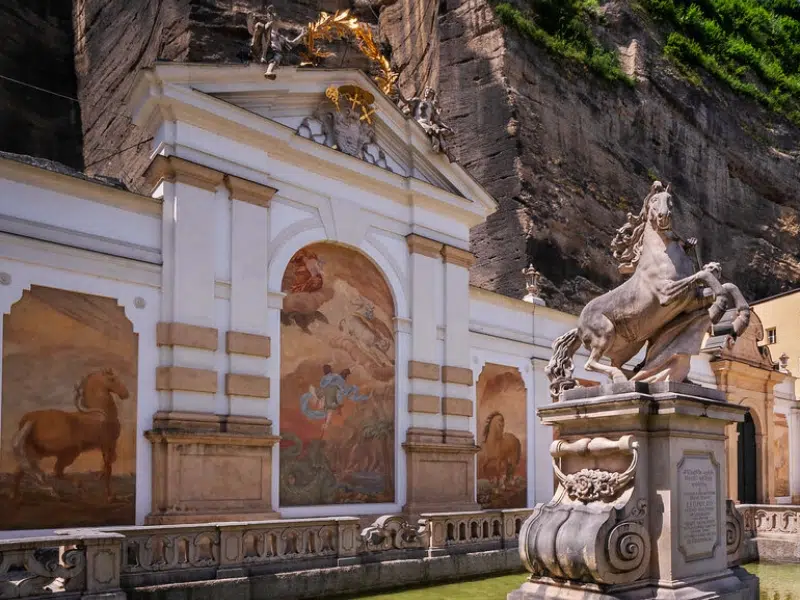
The Pferdeschwemme is a baroque horse bath on Herbert-von-Karajan-Platz in Salzburg, where the grooms of the prince-archbishops once washed and watered the horses of the court stables. The stables are now the Festival halls, but the pool is still there: a stone basin with a rearing horse and its tamer in the middle and a wall of painted horses behind.
The Pferdeschwemme at a glance
- Where: Herbert-von-Karajan-Platz, at the foot of the Mönchsberg cliff, between the Festival halls and the Sigmundstor tunnel.
- Built: 1693, remodelled in 1732.
- By: Johann Bernhard Fischer von Erlach (design); the horse-tamer group is by the sculptor Michael Bernhard Mandl.
- What it is today: a baroque fountain on a public square, free to see at any time.
- Time needed: 10 to 15 minutes, longer if you combine it with the Festival district.
From horse wash to festival backdrop
In the late 17th century the prince-archbishops of Salzburg kept their horses in the court stables, the Hofmarstall, on today's Hofstallgasse. The animals needed somewhere to drink and be washed, so in 1693 a large basin was built just outside, to designs by Johann Bernhard Fischer von Erlach, the architect who later gave Salzburg the Kollegienkirche. In the centre of the pool stands a sculpture by Michael Bernhard Mandl: a young man taming a rearing horse, an image of strength and control that suited a princely stable.
In 1732 Archbishop Leopold Anton von Firmian had the basin remodelled. Mandl's group was turned by 90 degrees and set on a new, more elaborate pedestal, and Josef Ebner painted a row of horses on the back wall, based on engravings by the 16th-century Flemish artist Stradanus and to a design by Franz Anton Danreiter. The court stables later became the Festival halls, and the square was named after the conductor Herbert von Karajan, who was born in Salzburg. The horse bath stayed, and today it sits at the edge of the busiest festival quarter in the city.
What to look for
- The horse tamer in the centre: a muscular figure holding a rearing horse by the bridle, raised on a tall pedestal above the water.
- The painted back wall: a gallery of horses in different poses and colours, framed like pictures, which turns the basin into an open-air stable.
- The chronogram of 1732: some capital letters in the Latin inscription are Roman numerals, and added together they give the year of the remodelling.
- Archbishop Firmian's coat of arms, a reminder of who paid for the makeover.
- The stone balustrade around the pool and the coins that visitors toss into the water.
A cameo in The Sound of Music
The Pferdeschwemme appears briefly in The Sound of Music, during the carriage ride in which Maria and the von Trapp children explore Salzburg, and many fans come to stand at the same spot. If you are following the film, the Mirabell Gardens, where the Do-Re-Mi song ends on the steps by the Pegasus fountain, are across the river.
Tips for your visit
- Come early in the morning for photos: later in the day tour groups and festival traffic fill the square.
- Stand on the Sigmundstor side of the square to get the basin, the statue and the painted wall in one frame, with the Mönchsberg cliff above.
- During the Salzburg Festival in summer the square fills with audiences before evening performances, which makes for good people-watching.
- Combine it with a walk along Hofstallgasse past the Festival halls to the Kollegienkirche and the market on Universitätsplatz.
Nearby
- Festival halls: the Großes Festspielhaus, the Haus für Mozart and the Felsenreitschule, built into the former court stables and the rock of the Mönchsberg, line Hofstallgasse right next to the pool.
- Sigmundstor (Neutor): an 18th-century road tunnel cut through the Mönchsberg, named after Archbishop Sigismund von Schrattenbach, a few steps from the basin.
- Kollegienkirche: Fischer von Erlach's large baroque university church on Universitätsplatz, a few minutes' walk away.
- Getreidegasse and Mozart's Birthplace: Salzburg's best-known shopping street with its wrought-iron shop signs, and the house where Mozart was born in 1756, a few minutes' walk away.
See Salzburg with World City Trail
Our Salzburg scavenger hunt turns the old town into a game you play on your phone. The route links 10 stops and takes around 2 hours, with about 31 minutes of walking. It includes Mirabell Palace and Gardens, Mozart's Birthplace and Salzburg Cathedral, and at each stop you solve a puzzle and hear a story about the city.
If you prefer a different format, there is also a self-guided walking tour of Salzburg and an outdoor escape game.
Play the Salzburg scavenger hunt →
Take the self-guided walking tour of Salzburg →
Play the outdoor escape game in Salzburg →
Facts checked in October 2026.