
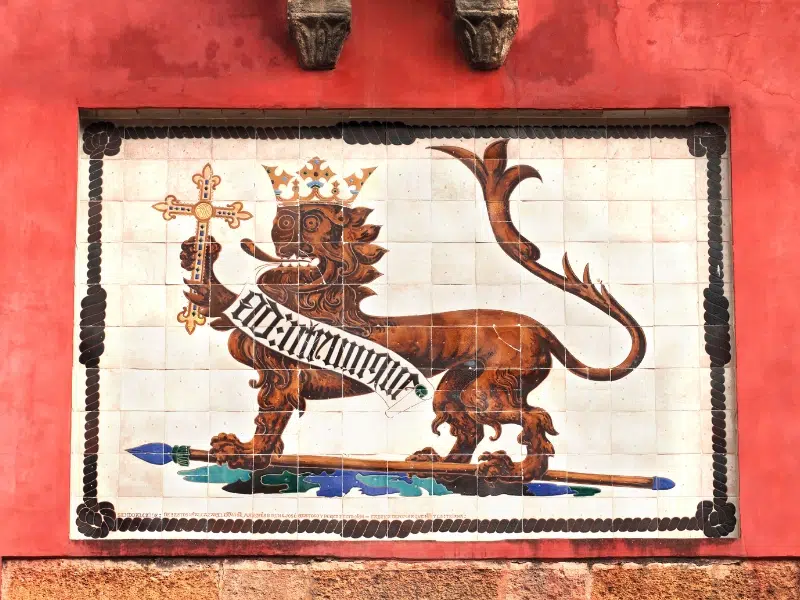
The Puerta del León (Lion Gate) is the main entrance to the Real Alcázar of Seville, set in a crenellated wall on the Plaza del Triunfo, opposite the cathedral. It is named after the tile panel above the arch: a crowned lion holding a cross, put up in 1892. The gate itself is far older, cut through Islamic-era walls during King Pedro I's building works in the 14th century.
The Puerta del León at a glance
- Where: on the Plaza del Triunfo, facing the cathedral and the Archivo de Indias.
- Built: the gate most likely in the 1350s, under Pedro I of Castile; the tile panel in 1892.
- By: the tile panel was designed by Manuel Tortosa y Fernández with historical advice from José Gestoso, and made at the Mensaque ceramics factory.
- What it is today: the main visitor entrance to the Real Alcázar, which together with the cathedral and the Archivo de Indias has been a UNESCO World Heritage Site since 1987.
- Time needed: a few minutes for the gate itself, two to three hours for the Alcázar behind it.
From hunters' gate to Lion Gate
The walls around the gate are older than the gate. Parts of the first Islamic fortress here date from the 11th century, and the Almohads rebuilt the whole enclosure in the 12th. After Ferdinand III of Castile took Seville in 1248, the Alcázar became a palace of the Castilian kings. Archaeologists who studied the gate concluded that it belongs to Pedro I's building programme, most likely in the 1350s: his builders broke through the older walls, added a new tower on the western side to balance the gate, and lined it up with the entrance to his palace.
For centuries it was called the Puerta de la Montería, a name linked to the king's hunters, the monteros. The lion came later. The English traveller Richard Ford recorded a painted lion above the arch in 1832; it was restored in 1876 and replaced in 1892 by the tile panel you see now, and the name Puerta del León probably dates from the 19th century. Inside, the Patio del León held a wooden theatre, a corral de comedias, from around 1625 until it burned down in 1691. In 1936–37 the architect Juan Talavera cleared the houses built against the walls and turned the courtyard into today's entrance.
What to look for
- The lion: crowned, holding a cross in its right claw, with a flag under its left.
- The scroll on the lion's chest with the Latin words 'Ad utrumque', usually read as 'ready for either', with the word paratus (ready) understood.
- The battlements running along the top of the thick wall on both sides of the gate.
- Once through the gate, the Almohad wall at the far end of the Patio del León, with three arches that were horseshoe-shaped before they were altered to round arches in the Christian period.
- The Sala de la Justicia off the Patio del León: a square Mudéjar hall, probably built under Alfonso XI around 1340–1350.
- Beyond the three arches, the Patio de la Montería and the carved façade of Pedro I's palace, begun in 1364.
Game of Thrones at the Alcázar
Many people who queue at the Puerta del León come for a television connection: the Alcázar played the Water Gardens of Dorne, the palace of House Martell, in the fifth season of Game of Thrones. The scenes were shot inside the palace and its gardens, not at the gate, so keep your camera ready for the courtyards and the garden paths once you are in.
Tips for your visit
- Book your Alcázar ticket ahead for a set time slot; the queue at the Puerta del León can be long in spring and summer.
- For a straight-on photo of the lion, step back across the Plaza del Triunfo: from the queue it sits too high above your head.
- Even without a ticket you can see the gate, the lion panel and the walls from the square; only the courtyards beyond the arch need one.
Nearby
- Seville Cathedral: one of the largest Gothic churches in the world, right across the square. Its bell tower, the Giralda, began as the minaret of the Almohad mosque.
- Archivo de Indias: the former merchants' exchange on the same square, built in the late 16th century, which has kept the archives of Spain's empire in the Americas since 1785.
- Monument to the Triumph: the column in the middle of the Plaza del Triunfo, which gives the square its name and recalls that the city came through the 1755 earthquake.
- Barrio de Santa Cruz: the old Jewish quarter of narrow lanes and small squares, reached through the Patio de Banderas just next to the gate.
See Seville with World City Trail
Our Seville scavenger hunt turns the old town into a game you play on your phone. The route links 10 stops and takes around 3 hours, with about 49 minutes of walking. The Puerta del León of the Alcázar is one of the stops, and the route also includes the Plaza de España.
If you prefer a different format, there is also a self-guided walking tour and an outdoor escape game in Seville.
Play the Seville scavenger hunt →
Take the self-guided walking tour of Seville →
Play the outdoor escape game in Seville →
Facts checked in October 2026.