
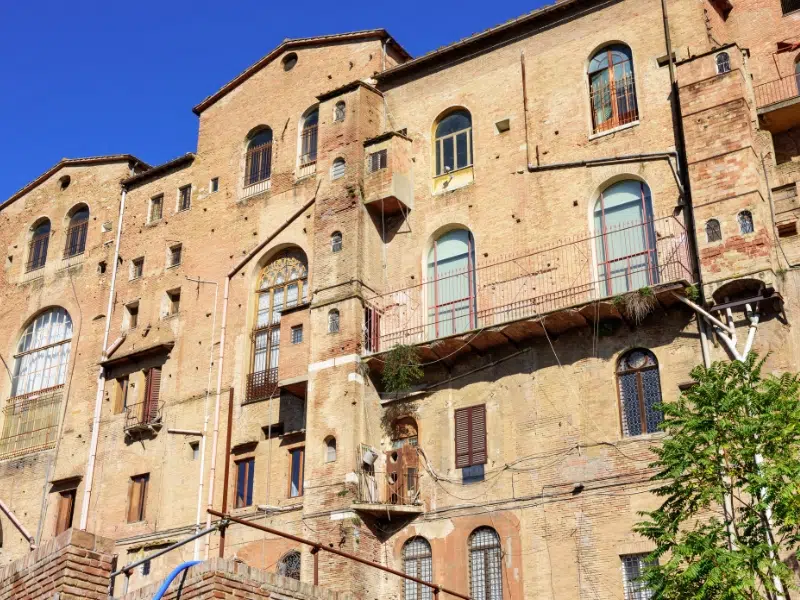
Santa Maria della Scala is the long building facing the steps of Siena Cathedral across the Piazza del Duomo. For roughly nine centuries it was a hospital, taking in pilgrims on the road to Rome, the sick, the poor and abandoned babies. Today it is a museum complex, and its great hall is still covered with 15th-century frescoes showing the hospital at work.
Santa Maria della Scala at a glance
- Where: Piazza del Duomo, directly opposite the cathedral steps, which gave it the name 'della Scala'.
- Founded: first documented in 1090; the main halls and church were built and enlarged between the 13th and 15th centuries.
- What it is today: a museum complex with frescoed halls, chapels, the original sculptures of the Fonte Gaia and the city's National Archaeological Museum underground.
- Time needed: 1.5–2 hours to see the main halls and the archaeological museum.
Nine centuries of caring for strangers
Siena sits on the Via Francigena, the medieval pilgrim road from Canterbury to Rome, and the hospital was probably set up by the cathedral canons to shelter travellers. Legend credits a cobbler named Sorore with founding it in 898, but the first document that mentions it is a deed of gift from 1090. In 1193 a papal bull made it a lay institution, independent of the cathedral, and from 1404 the city council appointed its rector. Gifts and bequests from Sienese families made it rich, and by the 14th century it owned huge farming estates across the Sienese state.
The hospital looked after pilgrims, who got free lodging and food vouchers for the road, and the sick, who received free meals and treatment in their own bed. It also took in abandoned babies, kept careful records of each child, taught them a trade and, at 18, sent them out with savings, clothes and household goods, plus a dowry for girls. Santa Maria della Scala continued as a hospital into the late 20th century. It opened as a museum in 1995, and parts of the complex are still being restored and opened up.
What to look for
- The Pellegrinaio: the pilgrims' hall, built around 1325, with frescoes from the 1440s by Domenico di Bartolo and others showing nurses, doctors, wet nurses and children in the hospital.
- The church of the Santissima Annunziata: built in the 13th century and remodelled in the late 15th, at the start of the visit.
- The Old Sacristy: covered with frescoes by Lorenzo di Pietro, known as Il Vecchietta.
- The Fonte Gaia sculptures: the original marble reliefs that Jacopo della Quercia carved for the fountain in the Piazza del Campo, now kept in the medieval hayloft.
- The archaeological museum: in tunnels deep under the building, with Etruscan and Roman finds from the Siena area.
The legend of the cobbler Sorore
Siena tells the hospital's beginnings as a legend: a cobbler called Sorore is said to have founded it in 898 to care for poor travellers and abandoned children. Historians doubt the story, since the first real document dates from two centuries later, but the hospital honoured him as the Blessed Sorore, and Il Vecchietta painted him kneeling at the centre of a scene in the complex. The name itself is simpler: 'scala' means stairs, after the cathedral steps the building faces.
Tips for your visit
- Start in the Pellegrinaio, where the frescoes explain what the building was for better than any panel.
- Leave time to go down: the lower levels, the hayloft and the tunnels are a big part of the visit.
- Combine it with the cathedral opposite and finish in the Piazza del Campo, where copies of the Fonte Gaia stand in the square.
Nearby
- Siena Cathedral: the striped marble cathedral across the square, with its inlaid marble floor and the Piccolomini Library.
- Piazza del Campo: the shell-shaped main square of Siena, a few minutes' walk downhill.
- Pinacoteca Nazionale: Siena's picture gallery of gold-ground Sienese painting, a short walk south.
See Siena with World City Trail
Our Siena scavenger hunt turns the old town into a game you play on your phone. The route links 10 stops and takes around two hours, with about 24 minutes of walking. Santa Maria della Scala is one of the stops, along with Siena Cathedral and the Pinacoteca Nazionale.
If you prefer a different format, there is also a self-guided walking tour and an outdoor escape game in Siena.
Play the Siena scavenger hunt →
Take the self-guided walking tour of Siena →
Play the outdoor escape game in Siena →
Facts checked in October 2026.