
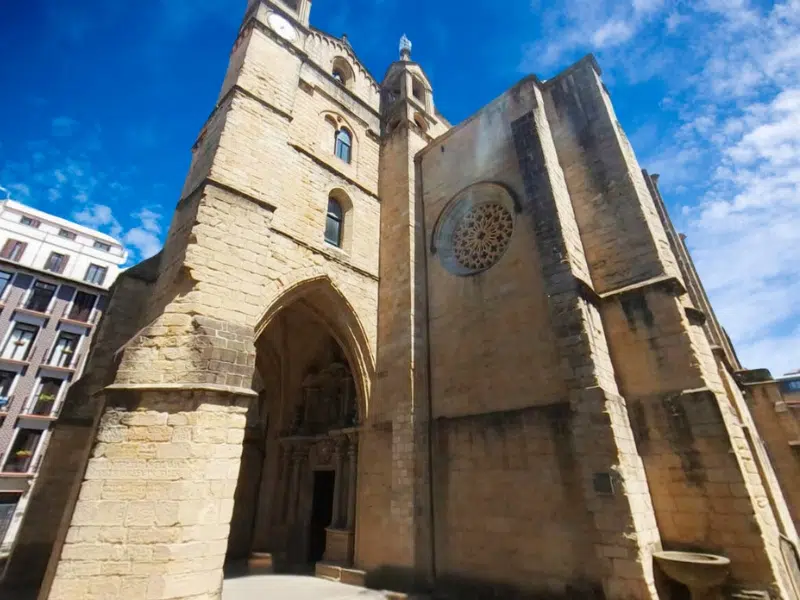
The Church of San Vicente (San Bizente Eliza in Basque) is a sturdy Gothic church on the eastern edge of San Sebastián's Old Town (Parte Vieja), next to the San Telmo Museum. Built between 1507 and 1574, it is considered the oldest building still standing in the city, and it was one of the very few to come through the fire of 1813 that destroyed almost the whole Old Town.
The Church of San Vicente at a glance
- Where: Calle San Vicente 3, in the Parte Vieja, by Plaza Zuloaga and the San Telmo Museum, at the foot of Monte Urgull.
- Built: 1507–1574, on the site of an earlier church damaged by fire in 1489; the bell tower dates from 1562.
- By: the master stonemasons Miguel de Santa Celay and Juan de Urrutia.
- What it is today: an active parish church, and the oldest surviving monument in San Sebastián.
- Time needed: 15–30 minutes, longer if you stop to study the altarpiece.
The church that outlived the town
In the 16th century San Sebastián was a small walled port, and San Vicente was built as one of its two parish churches, alongside Santa María. Work began in 1507 under the master stonemasons Miguel de Santa Celay and Juan de Urrutia and went on until 1574, with the bell tower going up in 1562. The result is a late Gothic church in the Basque style: three naves and a transept under simple cross vaults, with heavy buttresses and thick sandstone walls that make it look almost like a fortress from the street. The great altarpiece followed in the 1580s, and the presbytery was remodelled in 1775.
On 31 August 1813, during the Peninsular War, British and Portuguese troops stormed San Sebastián, held by a French garrison, and in the days that followed the town was sacked and burned. Nearly every house inside the walls was destroyed. San Vicente survived, and its walls served as an improvised hospital. In the 19th century the church gained one of its treasures, a French organ, and in the early 20th century new stained-glass windows. In 1999 a Pietà based on sketches by the Basque sculptor Jorge Oteiza was placed on the facade, linking the oldest building in the city with one of its best-known modern artists.
What to look for
- The main altarpiece: a Romanist (late Renaissance) work by Ambrosio de Bengoechea and Juan de Iriarte, agreed in 1583 and finished in 1586, considered one of the finest altarpieces of its style.
- The organ: built in 1868 by the French master organ builder Aristide Cavaillé-Coll and enlarged in 1893.
- The stained glass: windows from the early 20th century, many of them by the Maumejean workshop, plus four rose windows framed in sandstone.
- Oteiza's Pietà on the facade: installed in 1999, carved by the sculptor José Ramón Anda from Oteiza's sketches and under his supervision.
- The medallions by the entrance: reliefs of the Adoration of the Magi and of St Bernard, from the 16th century and attributed to Bengoechea or his circle.
A street named after a disaster
Calle 31 de Agosto, which runs from San Vicente across the Old Town to the Basilica of Santa María, is named after the day in 1813 when the town was stormed and set on fire. It is also one of the few places where houses from before the fire survived. Every year on 31 August, San Sebastián remembers the fire: the lights in Calle 31 de Agosto are switched off and candles are lit, and the evening ends with a torchlit walk from the porch of San Vicente to the Basilica of Santa María.
Tips for your visit
- This is a working parish church: visit outside Mass times if you want to look around, keep your voice down and dress respectfully.
- Walk around the outside too. The tower, the buttresses and Oteiza's Pietà are best seen from the street, and the size of the walls tells you why the church survived 1813.
- If you see an organ recital advertised, go: the Cavaillé-Coll is the best way to hear what the church sounds like.
Nearby
- San Telmo Museum: the museum of Basque society and culture, right next door in a 16th-century former convent, with large murals by Josep Maria Sert in the old church.
- Basilica of Santa María del Coro: the 18th-century Baroque basilica at the other end of Calle 31 de Agosto, with a richly carved facade facing the Buen Pastor Cathedral down the street.
- Plaza de la Constitución: the Old Town's arcaded main square, where the numbered balconies are a reminder that it was once used for bullfights.
- Monte Urgull: the hill above the Old Town, with paths up to the Castle of La Mota and the large statue of the Sacred Heart, and views over the bay.
See San Sebastián with World City Trail
Our San Sebastián scavenger hunt turns the old town into a game you play on your phone. The route links 10 stops and takes around 3 hours, with about 38 minutes of walking. Among the places it includes are the María Cristina Bridge, the Good Shepherd Cathedral and City Hall. You can play in English, German, French, Italian and Spanish.
If you prefer a different format, there is also a self-guided walking tour and an outdoor escape game in San Sebastián.
Play the San Sebastián scavenger hunt →
Take the self-guided walking tour of San Sebastián →
Play the outdoor escape game in San Sebastián →
Facts checked in October 2026.