
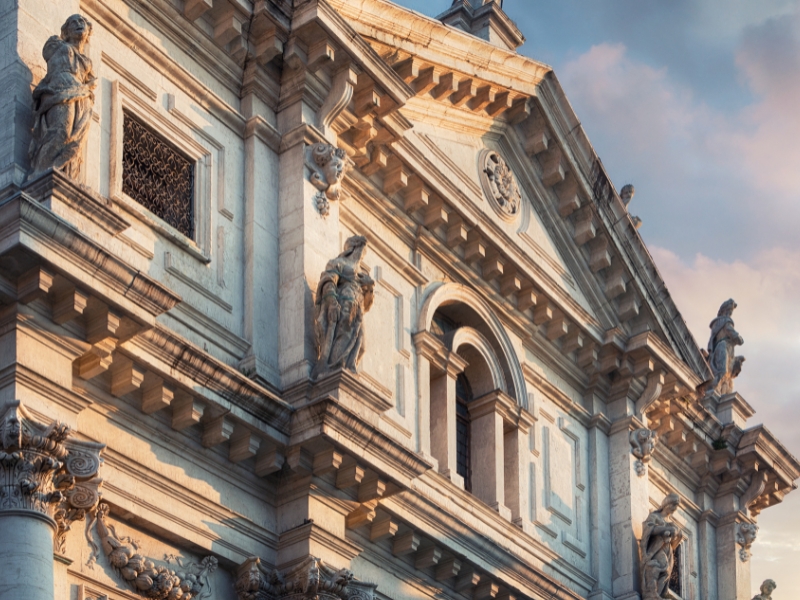
San Salvador is a large Renaissance church on the Mercerie, the busy shopping lanes between St Mark's Square and the Rialto Bridge in Venice. Most people walk straight past its white Baroque front, but inside are two paintings by Titian, the tomb of the last queen of Cyprus and a calm, airy space built from three domed bays in a row. Before you go in, look at the base of the left-hand column: a cannonball from 1849 is still stuck in it.
San Salvador at a glance
- Where: Campo San Salvador, on the Mercerie in the San Marco district, a few minutes' walk from the Rialto Bridge.
- Built: the present church was begun around 1507–1508; the facade was added in 1663.
- By: designed by Giorgio Spavento and continued after his death by Tullio Lombardo, with later work by Vincenzo Scamozzi; the facade is by Giuseppe Sardi.
- What it is today: an active parish church and one of the largest churches in Venice, open to visitors outside service times.
- Time needed: 20 to 30 minutes.
From a medieval church to a Renaissance hall
A church stood here very early in Venice's history; one tradition says it was founded in the 7th century by Saint Magnus after a vision of Christ guiding him to a red cloud. In 1177, Pope Alexander III consecrated the medieval church shortly after his famous reconciliation with Emperor Frederick Barbarossa at nearby San Marco. From the 12th century the church was run by canons regular, who stayed until 1807.
At the start of the 16th century the Venetian state helped pay for a complete rebuilding. Giorgio Spavento designed a new church made of three square bays laid end to end, each topped by a dome with a lantern, so that daylight falls into the nave from above. After Spavento died, Tullio Lombardo and later Vincenzo Scamozzi continued the work, and in 1663 Giuseppe Sardi gave it the Baroque facade facing the campo. The former monastery next door has a Renaissance cloister and is now used as offices.
What to look for
- Titian's Annunciation: on the right-hand wall, a late work by Titian, signed with the unusual inscription 'Titianus fecit fecit'.
- Titian's Transfiguration: the large altarpiece over the high altar, also by Titian.
- The tomb of Caterina Cornaro: the Venetian noblewoman who became Queen of Cyprus and ceded the island to Venice in 1489; she died in 1510.
- The tomb of Doge Francesco Venier: a Renaissance monument by Jacopo Sansovino on the right-hand wall.
- The cannonball: outside, at the foot of the left column of the facade, a ball fired during the Austrian bombardment of 1849, when Venice had declared itself an independent republic.
Titian 'made it, made it'
The inscription on Titian's Annunciation, 'Titianus fecit fecit', meaning 'Titian made it, made it', has puzzled visitors for centuries. A popular story says that the elderly painter wrote it twice in irritation after patrons complained that the picture looked unfinished, as if to insist that it really was his work. There is no firm evidence for the story, so treat it as a legend, but the doubled word is real and easy to spot in the lower part of the painting.
Tips for your visit
- Step in from the crowds of the Mercerie in the middle of the day: the church is usually calm and cool even when the lanes outside are packed.
- Stand under each of the three domes in turn to see how the light changes along the nave.
- It is a place of worship, so dress respectfully and avoid visiting during Mass.
Nearby
- Rialto Bridge: the stone bridge over the Grand Canal, completed in 1591, a few minutes' walk north.
- St Mark's Square: the great square with the Basilica and the Campanile, about five minutes south along the Mercerie.
- Campo San Bartolomeo: the busy little square with the statue of the playwright Carlo Goldoni, a popular meeting point near the Rialto.
See Venice with World City Trail
Our Venice scavenger hunt turns the city into a game you play on your phone. The route links 10 stops and takes around 2 hours, with about 41 minutes of walking, and it includes places such as the Frari Basilica, the Rialto Bridge and St Mark's Square.
If you prefer a different format, Venice also has a self-guided walking tour and an outdoor escape game.
Play the Venice scavenger hunt →
Take the self-guided walking tour of Venice →
Play the outdoor escape game in Venice →
Facts checked in October 2026.