
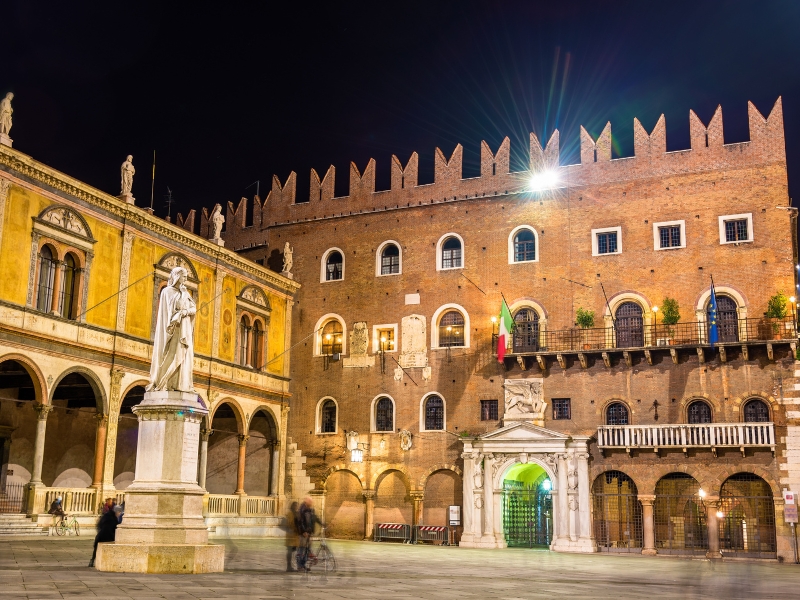
Piazza dei Signori, also known as Piazza Dante, is the enclosed square right behind Piazza delle Erbe in Verona, ringed by the palaces from which the city was governed by the medieval commune, the Della Scala lords and then Venice. In the middle stands a marble statue of Dante, who found refuge in Verona at the court of Cangrande della Scala. Under the arch that leads in from Piazza delle Erbe hangs a whale rib.
Piazza dei Signori at a glance
- Where: in the old town, between Piazza delle Erbe and the Scaliger Tombs, reached through the Arco della Costa.
- Built: around the square from the late 12th century (Torre dei Lamberti begun in 1172) to the 15th century (Loggia del Consiglio, 1476–1493); the Dante statue was unveiled in 1865.
- By: the Dante statue is by the Veronese sculptor Ugo Zannoni. The Loggia was long credited to the friar-architect Fra Giocondo, but that attribution is wrong; it was a collective work.
- What it is today: a pedestrian square of public buildings, with the prefecture, the courts, the provincial council in the Loggia and a modern art gallery in the Palazzo della Ragione.
- Time needed: 20–30 minutes for the square; add about an hour to climb the Torre dei Lamberti.
From the Scaligeri to the Venetian Republic
The square grew around the town hall of the medieval commune, the Palazzo della Ragione. Its tower, the Torre dei Lamberti, was begun in 1172 by the Lamberti family and was only 37 metres high at first. After lightning struck the top in 1403, it was raised between 1448 and about 1464 and finished with an octagonal bell chamber, reaching today's 84 metres. From the late 13th century the Della Scala family, the Scaligeri, ruled Verona and built their palaces on the square. Dante stayed in Verona as their guest in the early 14th century, and Cangrande della Scala was one of his patrons.
After 1405 Verona belonged to the Republic of Venice. In 1476 the city's council decided to build itself a meeting hall, and the Loggia del Consiglio was finished in 1493. On its roof stand statues of five famous men of Roman Verona: the poet Catullus, Pliny the Elder, Aemilius Macer, Vitruvius and Cornelius Nepos, carved by Alberto da Milano. In 1865, for the 600th anniversary of Dante's birth, the city put up the statue of the poet in the centre: about 3 metres of Carrara marble, and almost 7 metres with its base.
What to look for
- Dante: the poet stands with his head bowed and his chin on his hand, as if lost in thought.
- The Loggia del Consiglio: eight round arches below, painted decoration and the five Roman statues along the roofline. On the arch joining it to the next building stands the physician and poet Girolamo Fracastoro, by Danese Cattaneo (1559).
- The Arco della Costa: the arch to Piazza delle Erbe, with a large whale rib hanging from chains.
- The Torre dei Lamberti: look for the change from striped stone and brick at the bottom to the octagonal bell chamber at the top. You can climb its 368 steps, or take the lift for most of the way.
- The Scala della Ragione: the 15th-century outdoor staircase in the courtyard of the Palazzo della Ragione (Cortile Mercato Vecchio), reached through the archway from the square.
The whale rib
Nobody is sure how the rib came to Verona; it is usually said to have been brought by merchants. A local legend says it will fall on the first person who walks under it who has never told a lie. It has not fallen yet, which Veronese like to read as a comment on the honesty of everyone who has passed. The tower's bells have their own stories: the big Rengo once called the council and the army, and the small Marangona warned of fires and rang the hours.
Tips for your visit
- Come early in the morning or in the evening, when the square is quiet and the Loggia is lit up.
- Climb the Torre dei Lamberti late in the afternoon for the light on the roofs and the river Adige.
- Walk under the Arco della Costa from Piazza delle Erbe to arrive the way most people did in the past, then leave by the far corner for the Scaliger Tombs.
Nearby
- Piazza delle Erbe: the market square on the site of the Roman forum, with the Madonna Verona fountain, right through the arch.
- Scaliger Tombs (Arche Scaligere): the Gothic tombs of the Della Scala lords, behind a wrought-iron fence just round the corner. Cangrande's tomb carries a copy of his equestrian statue; the original is in the Castelvecchio Museum.
- Juliet's House: the medieval house with the famous balcony on Via Cappello, a few minutes' walk away.
- Sant'Anastasia: the big Gothic church a short walk north, known for the two hunchbacks holding up its holy water stoups.
See Verona with World City Trail
Our Verona scavenger hunt turns the old town into a game you play on your phone. The route links 10 stops and takes around 3 hours, with about 45 minutes of walking. It includes the Arena, Juliet's House and Porta Borsari; Juliet's House is only a few minutes from Piazza dei Signori. You can play in English, German, French, Italian, Spanish or Dutch.
If you prefer a different format, there is also a self-guided walking tour and an outdoor escape game in Verona.
Play the Verona scavenger hunt →
Take the self-guided walking tour of Verona →
Play the outdoor escape game in Verona →
Facts checked in October 2026.