
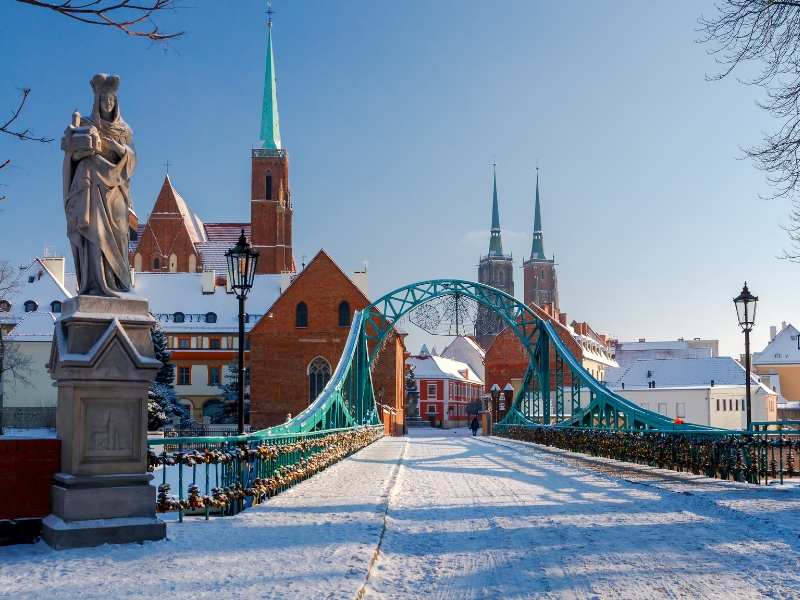
Tumski Bridge (Most Tumski) is the short steel bridge that carries pedestrians over a branch of the Oder from Sand Island to Ostrów Tumski, the oldest part of Wrocław. It has stood here since 1889, but the crossing is far older, and for centuries this was the border of a small church-run world with its own rules. Walk it at dusk and you may see the city's lamplighter at work on the far side.
Tumski Bridge at a glance
- Where: over the northern arm of the Oder, linking Sand Island (Wyspa Piasek) with Cathedral Island (Ostrów Tumski), a short walk north-east of the Market Square.
- Built: 1889, replacing earlier wooden bridges; renovated in 2019–2020.
- What it is: a two-span riveted steel truss bridge, about 52 metres long, open to pedestrians only.
- What it is today: the main walking route onto Cathedral Island and one of the most photographed spots in the city, known locally as the lovers' bridge.
- Time needed: 10–15 minutes to cross and take photos, longer if you wait for the lamps to be lit.
From wooden crossing to steel bridge
There has been a bridge here since at least the 12th century, when wooden crossings joined the island to the rest of the town. They were rebuilt again and again after floods, fires and wars; in 1423 one collapsed under the crowd of a Palm Sunday procession. In 1315 the island was sold to the Church and became a separate jurisdiction, so crossing the bridge meant entering a different territory. Fugitives from the city courts could seek sanctuary there, and men had to remove their hats, a rule that, according to the old accounts, applied even to kings.
The present bridge, with its riveted steel trusses, was put up in 1889 under German rule, when the city was called Breslau and the bridge Dombrücke. It was damaged in 1945 and repaired after the war, and it has been a protected monument since 1976. From 2009 couples began hanging padlocks on the railings and throwing the keys into the river. By 2019 the locks weighed around 17 tonnes, and they were cut off before a renovation that reopened the bridge in early 2020. Padlocks are no longer allowed and new ones are removed.
What to look for
- The two sandstone statues at the island end: St Hedwig, patron saint of Silesia, and St John the Baptist, patron of the cathedral, carved in the early 1890s by Gustav Grunenberg and set on neo-Gothic plinths.
- The steel trusses themselves: rows of rivets, diagonal bracing and a high portal frame that you walk through.
- The view along the river: the twin spires of the Cathedral of St John the Baptist ahead, the Church of the Holy Cross to the left, and the brick bulk of St Mary on the Sand behind you.
- A few padlocks hidden in odd corners: despite the ban, some still appear, and the city clears them regularly.
- The gas lamps on the island side: Ostrów Tumski still has around a hundred gas street lamps, lit by hand every evening.
The lamplighter of Ostrów Tumski
Wrocław is one of the few European cities where gas lamps are still lit by a person rather than a timer. Shortly before dusk a lamplighter in a dark cape and top hat walks the streets of Cathedral Island with a long pole, lighting the lamps one by one, and in the morning he puts them out again. Cross Tumski Bridge just before sunset and walk up Katedralna Street, and you have a good chance of meeting him.
Tips for your visit
- Come early in the morning for an empty bridge, or at dusk when the gas lamps come on and the spires are floodlit.
- The best photo of the bridge with the cathedral behind it is from the bank of Sand Island, a few steps west of the bridge.
- Don't add a padlock: it is no longer allowed, and the weight was one reason the bridge needed repairs.
- Combine it with Sand Island and a loop of Cathedral Island; the area is compact and easy to explore on foot.
Nearby
- Cathedral of St John the Baptist: the Gothic cathedral at the end of Katedralna Street, with a viewing terrace in one of its towers.
- Church of the Holy Cross: an unusual two-storey Gothic church; Nicolaus Copernicus was a canon of its chapter in the early 1500s.
- St Mary on the Sand: a tall Gothic hall church on Sand Island, just across the bridge, with fine stained glass.
- University of Wrocław Botanical Garden: a quiet garden on the north side of Cathedral Island, a few minutes' walk from the cathedral.
See Wrocław with World City Trail
Our Wrocław scavenger hunt turns the old town into a game you play on your phone. The route links 10 stops and takes around 3 hours, with about 58 minutes of walking, and includes places such as The Passage sculptures and Copernicus Park. You can play in English, German, French, Italian, Spanish, Dutch or Polish.
If you prefer a different format, there is also a self-guided walking tour and an outdoor escape game in Wrocław.
Play the Wrocław scavenger hunt →
Take the self-guided walking tour of Wrocław →
Play the outdoor escape game in Wrocław →
Facts checked in October 2026.