
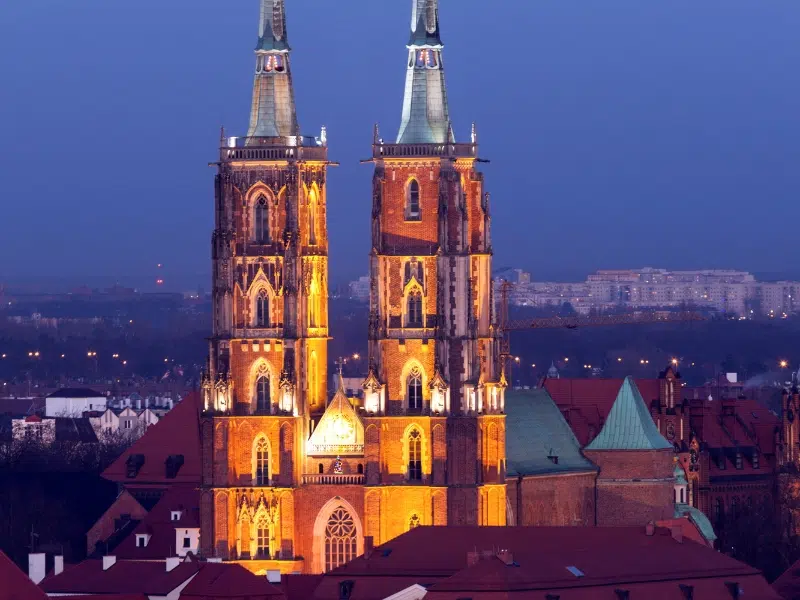
Wrocław Cathedral, the Archcathedral of St John the Baptist, is the brick Gothic church whose twin spires rise over Ostrów Tumski, the island where the city began. Work on the present building started in 1244, making it the first brick building in Wrocław, and it is the fourth church on this site. Badly damaged in 1945 and rebuilt after the war, it now has a lift up one of its towers to one of the best viewpoints in the city.
Wrocław Cathedral at a glance
- Where: Plac Katedralny on Ostrów Tumski (Cathedral Island), across the Oder from the Old Town, about 15 minutes' walk from the Market Square.
- Built: brick Gothic choir begun in 1244, nave finished by 1341; neo-Gothic remodelling in 1873–1875; rebuilt after 1945 and reconsecrated in 1951.
- What it is today: the seat of the Archdiocese of Wrocław and part of a Historic Monument of Poland, with daily Masses, Baroque chapels to visit and a viewing terrace in the tower.
- Time needed: 45 minutes to an hour including the tower terrace.
Four churches, two fires and one siege
The first church here was built in the mid-10th century, when Silesia was under Bohemian rule. After the diocese of Wrocław was founded in the year 1000, it was replaced by a larger basilica, which was destroyed around 1039 and followed by a Romanesque church. After the Mongol invasion of 1241, the bishops began the present Gothic cathedral in brick in 1244, starting with the choir and ambulatory. Bishop Nanker added the nave and the base of the western towers by 1341.
Fire destroyed the roof in 1540, and another fire in 1759 burned the towers, roof and sacristy; repairs took more than a century. In 1873–1875 Karl Lüdecke rebuilt the west front and interior in neo-Gothic style. In 1945, during the Siege of Breslau, about 70 per cent of the cathedral was destroyed, although the medieval walls survived. The roof and vaults were rebuilt by 1951, when Archbishop Stefan Wyszyński reconsecrated the church, but the spires only regained their original pointed shape in 1991.
What to look for
- The western portal: the Gothic porch between the towers, with its carved figures, is one of the most valuable medieval works in Wrocław.
- The tower terrace: a lift takes you most of the way up one of the spires, with a few stairs at the end, to an open terrace with views over the island, the Oder and the Old Town.
- The Chapel of St Elizabeth: a Baroque mausoleum of 1682–1700 behind the choir, with a statue of the saint by Ercole Ferrata and a cardinal's tomb by Domenico Guidi, both pupils of Bernini.
- The Elector's Chapel: the Baroque chapel on the north side, designed by the Viennese architect Johann Bernhard Fischer von Erlach and built in 1716–1724.
- The organ: the largest pipe organ in Poland, built in 1913 for the Centennial Hall, when it was the largest organ in the world.
- The Marian Chapel: the Gothic chapel directly behind the high altar, built in 1354–1365, with the tombs of bishops including Johann Roth.
The statue that did not burn
A story from the last days of the war is still told in the cathedral. When Soviet bombing set the building on fire in 1945, a marble statue of the Virgin and Child, carved by Carl Johann Steinhäuser in 1854, fell in the Marian Chapel. According to the account, the flames stopped in front of the fallen statue, which survived unharmed, and the three chapels behind the choir were spared. Whether you take it as a miracle or a lucky draught, the Baroque chapels you can visit today owe their survival to that night.
Tips for your visit
- Come in the late afternoon and stay on the island until dusk: a lamplighter in a cape still lights its 103 gas lamps by hand every evening.
- The tower terrace depends on the weather, so pick a clear day and check before you go.
- This is a working cathedral: keep quiet during Mass and dress modestly. The chapels behind the choir may be closed to sightseers during services.
- Walk to the cathedral over Tumski Bridge from the Sand Island; that way you see the spires rising above the river first.
Nearby
- Tumski Bridge: the green iron bridge linking Ostrów Tumski with the Sand Island, a few minutes' walk away and covered in lovers' padlocks.
- Church of the Holy Cross and St Bartholomew: a two-storey Gothic church just west of the cathedral, actually two churches stacked one above the other.
- Church of St Mary on the Sand: a Gothic hall church on the Sand Island, with tall star-shaped vaults.
- Wrocław Botanical Garden: founded in 1811, right behind the cathedral, a quiet green spot with ponds and old trees.
See Wrocław with World City Trail
Our Wrocław scavenger hunt turns the old town into a game you play on your phone. The route links 10 stops and takes around 3 hours, with about 58 minutes of walking, and includes places such as The Passage sculptures and Copernicus Park. You can play in English, German, French, Italian, Spanish, Dutch or Polish.
If you prefer a different format, there is also a self-guided walking tour and an outdoor escape game in Wrocław.
Play the Wrocław scavenger hunt →
Take the self-guided walking tour of Wrocław →
Play the outdoor escape game in Wrocław →
Facts checked in October 2026.