
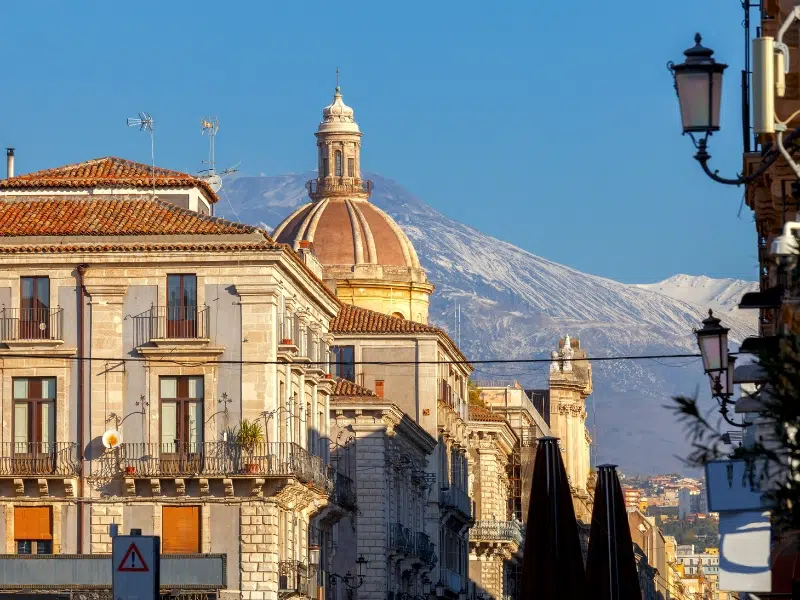
Via Etnea is Catania's main street, running dead straight north from Piazza del Duomo towards the volcano that gives it its name. It was laid out when the city was rebuilt after the earthquake of 1693, and on a clear day Mount Etna rises at the far end of the view, often with smoke drifting from its summit.
Via Etnea at a glance
- Where: from Piazza del Duomo in the historic centre north past Piazza Stesicoro and the Villa Bellini gardens towards the Tondo Gioeni.
- Built: planned in 1694 as one of the main axes of the new city after the 1693 earthquake.
- What it is today: Catania's shopping and strolling street, with baroque palaces, churches, cafés and the city's busiest pavements; the southern part is pedestrian.
- Time needed: one to two hours to walk the historic stretch from the cathedral to Villa Bellini, with stops.
A street drawn on a ruined city
In January 1693 an earthquake destroyed most of Catania, only a generation after the great lava flow of 1669 had reached the city walls. The Spanish viceroy, the Duke of Uzeda, put Giuseppe Lanza, Duke of Camastra, in charge of reconstruction, and by June 1694 a new plan was ready: a grid of wide, straight streets that would be safer in future earthquakes and easier to escape along. Via Etnea was one of its two main axes, crossing the city from the cathedral square northwards.
The street was meant to point straight at Etna. According to a well-known local story, a miscalculation left it aimed not at the crater but at the volcano's eastern slope; either way, the mountain closes the view. Along the new street, architects such as Giovanni Battista Vaccarini built churches and palaces in a distinctive Catania baroque, combining black lava stone with pale limestone. Over the following centuries Via Etnea grew into the city's main promenade.
What to look for
- The view north: on a clear day, especially in winter, Etna's summit sits at the end of the street, sometimes with snow or a plume of smoke.
- Piazza dell'Università, a short walk from the cathedral, with the university palace and its baroque courtyard.
- The Basilica della Collegiata, a church with a curved baroque façade on the east side of the street.
- Piazza Stesicoro, where part of the Roman amphitheatre lies exposed below street level, next to the monument to the composer Vincenzo Bellini.
- Villa Bellini, the city's favourite public garden, with a floral clock and views towards Etna from its terraces.
Built from the volcano
Look down and around as you walk: Via Etnea is literally made of Etna. The paving stones and the dark details of many palaces are basalt from old lava flows, contrasted with white limestone for cornices and window frames. The combination gives Catania's baroque its striking black-and-white look. The same lava rock that destroyed the city in the 17th century was used to rebuild it.
Tips for your visit
- Walk from south to north, so that Etna is in front of you the whole way.
- Go in the early evening, when Catanians come out for the passeggiata and the cafés fill up.
- Stop for granita with brioche or an arancino in one of the historic cafés along the street.
- Mornings in winter often give the clearest view of the volcano; summer haze can hide it.
Nearby
- Piazza del Duomo and the Elephant Fountain: the starting point of the street, with the cathedral and the lava-stone elephant.
- Roman Amphitheatre: the excavated section in Piazza Stesicoro, halfway along the street.
- Via dei Crociferi: a baroque street of churches and convents, parallel to Via Etnea a few minutes west.
- Teatro Massimo Bellini: Catania's opera house, a short walk east of the street.
See Catania with World City Trail
Our Catania scavenger hunt turns the old town into a game you play on your phone. The route links 10 stops and takes around two hours, with about 34 minutes of walking. Via Etnea is one of the stops, along with the Roman Amphitheatre and Piazza Stesicoro. You can play in English, German, French, Italian, Spanish or Dutch.
If you prefer a different format, Catania also has a self-guided walking tour and an outdoor escape game.
Play the Catania scavenger hunt →
Take the self-guided walking tour of Catania →
Play the outdoor escape game in Catania →
Facts checked in October 2026.