
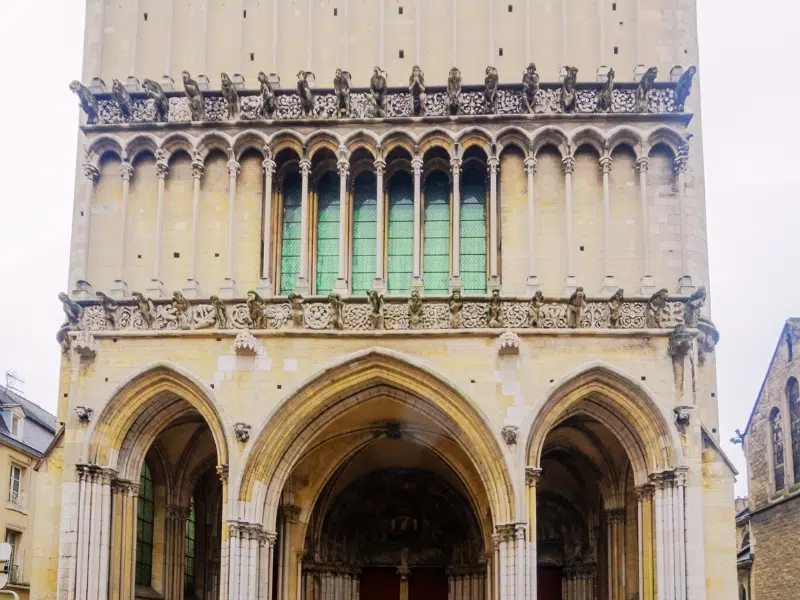
The Church of Notre-Dame (Our Lady) in Dijon is a 13th-century Gothic church in the old town, just behind the Palace of the Dukes of Burgundy. It is known for three things: a flat façade lined with 51 grimacing gargoyles, a family of mechanical bell-strikers on its clock tower, and a small stone owl that people touch for luck.
Notre-Dame de Dijon at a glance
- Where: on Place Notre-Dame in the old town, with the owl on its north side in Rue de la Chouette, a short walk north of the ducal palace.
- Built: from around the 1220s to the 1240s, on the site of an older Romanesque chapel; consecrated in 1334; a listed historic monument since 1840.
- What it is today: a working parish church, open to visitors outside services, and the starting point of the city's Owl Trail.
- Time needed: 30 to 45 minutes for the façade, the interior and the owl.
A Gothic church in the dukes' capital
Notre-Dame was built in the first half of the 13th century as a parish church in the centre of the medieval town, in the early Gothic style of Burgundy. Its west façade is unusual for French Gothic: instead of deep portals and towers, it is a flat screen of two open galleries, each topped by a row of carved gargoyles. The ones you see today are purely decorative; they were made in 1880–1882 by seven Paris sculptors during a restoration of 1865–1884 led by the architect Jean-Charles Laisné.
The clock came as war booty. In 1382 the armies of Philip the Bold, Duke of Burgundy, sacked the Flemish town of Kortrijk (Courtrai) and carried off its clock with its bell-striking figure. It was set up on Notre-Dame in 1383. Over the centuries Dijon gave the lonely striker a family: a wife, Jacqueline, in 1651, a son, Jacquelinet, around 1714, and a daughter, Jacquelinette, in 1884. Inside, the composer Jean-Philippe Rameau played the organ as a young man, between 1709 and 1713.
What to look for
- The 51 gargoyles of the façade: monsters, animals and human figures stacked in rows across the two galleries.
- The Jacquemart on the small clock tower beside the façade: Jacquemart and Jacqueline strike the hours, and their children strike the quarters.
- The owl (la Chouette): a small worn carving on a buttress of a chapel in Rue de la Chouette; tradition says you stroke it with your left hand and make a wish.
- Our Lady of Good Hope: a wooden statue of the Virgin from the 11th or 12th century, one of the oldest in France, once painted black and now back in its original colours.
- Five stained-glass windows from about 1235 in the north transept, showing scenes from the lives of St Peter and St Andrew.
The legend of the falling gargoyle
Why does the façade carry only decorative gargoyles? A medieval story says the original ones were taken down in the 13th century after one of them fell and killed a moneylender. It is a legend, but a popular one. The owl has its own mystery: no one knows why it was carved, but it has become a symbol of the city, worn smooth by countless hands. In January 2001 a vandal damaged it; it was repaired and put back in May the same year, and it is now watched by a camera.
Tips for your visit
- Look at the façade in the morning or early afternoon, when the light picks out the gargoyles; from the square, binoculars or a phone zoom help.
- There is usually a small queue at the owl: wait your turn, touch it gently with your left hand and keep your wish to yourself.
- Follow the Owl Trail: bronze arrows with an owl set into the pavement lead from here past the main sights of the old town.
Nearby
- Palace of the Dukes and the Museum of Fine Arts: the ducal residence and one of France's oldest museums, a few minutes' walk south.
- Hôtel de Vogüé: an early 17th-century mansion with a colourful glazed-tile roof, opposite the owl in Rue de la Chouette.
- Rue des Forges: one of the main streets of medieval Dijon, lined with medieval and Renaissance merchants' houses.
- Les Halles: the 19th-century covered market with its iron-and-glass hall, a short walk north-west.
See Dijon with World City Trail
Our Dijon scavenger hunt turns the old town into a game you play on your phone. The route links 10 stops and takes around 2 hours, with about 25 minutes of walking. It includes Porte Guillaume, the Cathedral of Saint-Bénigne, the Jardin des Cloches and Place François Rude. You can play in English, German, French, Italian, Spanish and Dutch.
If you prefer a different format, there is also a self-guided walking tour and an outdoor escape game in Dijon.
Play the Dijon scavenger hunt →
Take the self-guided walking tour of Dijon →
Play the outdoor escape game in Dijon →
Facts checked in October 2026.