
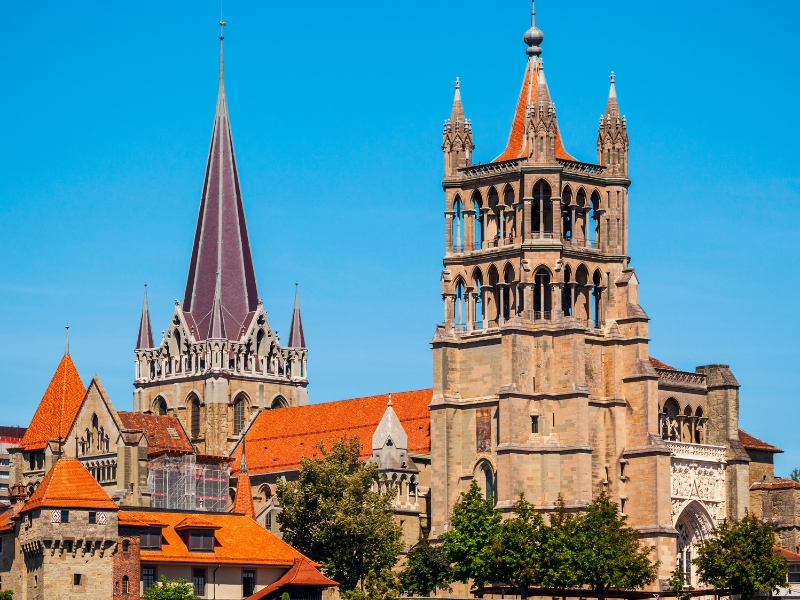
Lausanne Cathedral, the Cathédrale Notre-Dame, crowns the Cité hill above the old town and is one of the most important Gothic buildings in Switzerland. Pope Gregory X consecrated it in 1275. Every night a watchman still calls out the hours from its tower, a tradition first recorded in 1405.
Lausanne Cathedral at a glance
- Where: on the Cité hill, the highest part of Lausanne's old town, above Place de la Palud.
- Built: from about 1170 into the 13th century; consecrated on 20 October 1275 by Pope Gregory X in the presence of Rudolf of Habsburg.
- Restored: in the 19th century, from 1873 under the French architect Eugène Viollet-le-Duc, who designed the present spire.
- What it is today: a Protestant church since 1536, used for services and concerts, with a great organ inaugurated in 2003.
- Time needed: 30–45 minutes, plus about 20 minutes if you climb the tower.
From bishop's church to Protestant cathedral
Work began around 1170 under Bishop Landry de Durnes and lasted about 70 years. Lausanne was then a bishop's city, and the cathedral, dedicated to the Virgin Mary, drew pilgrims from across the region. Its consecration in 1275 was a grand occasion: Pope Gregory X performed the ceremony with Rudolf of Habsburg, the newly elected King of the Romans, at his side.
In 1536 Bern conquered the Vaud region and imposed the Reformation. The Lausanne Disputation, a public debate between Catholics and reformers, was held in the cathedral that year. Afterwards the altars, statues and relics were removed and the colours of the painted portal were covered up. The building has been a Protestant church ever since. In the 19th century a long restoration tried to recover its Gothic character; Viollet-le-Duc took charge in 1873 and added elements of his own, including the spire.
What to look for
- The painted portal on the south side: the main entrance until 1536, one of the few Gothic portals anywhere that still shows much of its medieval colour on the sculpted figures. It is now protected behind glass.
- The rose window in the south transept: about 8 metres across, made around 1220–1230 and attributed to the glass painter Pierre d'Arras. Its panels show a medieval picture of the world, with the seasons, the months, the elements and the signs of the zodiac.
- The Montfalcon portal on the west front, named after an early 16th-century bishop. Its sculptures were remade between 1892 and 1909 by Raphaël Lugeon.
- The great organ by the American builder Fisk, inaugurated in 2003: about 7,000 pipes in a striking wooden case designed by Giorgetto Giugiaro, better known for his car designs.
- The tower: 224 steps up to a gallery with views over the roofs to Lake Geneva and the Alps.
The watchman of Lausanne
Lausanne is one of the very few cities in Europe that still has a night watchman. Every night from 10 pm to 2 am, after the bell strikes each hour, the guet steps out on the tower and calls 'C'est le guet, il a sonné l'heure' ('This is the watch, the hour has struck') towards the four points of the compass. The service is first recorded in 1405 and was originally meant to spot fires in a town of wooden houses. In 2021 the team of watchmen admitted its first woman as a substitute.
Tips for your visit
- To hear the watchman, stand on the cathedral square just before 10 pm, 11 pm, midnight, 1 am or 2 am. The call is short, so be there before the hour.
- For the classic view of the old town and the lake, walk round to the terrace on the south side of the cathedral.
- The cathedral is a working church. Keep your voice down, and check the noticeboard for Sunday services and organ concerts, which are a good way to hear the Fisk organ.
- Arrive on foot from Place de la Palud through the covered Escaliers du Marché: the climb is short and brings you out right beside the cathedral.
Nearby
- Escaliers du Marché: the old covered wooden stairway between Place de la Palud and the Cité, worth taking up or down.
- Musée historique de Lausanne: the city museum in the former bishop's palace beside the cathedral, with a large model of Lausanne as it looked in the 17th century.
- Château Saint-Maire: the brick castle built for the bishops around 1400, now the seat of the Vaud cantonal government, a few minutes' walk north.
- Place de la Palud: the market square with the town hall, the Fountain of Justice and an animated clock, just down the steps.
See Lausanne with World City Trail
Our Lausanne scavenger hunt turns the old town into a game you play on your phone. The route links 10 stops and takes around 3 hours, with about 41 minutes of walking. It includes Lausanne station, the Esplanade de Montbenon and Place de la Palud. You can play in English, German, French, Italian, Spanish and Dutch.
If you prefer a different format, there is also a self-guided walking tour and an outdoor escape game in Lausanne.
Play the Lausanne scavenger hunt →
Take the self-guided walking tour of Lausanne →
Play the outdoor escape game in Lausanne →
Facts checked in October 2026.