
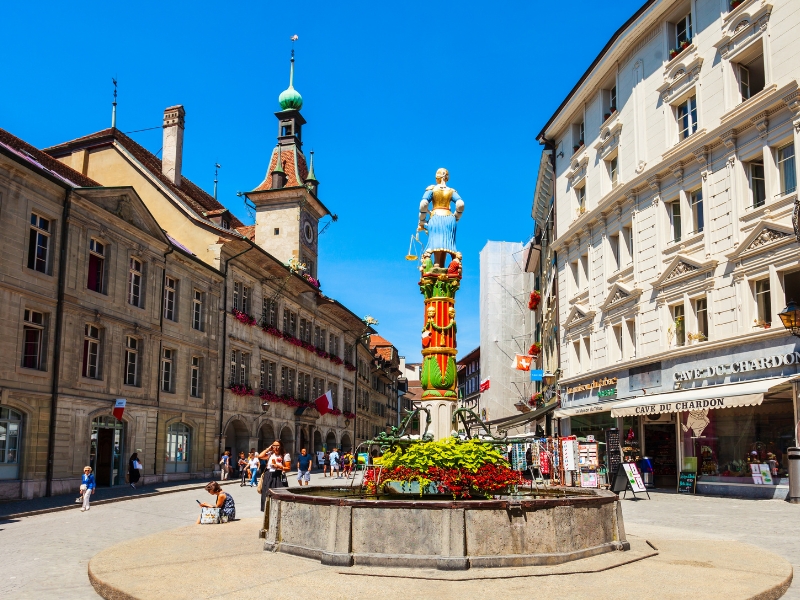
Place de la Palud is the small, sloping square in Lausanne's old town where the city council meets, the market sets up twice a week and people have gathered for centuries. On one side stands the arcaded town hall, in the middle the Fountain of Justice, and on a house just behind the fountain an animated clock whose figures come out on the hour. From one corner, a covered wooden staircase climbs to the cathedral.
Place de la Palud at a glance
- Where: in the lower part of Lausanne's old town, below the cathedral hill, between Rue du Pont and the Escaliers du Marché.
- Built: the present town hall dates from the 1670s; the fountain's statue of Justice was first carved in the late 16th century.
- What it is today: a pedestrian square with the seat of the city's council, cafés, shops and a street market on Wednesdays and Saturdays.
- Time needed: 15–20 minutes, more if you wait for the clock or browse the market.
From marshland to market square
The name gives away the site's past: palud comes from the Latin palus, a marsh. The square lies in the low ground near the old course of the Flon river, below the hill where the bishops of Lausanne built their cathedral. In the Middle Ages the lower town grew up here as a place of trade, with merchants and craftsmen around an open market space, while the clergy lived on the hill above.
The square became the centre of civic life. A town hall stood here long before the current building, which went up in the 1670s with arcades on the ground floor and the council chamber above. Vaud's independence from Bern was proclaimed on this square in January 1798, and when Lausanne became the capital of the new canton of Vaud in 1803, the square kept its role as the place where the city governs itself. Lausanne's municipal council still meets in the town hall today.
What to look for
- The Fountain of Justice: a stone basin with a column topped by Justice, holding her sword and scales. The statue was carved in 1584–85 by Laurent Perroud and his son; parts of the fountain are 20th-century copies, and the originals are kept in the city's history museum.
- The town hall facade: arcades at street level, a row of tall windows above and, on the roof, gutter spouts in the shape of dragons.
- The animated clock: on a building just behind the fountain, a clock installed in 1964. On the hour, doors open and small figures from the history of Vaud parade across a little stage to music.
- The Escaliers du Marché: the covered wooden staircase in the corner of the square, which has carried people up to the cathedral since the Middle Ages. Count the steps and look at the roof beams as you climb.
- The slope: the square tilts noticeably downhill. Lausanne is built on steep hills; the market grew up here in the Middle Ages because old roads to the west and south met at this spot.
Clockwatching at Palud
The animated clock is one of the small rituals of the old town. A few minutes before the hour, people start to linger in front of it; when the music starts, the figures roll out one after another, then the doors close again. It is short, so do not wander off for a coffee just before the hour, and it is a good moment to look around the square while everyone else is staring up.
Tips for your visit
- Come on a Wednesday or Saturday morning to see the square at its busiest, with fruit, vegetable, cheese and flower stalls spreading into the surrounding streets.
- For a photo of the town hall and fountain together, stand at the lower end of the square near Rue du Pont and shoot uphill.
- Combine Palud with the cathedral: climb the Escaliers du Marché, then return through Rue Viret or the Cité quarter to see the old town from above.
Nearby
- Lausanne Cathedral: the Gothic cathedral at the top of the Escaliers du Marché, a few minutes' climb away, where a night watchman still calls out the hours from the tower every night.
- Place de la Riponne and the Palais de Rumine: the large square just north of Palud, overlooked by the palace-like building that houses several of the city's museums.
- Château Saint-Maire: the former bishops' castle at the top of the old town, today the seat of the cantonal government of Vaud.
- The Flon district: the former warehouse quarter in the valley just west of Palud, now full of shops, bars and restaurants.
See Lausanne with World City Trail
Our Lausanne scavenger hunt turns the old town into a game you play on your phone. The route links 10 stops and takes around 3 hours, with about 40 minutes of walking. Place de la Palud is one of the stops, along with Lausanne station and the Esplanade de Montbenon. You can play in English, German, French, Italian, Spanish and Dutch.
If you prefer a different format, there is also a self-guided walking tour and an outdoor escape game in Lausanne.
Play the Lausanne scavenger hunt →
Take the self-guided walking tour of Lausanne →
Play the outdoor escape game in Lausanne →
Facts checked in October 2026.