
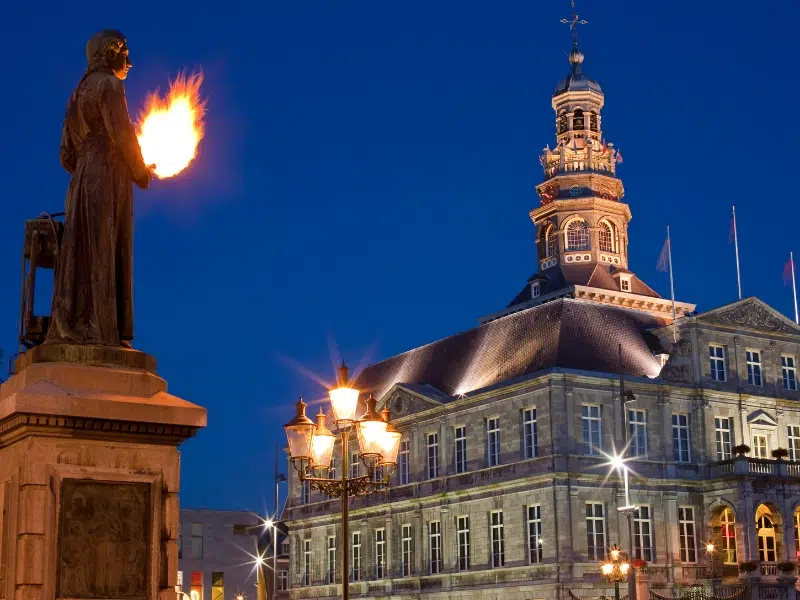
The Markt is Maastricht's market square, a broad open space in the city centre just west of the Maas. In the middle stands the 17th-century town hall by Pieter Post, built at a time when the city was ruled jointly by two powers and designed so that each could have its own half. Around it, market stalls, café terraces and two much-loved bronze statues make it the everyday centre of the city.
The Markt at a glance
- Where: in the city centre, a few minutes' walk from the Sint Servaasbrug and the Vrijthof.
- Built: a market square since the Middle Ages; the town hall was built from 1659 and taken into use in 1664, and its tower was finished in 1684.
- By: the town hall was designed by Pieter Post, a pupil of Jacob van Campen, and built under the Maastricht master builder Cornelis Pesser.
- What it is today: the city's market square, with the town hall still used by the municipality, regular markets and the Minckelers and Mooswief statues.
- Time needed: 20 to 30 minutes for a look around, longer on a market day.
A town hall for two masters
For centuries Maastricht had two rulers at once: the Duke of Brabant and the Prince-Bishop of Liège. After Frederick Henry of Orange captured the city in 1632, the Dutch States General took over the Brabant side. When the council commissioned a new town hall in 1655, it chose Pieter Post, an architect from Holland, a sign of the growing Dutch influence. Post placed the building in the middle of the square, against the wishes of the Liège side, and a cloth hall, a belfry and part of the first town wall with two gates were demolished to make room.
Building began in 1659 and the council moved in in 1664, though money ran out before the tower; it was completed only in 1684 by Adam Wynandts of Aachen. Inside, the building was divided into a Brabant half and a Liège half, each with its own rooms. The town hall also held the prison, the weigh house and the city library, and executions took place on a scaffold in front of it. When French forces took the city in 1794, the joint rule ended. Today the town hall is still a working municipal building.
What to look for
- The town hall: a free-standing block clad in pale stone, with a double flight of steps leading up to the entrance, a classic example of Dutch classicism.
- The tower: about 25 metres high, square at the base and octagonal above, with a carillon and a domed lantern on top.
- Minckelers: at the north end of the square stands the bronze of Jan Pieter Minckelers, unveiled in 1904. In 1781 he found that gas from heated coal could give light, and he holds a pipe with a burning flame.
- The Mooswief: Charles Vos's bronze market woman with her basket, unveiled in 1953, a tribute to the women who sold vegetables here.
- The market itself: on market days the square fills with stalls selling vegetables, fish, cheese and much more, with the largest market on Friday.
The Mooswief at carnival
Maastricht celebrates carnival, Vastelaovend in the local dialect, with great enthusiasm, and the Markt is one of its stages. One small tradition involves the statue: on the Saturday before carnival, the city's carnival prince places a wreath of fruit and vegetables around the Mooswief's neck. It is a fitting gift for a statue that honours the market women, and a sign that the festivities are about to begin.
Tips for your visit
- Come on a Friday morning to see the square at its busiest, then return in the evening, when the terraces fill up.
- For the best photo of the town hall, stand at the southern side of the square with the tower centred above the steps.
- Listen out for the carillon in the town hall tower, which plays tunes at set times.
- Combine the Markt with a walk to the Sint Servaasbrug and across the Maas to the Wyck district.
Nearby
- Sint Servaasbrug: one of the oldest bridges in the Netherlands, a stone bridge over the Maas built in the late 13th century.
- Vrijthof: the city's grand square with the Basilica of St Servatius and St John's Church, a short walk west.
- Dominicanen bookshop: a bookshop inside a former Gothic Dominican church, a few minutes away.
- Stokstraat quarter: elegant streets of restored old houses between the Markt and the Onze Lieve Vrouweplein.
See Maastricht with World City Trail
Our Maastricht scavenger hunt turns the old town into a game you play on your phone. The route links 10 stops and takes around 2 hours, with about 36 minutes of walking. The town hall on the Markt is one of the stops, along with places such as the Sint Servaasbrug and the Dominicanen bookshop. You can play in English, German, French, Italian, Spanish or Dutch.
If you prefer a different format, there is also a self-guided walking tour and an outdoor escape game in Maastricht.
Play the Maastricht scavenger hunt →
Take the self-guided walking tour of Maastricht →
Play the outdoor escape game in Maastricht →
Facts checked in October 2026.