
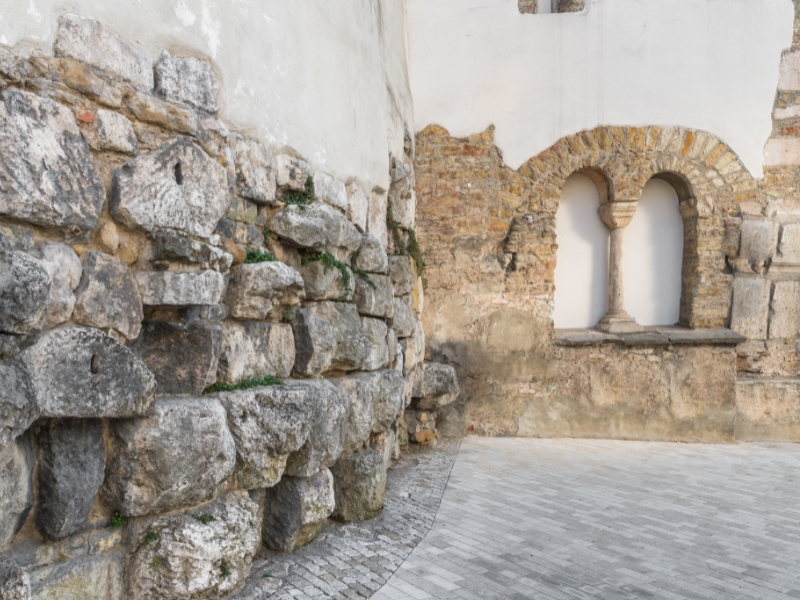
The Porta Praetoria is what is left of the northern gate of Castra Regina, the Roman legionary fortress that became Regensburg. Its stone arch and one of its towers are built into the north front of the Bischofshof, the old bishop's palace beside the cathedral. Finished in AD 179, it is the tallest Roman structure still partly standing in Bavaria.
The Porta Praetoria at a glance
- Where: Unter den Schwibbögen, on the north side of the Bischofshof, a minute's walk from Regensburg Cathedral.
- Built: completed in AD 179, under the emperors Marcus Aurelius and Commodus; uncovered again in 1885.
- What it is today: a Roman gate built into the facade of the Bischofshof, which is now a hotel and restaurant. The remains rise about 11 metres above the street, and the old town around it is a UNESCO World Heritage Site.
- Time needed: 10–15 minutes, more if you go inside the restored east tower.
From legion gate to brewery wall
In AD 179 the Romans completed a stone fortress on the Danube for the Third Italian Legion (Legio III Italica), the only legion stationed in the province of Raetia. Castra Regina, named after the river Regen, covered about 25 hectares and had room for some 6,000 soldiers. A large inscription recording that its wall, gates and towers were finished in 179 was found in two pieces in 1873 and is kept in the city's Historical Museum. The Porta Praetoria was one of four gates and faced north, towards the river and the Germanic lands beyond.
After Roman times the gate stayed in use for centuries, until the Stone Bridge was built in the 12th century and traffic moved elsewhere. In 1649 the bishop's brewery was built on top of it, and the Roman stones disappeared into its walls. Only when the brewery was demolished in 1885 did the old archway come to light again. Today four parts survive in the north wing of the Bischofshof, and the east tower was restored in 2016–2017.
What to look for
- The archway: the round arch you see is the western passage of what was once a double gateway. The eastern arch is gone; huge reused blocks fill its place.
- The east tower, preserved over its ground floor and upper floor, built straight into the facade of the later palace.
- The size of the stones: big squared blocks laid in regular courses, very different from the smaller medieval stonework around them.
- The street level: the Roman foundations lie about a metre below today's pavement, so the gate was once even taller than it looks. With roofs, its towers probably stood more than 20 metres high.
- The 'document Porta Praetoria', a small display inside the restored east tower; ask at the tourist information about access.
Why the gate faces the Danube
In a Roman camp, the porta praetoria was the main gate, the one that faced the enemy. In Regensburg that meant north: the Danube was the frontier of the empire, and the Germanic tribes lived on the other bank. Soldiers marching out of this gate were heading for the river, which is why it is only a few steps from the water today.
Tips for your visit
- Come in the morning, when the low sun from the east lights the stone and the narrow street is still quiet.
- Look for more of Roman Regensburg: a long stretch of the fortress wall is preserved in the basement car park at Dachauplatz, and the southeast corner of the fortress can be seen at Ernst-Reuter-Platz.
- The Bischofshof is a working hotel and restaurant: you can admire the gate from the street and the courtyard, but respect the guests' privacy.
Nearby
- Regensburg Cathedral (Dom St. Peter): Bavaria's great Gothic cathedral, with its two openwork spires, right behind the Bischofshof.
- Stone Bridge (Steinerne Brücke): the 12th-century bridge over the Danube, a few minutes' walk away, with the best view back over the old town.
- Old Town Hall (Altes Rathaus): where the Imperial Diet of the Holy Roman Empire met in permanent session from 1663 to 1806.
- Kepler Monument: the memorial to the astronomer Johannes Kepler, who died in Regensburg in 1630, in a small park near the station.
See Regensburg with World City Trail
Our Regensburg scavenger hunt turns the old town into a game you play on your phone. The route links 10 stops and takes around 3 hours, with about 46 minutes of walking, and includes the Kepler Monument and the Basilica of St Emmeram. You can play in English, German, French, Italian and Dutch.
If you prefer a different format, there is also a self-guided walking tour and an outdoor escape game in Regensburg.
Play the Regensburg scavenger hunt →
Take the self-guided walking tour of Regensburg →
Play the outdoor escape game in Regensburg →
Facts checked in October 2026.