
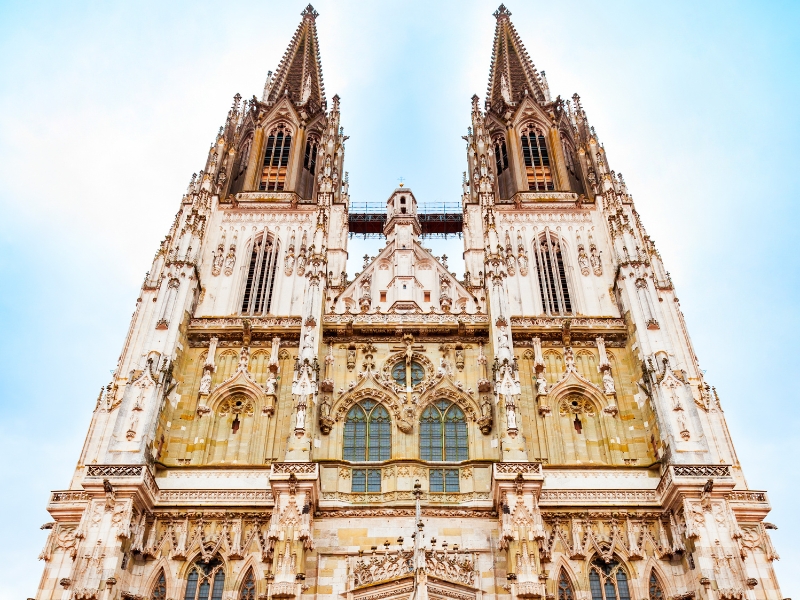
St Peter's Cathedral (Dom St. Peter) is the Gothic cathedral of Regensburg, whose twin openwork spires rise 105 metres above the old town on the Danube. It took almost 600 years to finish: work began in the 1270s, stopped for lack of money in the 16th century, and the spires were only completed in 1869. Inside, an angel carved around 1280 has been smiling at visitors ever since.
Regensburg Cathedral at a glance
- Where: Domplatz, in the middle of the old town, a few minutes' walk from the Stone Bridge.
- Built: from the 1270s, after fires destroyed the earlier cathedral; the towers were completed between 1859 and 1869, and the building was finished in 1872.
- What it is today: the cathedral of the Diocese of Regensburg and home of the Regensburger Domspatzen, the cathedral's boys' choir, which traces its history back to 975.
- Time needed: 30–45 minutes for the interior, plus time to walk around the outside.
- Good to know: it is a working church, so be quiet during services and leave sightseeing for the times in between.
Six centuries of building
The old Romanesque cathedral burned in 1272 and 1273, and Regensburg, then one of the richest trading cities in the German lands, began a new one in the latest French style. Progress was slow. The collegiate church of St John stood in the way and was only moved in the late 14th century, the nave received its roof in 1443 and part of the north tower was standing by around 1500. From 1525 the money ran out, and for more than three centuries the towers stood at half height under temporary roofs.
Completion came from Bavaria's kings. In 1835 Ludwig I had the interior 'purified', removing Baroque additions to restore the Gothic look. In 1859 King Maximilian II approved August von Voit's plan for the spires, the cathedral architect Franz Josef Denzinger directed the work, and the former king Ludwig I paid for it, insisting that both towers rise together. Ludwig died in 1868, a year before the finials were set on top on 29 June 1869. Since 1923 a state cathedral workshop, the Dombauhütte, has looked after the stonework, and by 2010 it had restored the more than 170 figures of the main portal.
What to look for
- The smiling angel: on the western crossing pillars stands an Annunciation group carved around 1280–1285 by an artist known as the Erminold Master. The archangel Gabriel smiles openly at Mary, which was unusual in sculpture of the time.
- The devil and his grandmother: two strange stone creatures sit left and right of the main portal. One, part eagle, part lion, part fish, is said to be the devil; the other, more like a dragon, his grandmother. Nobody knows their real origin or meaning.
- The west front: more than 170 figures, from saints and prophets to lions, monkeys, pigs and dragons, crowd around the main entrance.
- The stained glass: a large share of the medieval windows survives, giving the choir and nave much of their colour.
- The hanging organ: installed in 2009 on the north wall of the transept by the organ builder Rieger, it has 5,871 pipes and was described at its inauguration as the largest hanging organ in the world.
Why the cathedral took so long
A local story ties the slow building of the cathedral to the Stone Bridge, built in the 12th century. According to the legend, the cathedral's master builder and the bridge's master builder made a bet on who would finish first; the bridge builder made a pact with the devil and won, and the cathedral stayed unfinished for centuries. It is only a legend, since the bridge was finished long before the Gothic cathedral was even begun, but it is still told in the old town today.
Tips for your visit
- Look at the west front in the afternoon, when the sun lights up the portal and its figures; for the whole facade with both spires, stand at the far end of Domplatz.
- To hear the Domspatzen, check the cathedral's music schedule: the choir sings at many Sunday services during the school year.
- Combine the cathedral with the Porta Praetoria a few steps north, and finish at the Danube with the view from the Stone Bridge back to the spires.
Nearby
- Porta Praetoria: the remains of the north gate of the Roman legionary fortress, built in 179, built into a later building just north of the cathedral.
- Stone Bridge (Steinerne Brücke): the 12th-century bridge over the Danube, one of the oldest surviving stone bridges in Germany, a few minutes' walk away.
- Old Town Hall: where the Perpetual Imperial Diet of the Holy Roman Empire met from 1663 to 1806.
- Historische Wurstkuchl: the small sausage kitchen beside the Stone Bridge, a Regensburg institution for centuries.
See Regensburg with World City Trail
Our Regensburg scavenger hunt turns the old town into a game you play on your phone. The route links 10 stops and takes around 3 hours, with about 46 minutes of walking. It includes the Kepler Monument and the Basilica of St Emmeram. You can play in English, German, French, Italian and Dutch.
If you prefer a different format, there is also a self-guided walking tour and an outdoor escape game in Regensburg.
Play the Regensburg scavenger hunt →
Take the self-guided walking tour of Regensburg →
Play the outdoor escape game in Regensburg →
Facts checked in October 2026.