
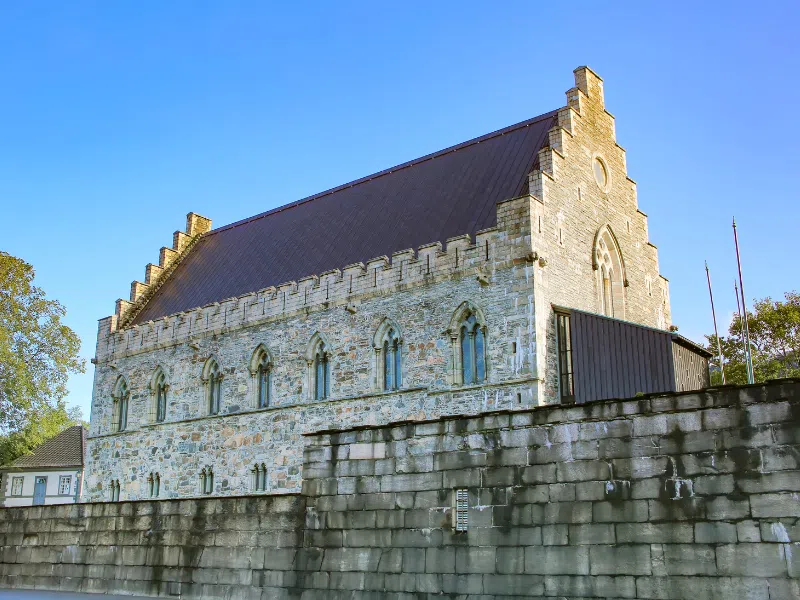
Bergenhus Fortress (Bergenhus festning) stands on the headland at the mouth of Vågen, Bergen's old harbour, just beyond the wooden houses of Bryggen. When Bergen was Norway's capital in the 13th century, the kings held court here, and King Håkon Håkonsson's great stone hall is still standing. The grounds are free to wander, but this is still a working military area under the Royal Norwegian Navy.
Bergenhus Fortress at a glance
- Where: on the north side of Vågen, at the far end of Bryggen, a few minutes' walk from the Hanseatic wharf.
- Built: from the 13th century as a royal residence on the site called Holmen; Haakon's Hall 1247–1261, Rosenkrantz Tower around 1270 (enlarged in the 1560s), curtain wall around 1520.
- What it is today: a fortress still commanded by the Royal Norwegian Navy, with open grounds, concerts on the Koengen field, and Haakon's Hall and the Rosenkrantz Tower shown as museums by the Bergen City Museum.
- Time needed: 30 minutes for the grounds, 1–1.5 hours if you go inside Haakon's Hall and the tower.
From royal Holmen to naval headquarters
In the Middle Ages the headland was called Holmen. Bergen was Norway's capital until 1299, and Holmen held the royal residence, the cathedral known as Christ Church, several other churches, the bishop's residence and a Dominican monastery. King Håkon Håkonsson built his great hall between 1247 and 1261; on 11 September 1261 it hosted the royal wedding of his son Magnus. Magnus, later called Lagabøte, the Law-mender, built the tower that would become the Rosenkrantz Tower around 1270.
Around 1520 the feudal overlord Jørgen Hanssøn built a curtain wall that turned the palace into a fortress, and in 1531 Eske Bille razed Christ Church, once the scene of coronations. In the 1560s Erik Rosenkrantz added three floors to the tower that now carries his name. During the Second World War the German navy made Bergenhus its local headquarters. On 20 April 1944 the Dutch ship Voorbode, in German service and loaded with about 120 tonnes of explosives, caught fire at the fortress quay and blew up: nearly 100 people died, thousands were injured, Haakon's Hall burned and the Rosenkrantz Tower was badly damaged. The hall was restored and reopened on 11 September 1961, 700 years to the day after the royal wedding.
What to look for
- Haakon's Hall (Håkonshallen): the largest non-church stone building from the Middle Ages in Norway, with its tall gables and a great hall on the upper floor. The 1730 stable building next to it is now the entrance.
- The Rosenkrantz Tower: look for the join between the medieval tower and the 16th-century floors added on top. Inside, a dungeon in the cellar and, when open, a roof with views over the harbour.
- The outline of Christ Church on the lawn: a low hedge traces the walls of the vanished cathedral, and a statue of St Sunniva, Bergen's patron saint, marks where the altar stood.
- The northern gate from the early 19th century, carrying a royal monogram and the year 1812.
- The seven cannons on the fortress's northern point, once for defence and now used to fire salutes.
A cannonball in the cathedral
The only battle ever fought at Bergenhus came in 1665, during the Second Anglo-Dutch War, when an English fleet attacked Dutch merchant ships sheltering in Vågen and the fortress guns joined the fight. The English were driven off. You can still see a reminder of that day across town: a cannonball from the battle is lodged in the wall of Bergen Cathedral.
Tips for your visit
- Walk out to the waterside near the saluting cannons for a view back across Vågen to Bryggen and Mount Fløyen.
- Remember that this is an active military area: respect closed gates and signs, and don't wander into fenced-off sections.
- In summer, Koengen hosts large open-air concerts; on those days parts of the grounds are busy or closed, so check what's on if you want a quiet visit.
- Combine the fortress with an early morning walk through Bryggen, before the alleys fill up.
Nearby
- Bryggen: the row of wooden Hanseatic merchant houses on the harbour, on UNESCO's World Heritage List, a few minutes' walk away.
- Bryggens Museum: built over the excavated remains of medieval Bergen, with finds from everyday life in the city, between the fortress and Bryggen.
- Fløibanen: the funicular up Mount Fløyen, for the classic view over the city and the harbour, about 10–15 minutes' walk.
- Fish Market (Torget): the harbour-side market at the head of Vågen, at the other end of Bryggen.
See Bergen with World City Trail
Our Bergen scavenger hunt turns the city centre into a game you play on your phone. The route links 10 stops and takes around 1.5 hours, with about 37 minutes of walking. Along the way it includes the National Stage (Den Nationale Scene), the Sailor's Monument and Bergen Cathedral, where you can look for that cannonball.
If you prefer a different format, there is also a self-guided walking tour and an outdoor escape game in Bergen.
Play the Bergen scavenger hunt →
Take the self-guided walking tour of Bergen →
Play the outdoor escape game in Bergen →
Facts checked in October 2026.