
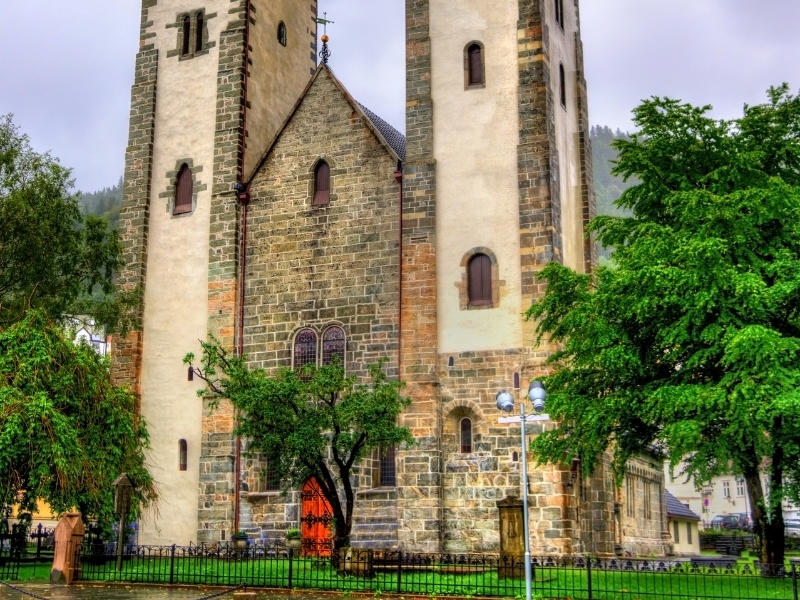
St Mary's Church (Mariakirken) is the twin-towered stone church just behind Bryggen, the old Hanseatic wharf in Bergen. Built in the 12th century, it is believed to be the oldest building still standing in the city. For more than three centuries it was the church of the German merchants who ran Bryggen, and their gifts still fill the interior, above all an extraordinary pulpit from 1676.
St Mary's Church at a glance
- Where: at the north end of Bryggen, a short walk from the harbour, next to Bryggens Museum.
- Built: mainly between the 1130s and about 1180, with the choir extended after a fire in 1248.
- What it is today: a working Church of Norway parish church, which also hosts the English-language services of the Bergen Anglican Church. It reopened in 2015 after a five-year restoration.
- Time needed: 30 minutes inside, longer if you want to study the pulpit and the altarpiece.
From royal town church to the Germans' church
Between the reign of King Olav Kyrre (1066–1093) and the end of the 12th century, Bergen gained twelve churches and three monasteries. St Mary's is the only one that survives. Its builders are unknown, though the decoration suggests influences from England and northern Italy. It is a Romanesque basilica of grey stone, mainly soapstone, with a tall nave, two lower aisles and two towers on the west front, a rare feature for a Norwegian parish church. Town fires damaged it in 1198, during an attack by the Bagler faction, and again in 1248, after which the towers were raised and the choir lengthened, with a hint of Gothic.
In 1408 the church was handed to the German merchants of the Hanseatic League, who controlled the trade in dried fish at Bryggen. It was their official church until 1766, then the parish church of Bergen's German congregation until 1874, and sermons were still preached in German until after the First World War. In 1814 it also served as a polling place for the election to Norway's constitutional assembly. The architect Christian Christie restored it in the 1860s, and a major restoration from 2010 to 2015 ended with a new organ and a reconsecration on 21 June 2015.
What to look for
- The two west towers: they are original and were repaired after the fire of 1248.
- The south portal: the grandest of the doors, late Romanesque, one of three portals each from a different medieval period.
- The pulpit: given in 1676 by the German merchants at Bryggen, and unique in Norway. Look for the tortoiseshell and lacquer work, the carved women who stand for the Christian virtues, and the half-spheres showing the northern and southern hemispheres.
- The altarpiece: a 15th-century winged altar, probably made in Lübeck, with Mary holding the infant Jesus in the centre, flanked by St Olav, St Catherine, other saints and the apostles.
- The choir: statues of the apostles and St Paul from 1634, a choir stall from 1589 and gravestones of German sea captains, merchants and pastors set into the floor.
- The faint wall paintings from the 15th century, uncovered in the 1930s: the Ascension on the north wall and Pentecost on the south wall.
An altarpiece that changes with the seasons
Most of the year the altarpiece stands open, showing Mary and the saints in gold. Its hinged wings are closed only during Advent and Lent, when the outside panels show scenes from the life of Jesus. Above it hangs a crucifix added in 1682, with a Latin inscription meaning 'All our hope is in the death of the Lord'. If you visit in the weeks before Christmas or Easter, you will see a different church from summer visitors.
Tips for your visit
- It is an active parish church, so visits pause for services, weddings and funerals; check before you go and keep your voice down inside.
- Walk round the outside first: the best view of the twin towers is from the west end, and the south side shows the carved Romanesque portal.
- Combine it with Bryggens Museum next door, which shows the remains of medieval Bergen found under the wharf, to understand who worshipped here.
Nearby
- Bryggen: the row of wooden Hanseatic buildings on the harbour, on the UNESCO World Heritage list, with narrow passages to explore.
- Bryggens Museum: built over excavations of the oldest part of Bergen, with finds from daily life in the medieval town.
- Bergenhus Fortress and Haakon's Hall: the royal stronghold at the harbour mouth, with a 13th-century stone banqueting hall.
- Rosenkrantz Tower: the 16th-century tower at Bergenhus, built around an older medieval core.
See Bergen with World City Trail
Our Bergen scavenger hunt turns the city centre into a game you play on your phone. The route links 10 stops and takes around 1.5 hours, with about 37 minutes of walking. It includes the National Stage (Den Nationale Scene), the Sailor's Monument and Bergen Cathedral.
If you prefer a different format, there is also a self-guided walking tour and an outdoor escape game in Bergen.
Play the Bergen scavenger hunt →
Take the self-guided walking tour of Bergen →
Play the outdoor escape game in Bergen →
Facts checked in October 2026.