
Perched majestically on the slopes of the Drachenfels mountain, overlooking the Rhine River, Drachenburg Castle (Schloss Drachenburg) is a breathtaking architectural marvel that transports visitors into a fairytale realm. Located just south of Bonn, near Königswinter, this opulent edifice is not a medieval fortress but a magnificent 19th-century villa, built with the romanticized grandeur of a bygone era. It stands as a testament to the dreams of a wealthy banker and offers a captivating blend of historical fantasy, stunning views, and intricate craftsmanship, making it one of the Rhineland’s most enchanting attractions.

A Dream Realized: Construction in the Late 19th Century
The vision for Drachenburg Castle belonged to Stephan von Sarter, a successful Bonn-born financier who had made his fortune in Paris. Despite his immense wealth and a knighthood, he never actually resided in the castle he commissioned. Sarter desired a monumental residence that reflected his status and a romanticized ideal of German medieval architecture, even though it incorporated various historical styles.
Construction of the castle began in 1882 and was completed in a remarkably short time, by 1884. The architects were Ernst von Ihne and Carl Schlösser, who designed a lavish structure blending elements of neo-Gothic, neo-Renaissance, and Romanesque Revival styles. It was conceived as a “Schloss” in the grandest sense, a palatial villa rather than a functional defensive castle, built purely for show and prestige. Its strategic location on the Drachenfels (Dragon’s Rock) – famously linked to the Nibelungen saga and the dragon Fafnir – further enhanced its mythical appeal.
Sarter never lived in Drachenburg, choosing to remain in Paris. The castle briefly served as a summer residence for his nephew and then passed through various hands and functions over the following decades, including a private boarding school and even a railway school in the mid-20th century.

Architectural Splendor and Exquisite Interiors
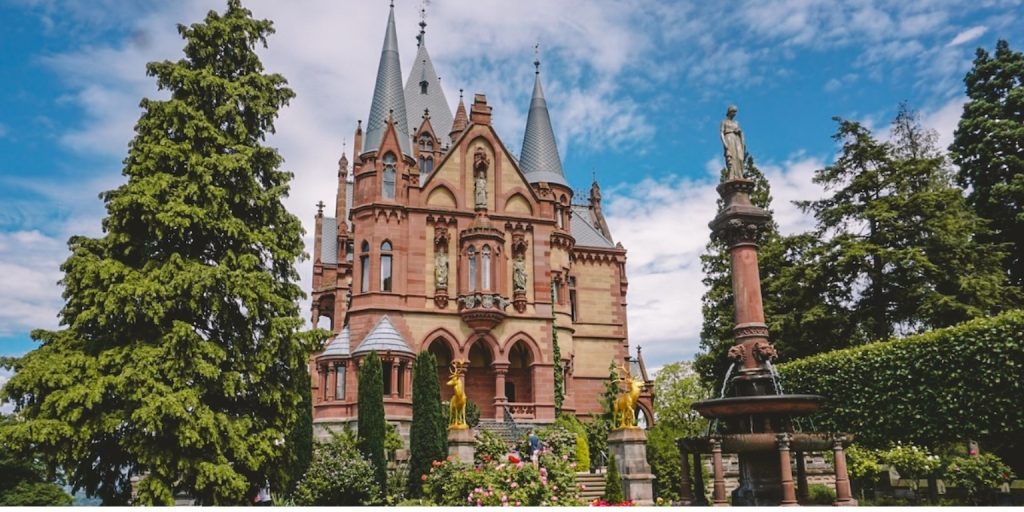
Drachenburg Castle is a feast for the eyes, both inside and out. Its exterior is characterized by an array of towers, turrets, gables, and ornate facades, seemingly plucked from a storybook. The use of varied stone, intricate carvings, and decorative elements creates a visually rich and complex silhouette against the backdrop of the Rhine Valley.
- The Hall of Knights (Rittersaal): Despite the castle not being medieval, this grand hall evokes chivalric romance with its dark wood paneling, ornate ceilings, and impressive fireplace.
- Stained Glass and Murals: Numerous rooms feature exquisite stained-glass windows depicting scenes from history and mythology, alongside richly painted murals that adorn walls and ceilings.
- Rich Furnishings: Although much of the original furniture was dispersed over time, painstaking restoration efforts have sought to recreate the opulent atmosphere of Sarter’s era.
- Belvedere: The castle offers several terraces and viewing platforms that provide spectacular panoramic vistas of the Rhine, the Siebengebirge mountains, and the surrounding landscape, including the ruins of the true medieval Drachenfels castle above.
From Decline to Glorious Restoration
After World War II, the castle suffered from neglect and damage, serving various purposes and gradually deteriorating. Its future seemed uncertain, even facing potential demolition. However, in the 1970s, a comprehensive and visionary restoration project was initiated. It was acquired by the state of North Rhine-Westphalia in 1986 and subsequently transferred to a foundation dedicated to its preservation.
The restoration, which spanned over two decades and involved extensive research and meticulous craftsmanship, aimed to return the castle to its original splendor. This monumental effort saw the painstaking reconstruction of damaged sections, restoration of frescoes, and the reacquisition of period furniture and decor, culminating in the castle’s grand reopening as a public museum and cultural attraction. The main phases of reconstruction and restoration were completed in 2009, allowing the castle to shine in its full glory.
Today, Drachenburg Castle, built between 1882 and 1884 and extensively restored by 2009, is a cherished landmark. It is easily accessible via the Drachenfelsbahn, Germany’s oldest rack railway, which transports visitors up the mountain. It hosts a variety of cultural events, exhibitions, and serves as a popular backdrop for films and photoshoots. This magnificent “dream castle” near Bonn stands as a captivating testament to 19th-century romanticism, architectural ambition, and the enduring power of historical preservation.