
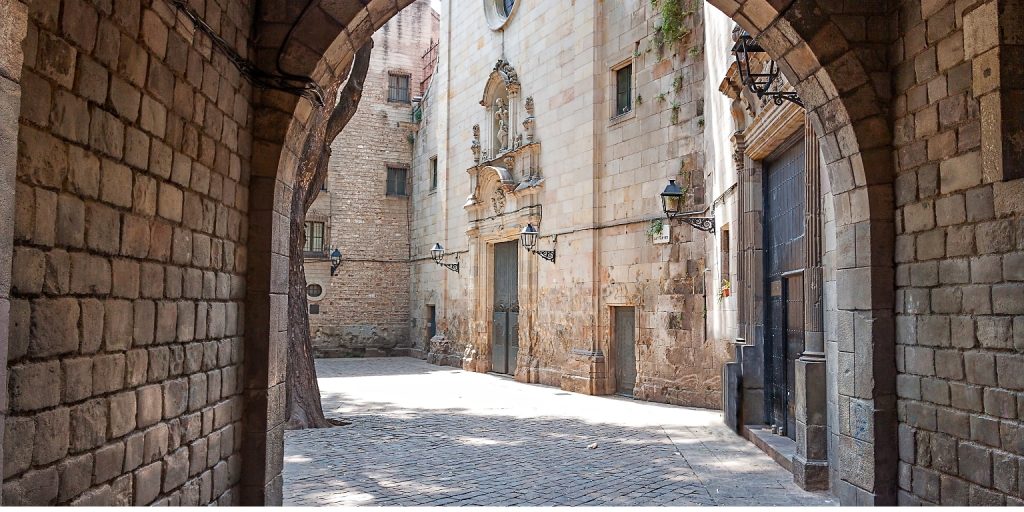
Stepping into the Gothic Quarter in Barcelona (Barri Gòtic) is like entering a time capsule, where the echoes of ancient Rome intertwine with medieval grandeur and a vibrant modern pulse. This captivating district, the oldest part of Barcelona’s Ciutat Vella (Old City), is a mesmerizing labyrinth of narrow, winding streets, hidden squares, and impressive Gothic architecture. It is the very heart of the city’s historical narrative, inviting exploration of its layered past, from Roman foundations to the seat of medieval power, making it an indispensable experience for any visitor to Barcelona.

From Roman Barcino to Medieval Powerhouse
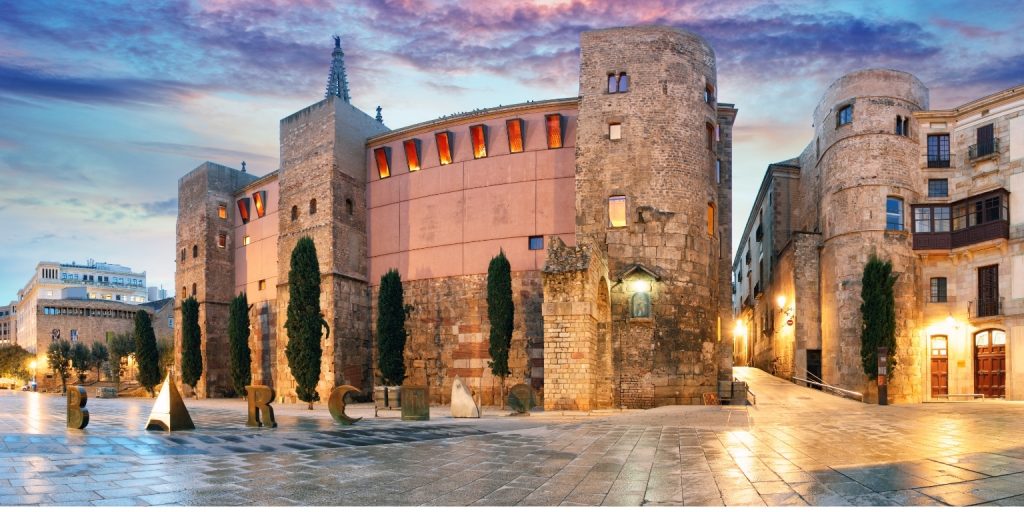
The origins of the Gothic Quarter in Barcelona stretch back over two millennia to the Roman city of Barcino, founded by Emperor Augustus around 15 BC. The layout of many of the quarter’s streets still follows the ancient Roman cardo (north-south) and decumanus (east-west) axes, and significant remnants of the original Roman walls can still be seen integrated into later buildings. The commanding columns of the Temple of Augustus, now hidden within a courtyard off Carrer del Paradís, offer a striking testament to this Roman foundation.
However, the district truly earned its name and distinct character during the Middle Ages, from the 13th to the 15th centuries. This was Barcelona’s golden age, when it rose to prominence as a powerful maritime and commercial center of the Crown of Aragon. Most of the genuinely Gothic structures date from this period, including the magnificent Barcelona Cathedral (Cathedral of the Holy Cross and Saint Eulalia), whose construction spanned from the late 13th to the mid-15th century (though its famous neo-Gothic façade was completed much later, in the late 19th and early 20th centuries).
The Plaça del Rei (King’s Square) is another medieval gem, a perfectly preserved royal courtyard surrounded by genuinely Gothic and Renaissance buildings, including the Palau Reial Major (the former royal palace of the Counts of Barcelona and Kings of Aragon) and the Saló del Tinell (a grand ceremonial hall). The adjacent Plaça Sant Jaume has been the city’s political hub for centuries, standing on the site of the ancient Roman forum and still housing the Generalitat de Catalunya (Catalan Government) and the City Hall.
A Mix of Authentic and Neo-Gothic Charms
It is important to note that while the Gothic Quarter in Barcelona boasts genuine medieval roots, much of what visitors see today is a product of extensive restoration and “neo-Gothic” embellishment undertaken, particularly in the late 19th and early 20th centuries. This period saw a deliberate effort to reconstruct and “medievalize” the district, often filling in gaps or replacing less distinguished buildings with structures designed in a Gothic style.
A prime example is the iconic Pont del Bisbe (Bishop’s Bridge), an ornate archway connecting the Casa dels Canonges (Canon’s House) to the Palau de la Generalitat. Despite its appearance, this bridge was built relatively recently, in 1928, designed by architect Joan Rubió i Bellver to enhance the Gothic ambiance. These additions, while not medieval, contribute significantly to the quarter’s unique, romantic atmosphere and historical narrative. The former Jewish Quarter (Call Jueu), a maze of narrow alleys around Carrer del Call, also preserves traces of its medieval past, though many buildings have been altered over time.
A Labyrinth of Discovery and Modern Life
Today, the Gothic Quarter in Barcelona is a captivating blend of past and present. Its pedestrianized streets invite endless exploration, leading visitors through hidden courtyards, past ancient Roman walls, and into lively squares where street performers entertain and locals gather for tapas. Charming boutiques, artisan workshops, traditional Catalan restaurants, and lively bars now occupy the ground floors of centuries-old buildings, creating a dynamic contrast.
As dusk falls, the quarter transforms, taking on a mysterious and romantic aura as gas lamps illuminate the ancient stone walls. It’s a place where every turn reveals a new detail, from a weathered gargoyle to a quiet cloister. The Gothic Quarter in Barcelona, with its foundations stretching back to 15 BC, its true Gothic flourishing in the 13th-15th centuries, and its significant restoration in the early 20th century, remains the historical and spiritual heart of the city, offering an unforgettable journey through time.