
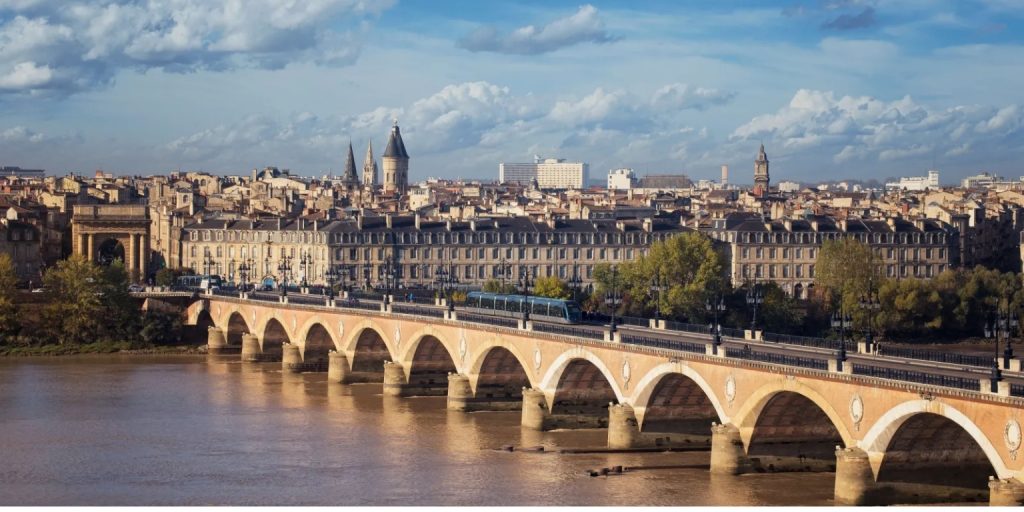
The Pont de Pierre (Stone Bridge) is more than just a crossing; it is an iconic symbol of Bordeaux, elegantly spanning the mighty Garonne River and connecting the city’s historic left bank with the dynamic right bank. Commissioned by Napoleon I and completed in the early 19th century, this majestic bridge was a monumental engineering feat for its time and remained the sole bridge across the Garonne in Bordeaux for over a century. Today, the Pont de Pierre in Bordeaux stands as a testament to resilience, strategic vision, and architectural beauty, offering breathtaking views and a direct link to the city’s rich past.
Napoleon’s Vision: Overcoming the Garonne
For nearly two millennia, the wide, tidal, and often turbulent Garonne River posed a formidable natural barrier, preventing direct land connection between Bordeaux’s two banks. Trade and movement across the river relied solely on ferries, a bottleneck that increasingly hindered the city’s growth and strategic importance.
The impetus for constructing the first permanent bridge came from Emperor Napoleon I. During his military campaigns in Spain in the early 19th century, he recognized the urgent need for a more efficient way to move troops and supplies across the Garonne. He issued the decree for its construction in 1810.
The project was led by engineers Claude Deschamps and Jean-Baptiste Basilide Billaudel. The construction, which began in 1819 and was completed in 1822, faced immense challenges due to the Garonne’s strong currents and significant tidal range. Innovative techniques were employed, including the use of a diving bell to stabilize the bridge’s foundations on the riverbed. Despite the difficulties and interruptions (including Napoleon’s abdication), the work persevered. The bridge was inaugurated in 1822, shortly after Napoleon’s death, and was initially named Pont Louis XVIII before being popularly known as the “Pont de Pierre” due to its robust stone and brick construction.
Architectural Grandeur and Symbolic Details
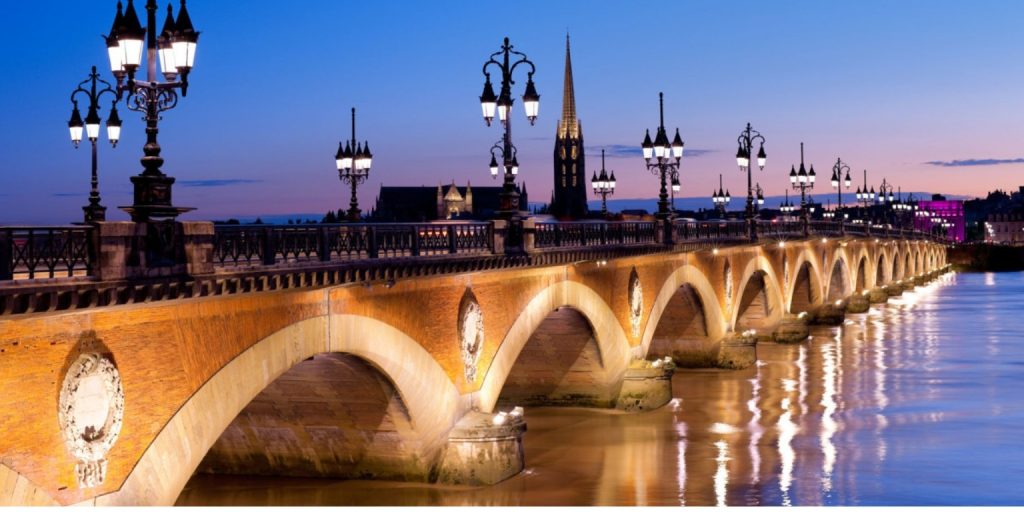
The Pont de Pierre in Bordeaux is a masterpiece of early 19th-century engineering and neoclassical design. It measures approximately 486 meters (1,594 feet) in length and is distinguished by its 17 elegant arches. A popular legend, though historically unconfirmed, claims that the number of arches corresponds to the number of letters in “Napoleon Bonaparte.” Each of the bridge’s piers is adorned with a white medallion bearing three intertwined crescents, symbolizing the coat of arms of Bordeaux (the Port of the Moon).
The bridge was cleverly designed with a hollow structure, incorporating internal galleries for maintenance and for housing measuring devices that monitor its stability – a testament to the ingenuity required to build on such a challenging riverbed. In 2002, the Pont de Pierre was classified as a French Historical Monument, recognizing its significant architectural and historical value.
A Living Landmark: Adapting to Modernity
For over 140 years, until 1965, the Pont de Pierre remained the only bridge connecting the two banks of the Garonne in Bordeaux, playing an instrumental role in the city’s development, particularly the expansion of its right bank. Over the decades, it underwent several modifications to accommodate increasing traffic, including widening works in 1924.
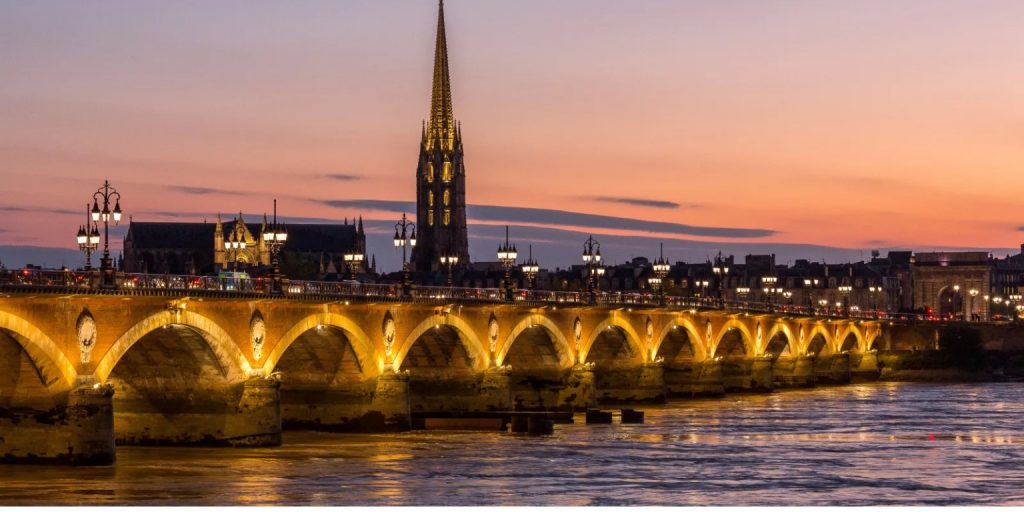
In recent years, the Pont de Pierre in Bordeaux has undergone another significant transformation to preserve its integrity and enhance the urban experience. Since 2018, it has been closed to private vehicular traffic. This decision, part of Bordeaux’s commitment to sustainable urban mobility and pedestrian-friendly spaces, has transformed the bridge into a vibrant promenade exclusively for pedestrians, cyclists, and public transport (trams and buses). This allows for a more leisurely appreciation of its architecture and the stunning views it offers.
Today, strolling across the Pont de Pierre is a quintessential Bordeaux experience. From its vantage point, visitors can enjoy panoramic views of the Garonne, the UNESCO World Heritage-listed Port de la Lune, the iconic Place de la Bourse with its Water Mirror, and the evolving skyline of the right bank. Especially at sunset, when the golden light bathes the stone and the city lights begin to twinkle, the Pont de Pierre in Bordeaux becomes a truly magical place, embodying the enduring connection between this magnificent city and its life-giving river.