
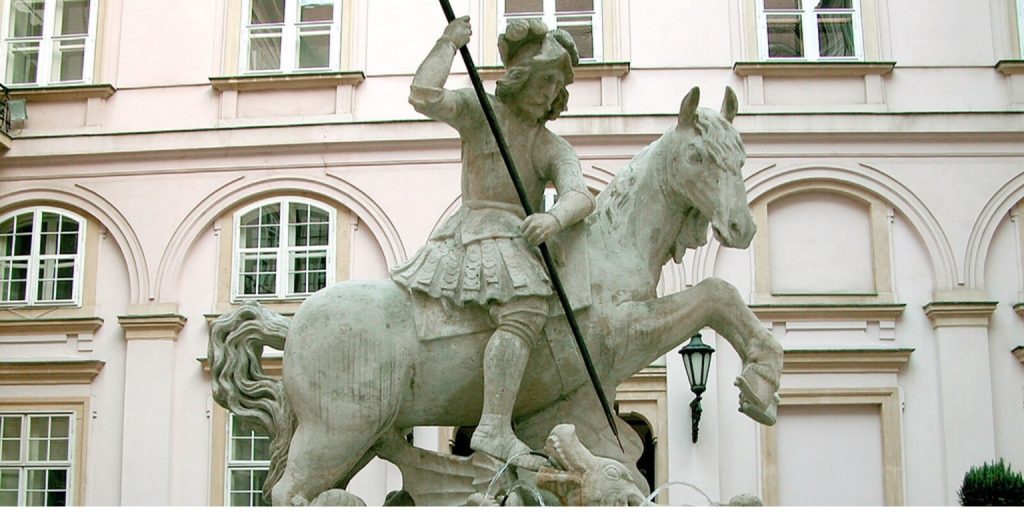
The Fountain of St George stands in the square inner courtyard of the Primate's Palace in Bratislava's old town: a Baroque sandstone group of the saint on a rearing horse, driving his lance into a dragon coiled round the horse's leg. It was made in the mid-17th century for the archbishops' famous garden outside the city walls, and the rider is said to have the features of Archbishop Juraj Lippay. Only around 1930 did it move to the palace courtyard, where most visitors find it by chance.
The St George Fountain at a glance
- Where: in the inner courtyard of the Primate's Palace on Primaciálne námestie, reached through the palace entrance hall, a minute's walk from the Main Square.
- Created: in the mid-17th century; moved to the palace courtyard around 1930.
- By: designed under Archbishop Juraj Lippay; the stonemason is unknown, and the dragon heads were later reconstructed by the sculptor Alojz Rigele.
- What it is today: a fountain in the courtyard of the palace that houses the office of the mayor of Bratislava.
- Time needed: 10 minutes for the courtyard, an hour if you also visit the palace's state rooms.
From the archbishops' garden to the palace courtyard
When the Ottomans occupied Esztergom in the 16th century, the archbishops of Esztergom, the heads of the Church in Hungary, moved to Bratislava, then called Pressburg. On the slopes north of the town they created a large ornamental garden that became famous across Europe; the Jesuit scholar János Lippay wrote a three-volume description of it, one of the first gardening books in Hungarian. The St George group was made for this garden in the mid-17th century, during the time of Archbishop Juraj Lippay.
The garden later disappeared, and the land where it lay is associated with the grounds of the Grassalkovich Palace. The fountain was moved to the courtyard of the Primate's Palace around 1930. The palace itself was built in 1778–1781 on land belonging to the archbishops of Esztergom, for Cardinal József Batthyány. In its Hall of Mirrors, France and Austria signed the Peace of Pressburg on 26 December 1805, after Napoleon's victory at Austerlitz.
What to look for
- The horse: St George sits on a rearing horse, the figure slightly smaller than life size, frozen at the moment of the strike.
- The dragon: the creature coils round the horse's leg as the lance goes in. Its heads were reconstructed later by Alojz Rigele.
- The rider's face: tradition says St George was given the features of Archbishop Juraj Lippay, the patron of the garden it was made for.
- The courtyard: the square, arcaded inner yard of the palace, a quiet space just steps from the busy old-town streets.
- The cardinal's hat: back on the square, look up at the palace roof, where an iron model of a cardinal's hat weighing 150 kg crowns the pediment.
Two stories behind the dragon
The fountain has collected more than one meaning. Historians see the scene as a symbol of the Catholic Church's fight against the Reformation: the 17th-century archbishops of Esztergom were leading figures of the Counter-Reformation in Hungary, and a saint defeating a dragon was a clear message. Local legend tells a gentler story, linking the statue to a maiden named Dubravka, saved from the dragon by the brave knight. Neither tale changes what you see, but both explain why the dragon is so firmly beaten.
Tips for your visit
- Walk in through the main entrance of the palace on Primaciálne námestie; the courtyard is easy to miss from outside.
- The palace is a working city hall, so be discreet, and check before you go, as access can be restricted during official events.
- If you have time, visit the state rooms upstairs: the Hall of Mirrors and the 17th-century English tapestries woven at Mortlake, rediscovered during a reconstruction in 1903.
- Combine the fountain with the Main Square and the Old Town Hall, both a minute away.
Nearby
- Main Square and the Old Town Hall: the centre of the old town, with the Maximilian (Roland) Fountain and the colourful tower of the Old Town Hall.
- Čumil: the bronze sewer worker peeking out of a manhole on Panská and Rybárska brána, a few minutes' walk away.
- Michael's Gate: the only preserved gate of the medieval town fortifications, at the end of Michalská street.
- Blue Church: the Art Nouveau Church of St Elizabeth, painted in pale blue, about 10 minutes' walk away.
See Bratislava with World City Trail
Our Bratislava scavenger hunt turns the old town into a game you play on your phone. The route links 10 stops and takes around 2 hours, with about 31 minutes of walking, and includes places such as the Blue Church and St Martin's Cathedral.
If you prefer a different format, there is also a self-guided walking tour and an outdoor escape game in Bratislava.
Play the Bratislava scavenger hunt →
Take the self-guided walking tour of Bratislava →
Play the outdoor escape game in Bratislava →
Facts checked in October 2026.