
In the heart of Innsbruck, within the solemn confines of the Hofkirche (Court Church), lies one of Europe’s most extraordinary and poignant funerary monuments: The Empty Tomb of Maximilian I. This magnificent cenotaph, envisioned by Emperor Maximilian I himself as his final resting place, is a colossal testament to Habsburg imperial ambition and artistic patronage. Ironically, despite its grandeur and the legions of bronze figures guarding it, the tomb remains empty, making it a powerful symbol of unfulfilled desires and the capricious nature of history. A visit to The Empty Tomb of Maximilian I in Innsbruck offers a fascinating journey into the mind of a Renaissance monarch and the unparalleled artistry of his era.
A Grand Vision Never Realized
Emperor Maximilian I (1459-1519), often dubbed “the Last Knight” for his blend of medieval chivalry and Renaissance intellectualism, was keenly aware of his own legacy. Throughout his reign, he meticulously planned his eternal memorial, intending it to be a monumental tribute to his life, his lineage, and the glory of the Habsburg dynasty. His initial desire was to be buried in the castle chapel in Wiener Neustadt, where he had already established a modest tomb.
However, the scale of the memorial he envisioned quickly outgrew the humble confines of the Wiener Neustadt chapel. Maximilian commissioned a vast array of bronze figures and marble reliefs, work on which began during his lifetime in the early 16th century. By the time of his death in 1519, this ambitious project was far from complete. His will stipulated that he be buried simply beneath the altar in Wiener Neustadt, and indeed, his remains were laid to rest there.
It was his grandson, Emperor Ferdinand I, who decided to bring Maximilian’s grand vision to fruition, albeit in a different location. Recognizing the artistic and dynastic importance of the project, Ferdinand I ordered the construction of a dedicated church in Innsbruck to house the elaborate tomb. This new church, the Hofkirche, was completed by 1553, nearly 35 years after Maximilian’s death. Despite the creation of this magnificent setting, Maximilian’s remains were never transferred to Innsbruck, leaving his meticulously crafted tomb monument perpetually empty – a cenotaph.
The “Schwarze Mander”: Guardians of the Empty Throne
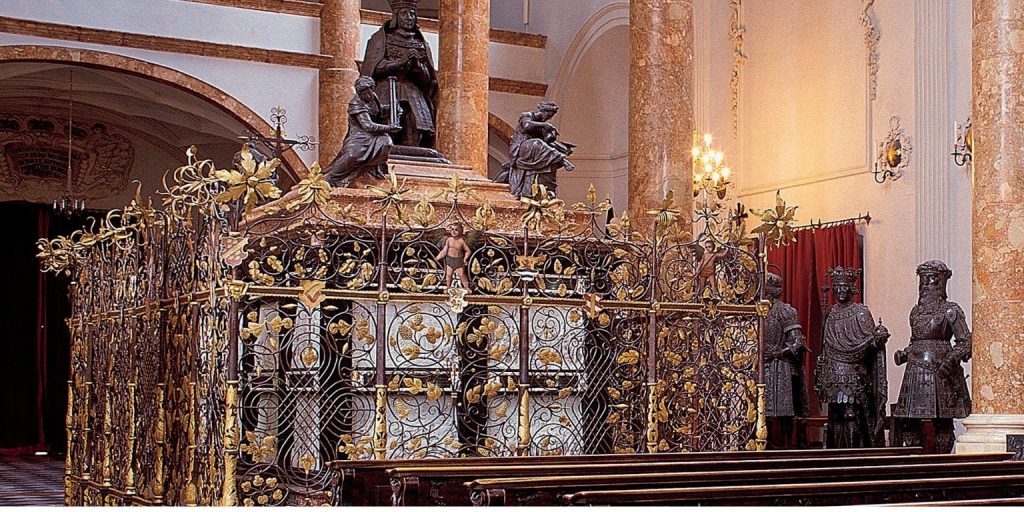
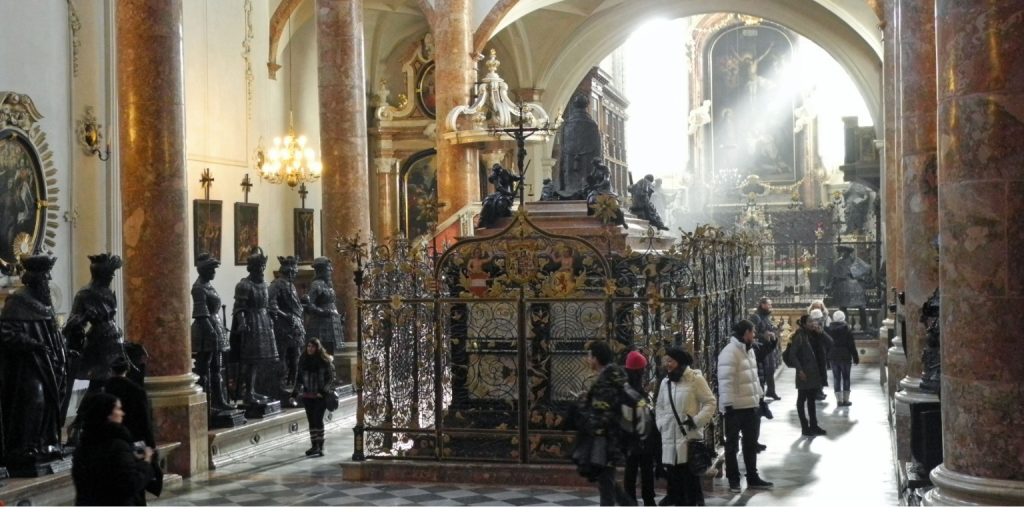
The central feature of The Empty Tomb of Maximilian I in Innsbruck is the immense, ornate sarcophagus located in the nave of the Hofkirche. It is surrounded by 28 larger-than-life bronze statues, famously known as the “Schwarze Mander” (Black Men), though eight of them are, in fact, women. These imposing figures, cast between 1502 and 1555, represent Maximilian’s ancestors, real and mythical heroes, and key figures from his imperial lineage, including King Arthur, Godfrey of Bouillon, and even his two wives, Maria of Burgundy and Maria Sforza.
These “Black Men” are masterpieces of High Renaissance bronze casting, showcasing incredible detail in their armor, clothing, and facial expressions. The artists involved in the creation of Empty Tomb of Maximilian I included renowned sculptors like Peter Vischer the Elder and Stephan Godl, with some designs even attributed to Albrecht Dürer. They were originally planned to number 40, symbolizing a grand processional escort for the deceased emperor. Their dark, almost mystical presence gives the Hofkirche its popular nickname, the “Schwarzmanderkirche.”
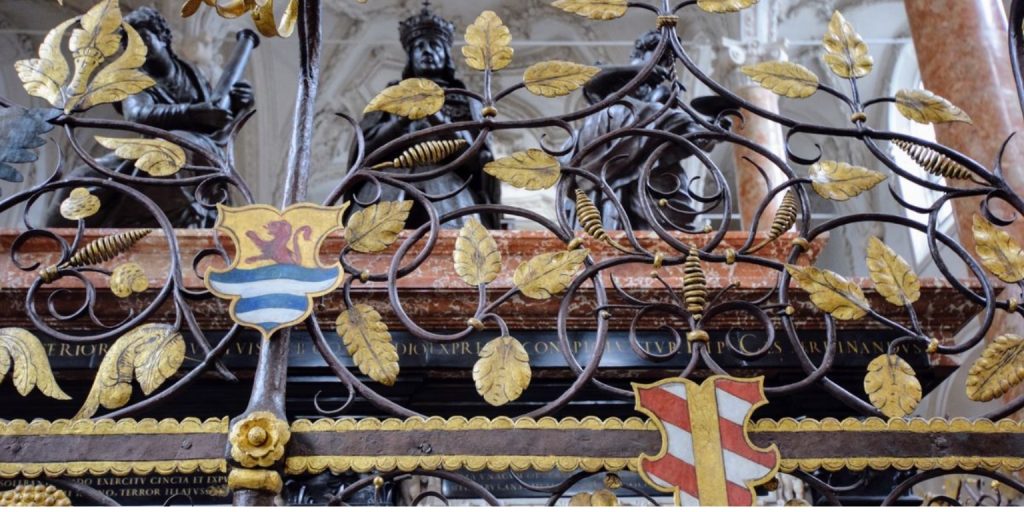
The sarcophagus itself, made of black Hagau marble, is adorned with 24 exquisite white marble reliefs depicting significant events from Maximilian’s life and reign, such as his marriage to Mary of Burgundy and various military victories. These reliefs, created by Alexander Colin based on woodcuts from Dürer’s “Triumphal Arch,” are considered some of the finest examples of Renaissance sculpture in Austria. Above the sarcophagus, a kneeling bronze figure of Maximilian, deep in prayer, watches over his own magnificent but vacant resting place.
A Legacy Beyond Burial
The Empty Tomb of Maximilian I in Innsbruck is more than just a funerary monument; it is an enduring symbol of ambition, artistry, and the complexities of power. It represents Maximilian’s profound desire for an “eternal memory” that transcended even his physical presence. The Hofkirche itself, designed to house this immense work, also contains other significant tombs, including that of the Tyrolean national hero Andreas Hofer, and the Silver Chapel, the burial place of Archduke Ferdinand II and his wife Philippine Welser.
Located at Universitätsstraße 2, 6020 Innsbruck, the Hofkirche, with its stunning cenotaph and the legendary Schwarze Mander, remains one of Innsbruck’s most compelling attractions. It offers a unique opportunity to witness one of Europe’s most ambitious imperial projects, a grand monument to a powerful emperor, where the story is perhaps even more captivating precisely because the tomb intended for him remains, beautifully, eternally empty.