
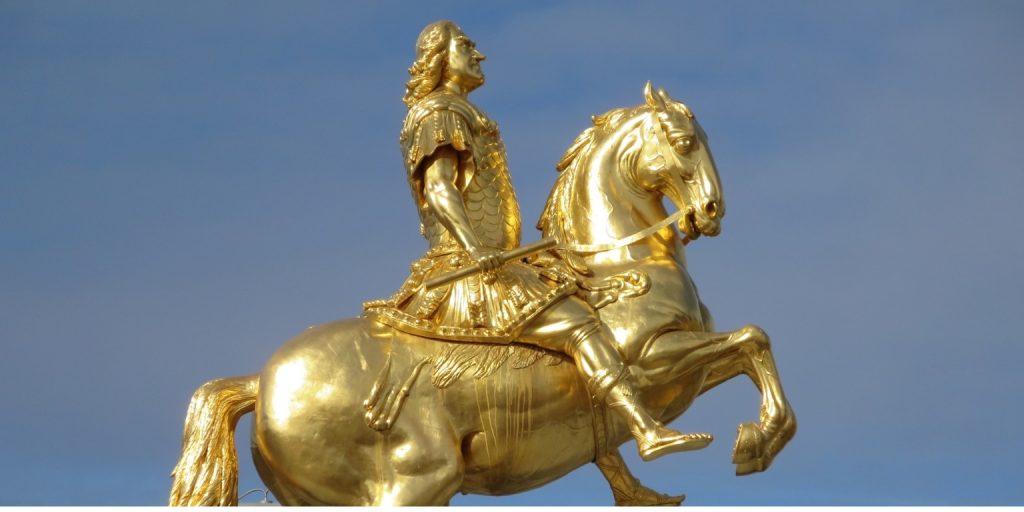
Dominating the historic Neustädter Markt in Dresden’s New Town, stands one of the city’s most iconic and resplendent landmarks: the Statue of Augustus the Strong. Universally known as the Goldener Reiter (Golden Rider), this gilded equestrian statue is a magnificent testament to the Baroque splendor and the powerful legacy of Augustus II the Strong, who, as Elector of Saxony and King of Poland, transformed Dresden into a leading European capital of art and culture. The Statue of Augustus the Strong in Dresden is not merely a monument; it is a symbol of regal power, artistic ambition, and the city’s enduring resilience.
A Royal Tribute Unveiled in 1736
The creation of the Golden Rider was commissioned by Augustus the Strong’s son, Augustus III, to honor his illustrious father. The design was conceived by the French court sculptor Jean Joseph Vinache (1696-1754). The statue itself was cast in copper in 1734 by the Augsburg smith Ludwig Wiedemann, who meticulously applied gold leaf to its surface, giving it its characteristic brilliant gleam.
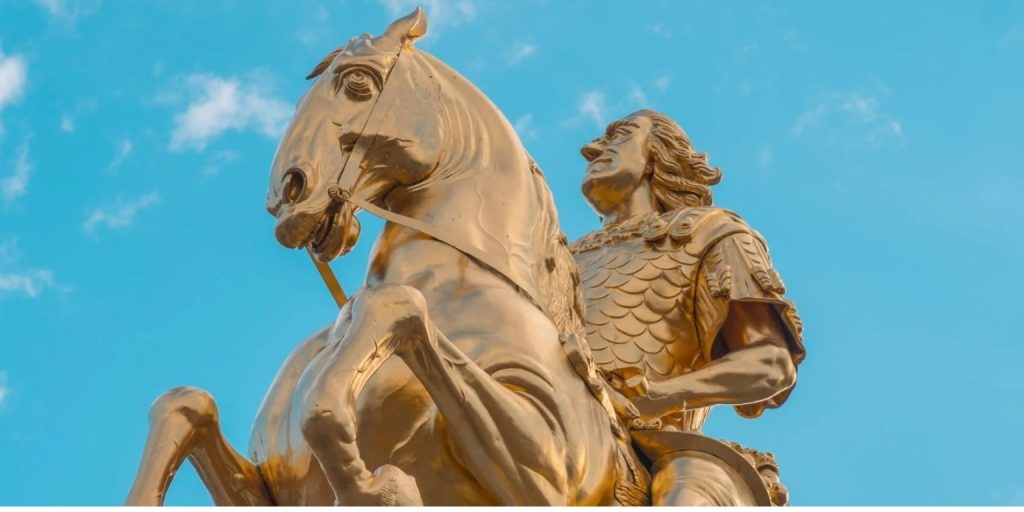
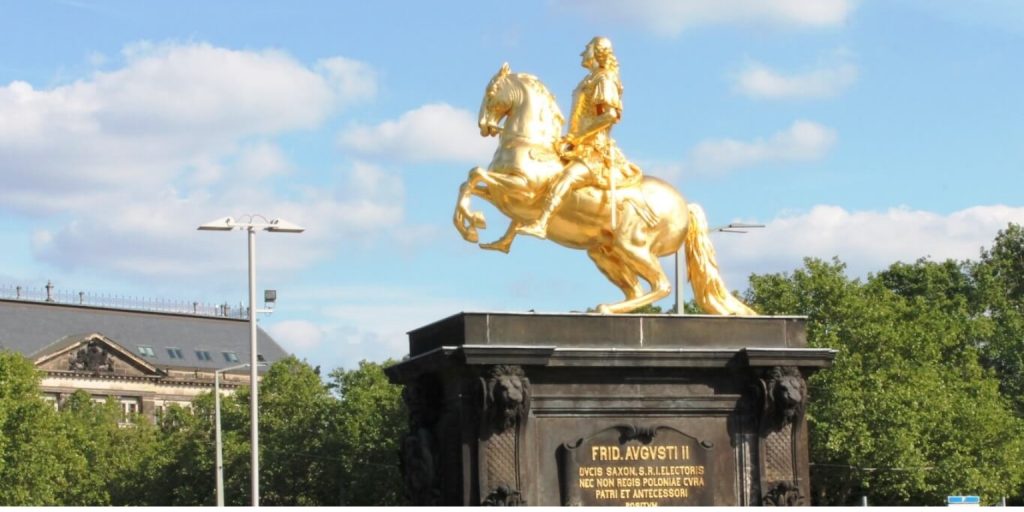
The unveiling of the statue took place in 1736 at the Neustädter Markt, where it has stood ever since. It depicts Augustus the Strong in the majestic pose of a Roman emperor or a conquering hero, clad in Roman armor, proudly mounted on a rearing horse. The unique orientation of the statue is significant: Augustus is shown riding towards the northeast, symbolically heading towards his other kingdom, Poland. This powerful imagery served to reinforce his dual monarchy and his ambition. The large pedestal on which the statue rests was completed much later, in 1884, enhancing its monumental presence.
Augustus the Strong: Architect of Dresden’s Golden Age
The man immortalized by the Golden Rider was Elector Frederick Augustus I of Saxony, better known to history as Augustus the Strong (1670–1733). His reign was a pivotal period for Dresden, marked by an unparalleled explosion of artistic, architectural, and cultural development. Augustus possessed an insatiable appetite for beauty, a keen eye for talent, and the political will and wealth to fund extravagant projects.
Under his patronage, Dresden became known as the “Florence on the Elbe.” He amassed incredible art collections, including the world-renowned Green Vault (Grünes Gewölbe) and the Porcelain Collection, driven by his personal “maladie de porcelaine” (porcelain sickness) which led to the invention of European hard-paste porcelain at Meissen. He commissioned iconic Baroque structures such as the Zwinger palace, the Frauenkirche (though its reconstruction was after his death, its spirit was very much a part of his vision), and numerous other palaces and churches that define Dresden’s skyline. The Statue of Augustus the Strong stands as a visual summation of his efforts to transform his capital into a center of European Baroque culture and power.
Resilience and Rebirth
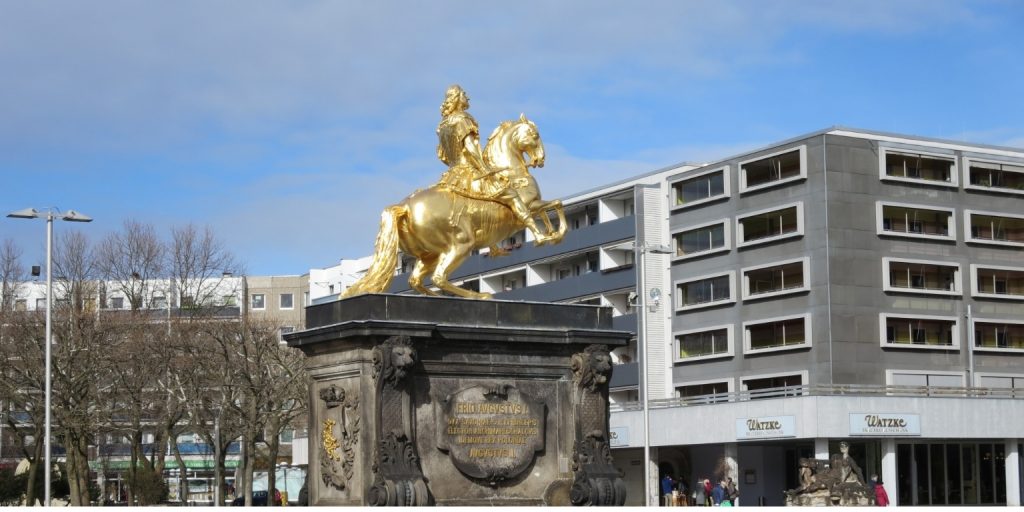
The history of the Golden Rider is also a testament to Dresden’s resilience. During the devastating Allied bombing raids in February 1945, which flattened much of the city, the statue miraculously escaped destruction. It had been prudently dismantled in 1944 and stored in an underground cave near Pillnitz.
After the war, a painstaking three-year restoration process brought the statue back to its former glory. It was triumphantly re-erected at Neustädter Markt in 1956, just in time for Dresden’s 750th anniversary. This return symbolized not only the city’s commitment to preserving its heritage but also its incredible capacity for regeneration from the ashes of war.
A Beacon in the Neustadt
Today, the Statue of Augustus the Strong in Dresden continues to be a central meeting point and a major tourist attraction. It stands at the intersection of Hauptstraße, a popular pedestrian boulevard, and just across the Augustus Bridge from the historic Altstadt (Old Town). Its golden gleam reflects in the sunlight, drawing the eyes of countless visitors and serving as an unmistakable emblem of Dresden’s rich past.
The Golden Rider, sculpted by Jean Joseph Vinache and inaugurated in 1736, is more than a mere statue; it’s a living monument to the man who shaped Dresden’s Baroque identity and a powerful symbol of the city’s enduring spirit through centuries of triumph and adversity.