
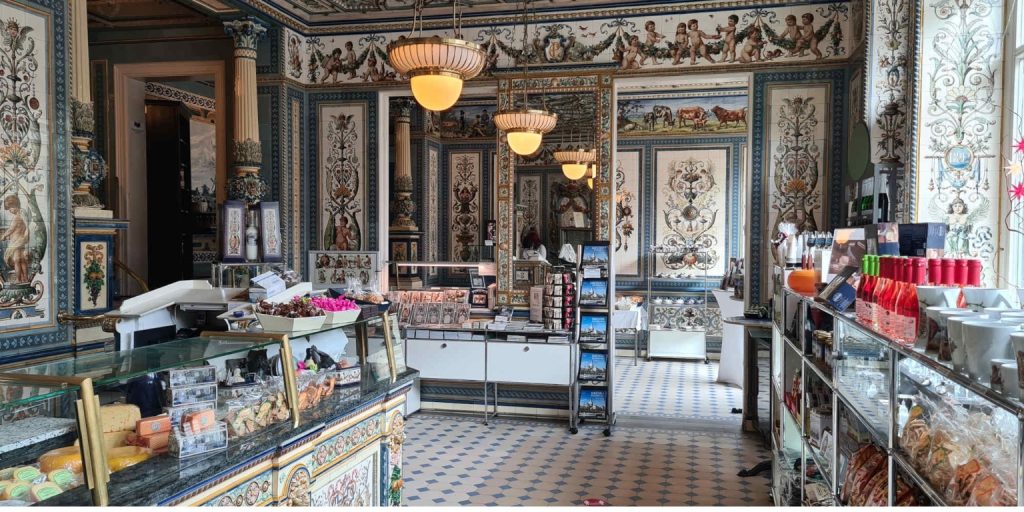
Pfunds Molkerei is a small dairy shop on Bautzner Straße in Dresden's Neustadt, and every surface of it, walls, ceiling and floor, is covered in hand-painted tiles from 1892. It was opened by the Pfund brothers, whose dairy was the first in Germany to make condensed milk, and in 1997 the Guinness Book of Records listed it as the most beautiful dairy shop in the world. It still sells milk and cheese today.
Pfunds Molkerei at a glance
- Where: Bautzner Straße 79 in the Äußere Neustadt, on the north bank of the Elbe.
- Opened: the tiled shop opened in autumn 1892, in the company's main building of 1891; the dairy itself was founded in 1880.
- By: the brothers Paul and Friedrich Pfund; the tiles were designed by artists of Villeroy & Boch and painted by hand.
- What it is today: a working shop selling cheese, milk and dairy products, and one of the best-known interiors in Dresden.
- Time needed: 15–30 minutes, longer if you stop for a glass of milk at the counter.
Six cows and a milk empire
In 1879 the farmer Paul Pfund moved to Dresden with his family, six cows and a few pigs. In 1880 he and his brother Friedrich founded a dairy, at a time when the growing city badly needed clean, safe milk. The business grew fast: the company says it processed 500 litres a day in its first year and 40,000 litres a day by 1895. The Pfunds were pioneers of pasteurisation, the first in Germany to produce condensed milk, and also made baby food and milk soap. The shop at Bautzner Straße 79 was the showpiece of the business, and its tiles were meant to suggest cleanliness as much as luxury.
The family lost the firm to the state. The shop was placed under a preservation order in 1966, which helped save the interior, and on 1 May 1972 the GDR expropriated the company, which became VEB Dresdner Molkerei and was closed in 1978. A plan to replace the old wall tiles with plastic panels was never carried out. After German reunification the heirs regained their rights, and the shop reopened in 1995. Fewer than 5 percent of the tiles had to be replaced, and Villeroy & Boch made the new ones at its factory in Mettlach.
What to look for
- The ceiling: look straight up. The tiles carry on overhead, framed by painted borders, so the room feels like a tiled box.
- The painted pictures among the tiles: cherubs, scrolls and ornament in the Neo-Renaissance style, with painted scenes set into the walls.
- The floor, also tiled, in patterns that match the walls.
- The repairs: when the shop was restored, fewer than one tile in twenty had to be remade. See if you can spot any of the newer Mettlach tiles among the 1892 originals.
- Milk soap on the shelves: it is still made to the original recipe, a link to the Pfunds' own product range.
The most beautiful dairy shop in the world?
The title comes from the Guinness Book of Records, which entered the shop under that name in November 1997. It is not a contest that anyone else enters every year, so treat it as a fun label rather than a ranking. Still, few people walk in without looking up for a long minute. It is worth knowing that tile shops like this were once a sign of modern hygiene: smooth, washable surfaces showed customers that the milk was safe.
Tips for your visit
- Come early in the day or on a weekday. The shop is small, and tour groups and queues can fill it quickly.
- It is a working shop, not a museum. Photo rules are posted at the door; follow them and let paying customers reach the counter.
- Order a glass of milk or buttermilk at the counter, or buy a piece of Saxon cheese to take away. It is the best way to see the room without rushing.
- Combine it with a walk through the Neustadt: the streets around Alaunstraße and Görlitzer Straße are full of cafés and street art.
Nearby
- Kunsthofpassage: a set of linked courtyards in the Neustadt with themed façades, including the Courtyard of the Elements, where rainwater runs down a wall of pipes and funnels.
- Albertplatz and the Erich Kästner Museum: the round square at the centre of the Neustadt, with a small museum about the author of Emil and the Detectives, who grew up nearby.
- Bautzner Straße Memorial: the former Soviet and Stasi remand prison further along the same street, now a memorial to political prisoners.
- The Elbe meadows: walk down to the river for the classic view across the water to the Old Town's domes and towers.
See Dresden with World City Trail
Our Dresden scavenger hunt turns the Old Town into a game you play on your phone. The route links 10 stops and takes around 2 hours, with about 24 minutes of walking, and includes places such as the Zwinger, the Frauenkirche and the Semperoper, across the river from Pfunds.
If you prefer a different format, there is also a self-guided walking tour and an outdoor escape game in Dresden.
Play the Dresden scavenger hunt →
Take the self-guided walking tour of Dresden →
Play the outdoor escape game in Dresden →
Facts checked in October 2026.