
In the grand Piazza Verdi, in front of the magnificent Teatro Massimo, stands an architectural gem that often goes unnoticed by the casual tourist. The Chiosco Ribaudo al Massimo in Palermo is more than a simple kiosk; it is a stunning piece of late 19th-century urban design, a testament to the city’s rich cultural history. While often confused with other kiosks of the same name, this specific structure is a masterpiece of Art Nouveau, a graceful and enduring symbol of the Belle Époque when Palermo was a dazzling hub of European high society and cultural life.

A Masterpiece by Ernesto Basile
The story of the kiosk is deeply intertwined with the architectural vision of Ernesto Basile, one of Italy’s foremost architects of the Art Nouveau (or Liberty style, as it’s known in Italy). Basile was the genius behind the completion of the Teatro Massimo, and as part of his work, he designed elegant street furniture to enhance the urban landscape. In 1896, he created two magnificent kiosks to stand in front of the theatre, one of which is the Chiosco Ribaudo.
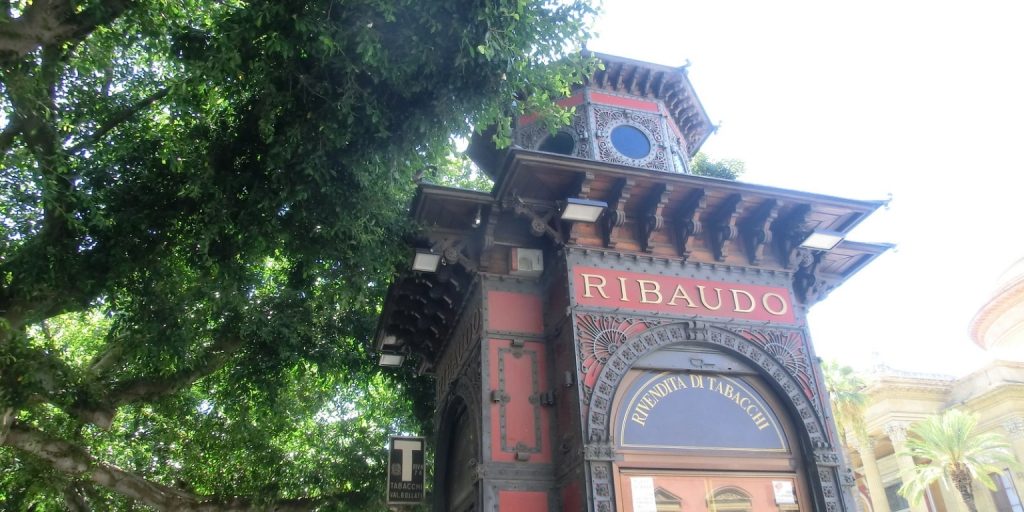
Basile’s design for the kiosk is a captivating blend of influences. It marries the flowing, organic lines of Art Nouveau with intricate Moorish and Victorian colonial details, reflecting Sicily’s complex cultural heritage. The structure is a beautiful composition of elegant wrought iron and carved wood, a symphony of curved lines and decorative flourishes. It was built not just as a functional space but as a work of art, a perfect small-scale complement to the grand neoclassical opera house it faces.
A Change of Purpose
The original purpose of the Chiosco Ribaudo was to serve the public with traditional refreshing beverages, newspapers, and even theatre tickets. These kiosks were a social focal point, where locals would gather to enjoy a cold drink, catch up on the day’s news, and simply watch the world go by. The vendors specialized in traditional Sicilian drinks, such as schiacciata (a simple, refreshing concoction of lemon, water, and salt) or gingerino (a non-alcoholic aperitif), offering a taste of authentic local life for just a few coins.
Over the decades, as urban life and commercial needs changed, the kiosks were repurposed. Today, the Chiosco Ribaudo no longer serves the classic cold drinks of its past. Instead, it operates as a tobacconist and newsagent, a small, functional shop that, while still serving the public, has left its original purpose behind. This change is a quiet reminder of how a city evolves, yet the beauty of the kiosk’s architecture ensures that its historical significance is never lost.

A Symbol of Palermo’s Identity
The Chiosco Ribaudo al Massimo is more than just a convenient place to buy a newspaper. It is a symbol of a golden age, a period when Palermo was at the height of its artistic and economic power. The Liberty style that flourished here, championed by Basile and his contemporaries, created some of the city’s most beautiful and enduring landmarks. The kiosks stand as a testament to the elegant urban vision of that time, a commitment to beauty and artistry in even the most mundane of public structures.
For locals, the kiosk is a familiar and beloved part of the cityscape, a fixed point in a constantly changing world. For tourists, it is a fascinating piece of the puzzle that makes up Palermo’s unique character. A visit to the Teatro Massimo is not complete without taking a moment to appreciate this intricate and beautiful kiosk, a small but essential piece of the city’s history. The Chiosco Ribaudo is an open-air museum of art and urban design, inviting everyone to pause, look, and appreciate the elegance of a bygone era.