
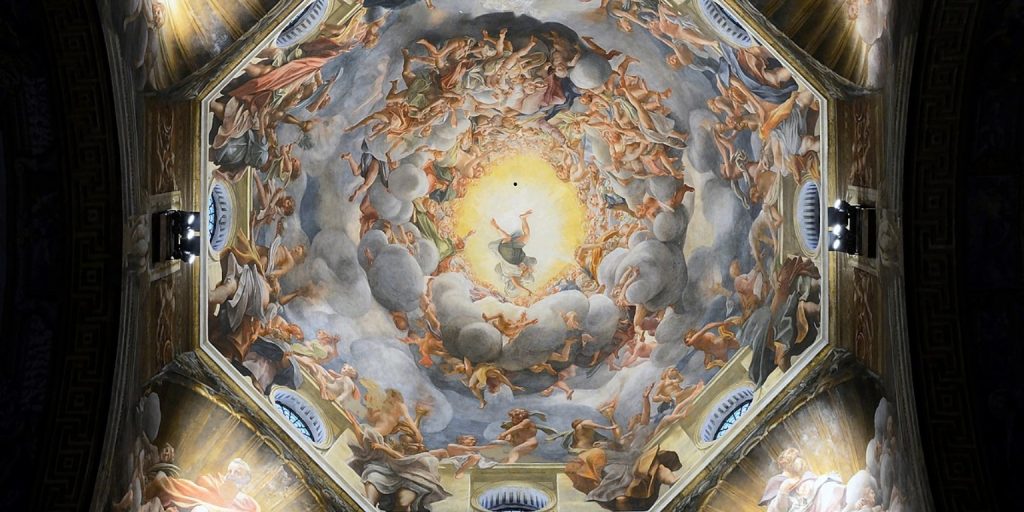
The Assumption of the Virgin is the fresco by Antonio Allegri, known as Correggio, that fills the dome of Parma Cathedral. Instead of painting a scene inside a frame, Correggio turned the whole dome into an open sky: from the floor you look up into a spiral of clouds, angels and saints swirling around the Virgin as she rises. Painters in Rome copied the idea for the next hundred years.
The Assumption of the Virgin at a glance
- Where: in the dome over the crossing of Parma Cathedral, on Piazza Duomo in the historic centre.
- Created: the contract was signed on 3 November 1522; recent archival research dates the actual painting of the dome and pendentives to about 1530–32.
- By: Antonio Allegri da Correggio (around 1489–1534).
- What it is today: a fresco in a working cathedral, seen from the nave and crossing below.
- Time needed: 20–30 minutes for the dome, longer for the rest of the cathedral and the baptistery next door.
A commission that outlived the painter
Correggio had just finished the dome of the nearby Benedictine church of San Giovanni Evangelista when, in 1522, the cathedral's building board signed him up for a much larger job: the dome, the pendentives, the walls towards the apse, the vault before the high altar and the apse itself. The fee was 1,000 gold ducats. Scaffolding to reach the dome was only built in June 1530, and the painter then worked quickly, completing the dome in 283 working days of fresco, each a patch of fresh plaster painted in one go.
Correggio never finished the rest. Plans to continue into the apse were being made in 1532, but he died suddenly on 5 March 1534, and only the dome and pendentives, roughly 650 square metres, are by him. Tradition, recorded by 18th-century local scholars, says the canons were baffled by such a radical image and that praise from Titian, visiting with Emperor Charles V, helped convince them; there is no contemporary document for this story.
What to look for
- The Virgin in a red and blue robe on the side towards the apse, carried upwards by a whirl of angels, many of them singing or playing instruments.
- At the very centre, a foreshortened figure plunging down to meet her, usually read as Christ; some scholars think it is an angel instead.
- Around the base of the dome, between the round windows, the apostles standing on a painted ledge, looking up in amazement as if at her empty tomb.
- Among the crowd of the blessed, Adam and Eve, and Judith holding the head of Holofernes.
- In the four pendentives, Parma's patron saints: John the Baptist with the lamb, Hilary, Joseph and Bernard degli Uberti, the only one looking upwards.
Why it mattered
Correggio treated the whole curved surface as one picture and painted the figures from below, so that legs and feet hang over you and the dome seems to open into heaven. The technique, called di sotto in su (from below, upwards), was daring in the 1530s. A century later it became the model for Baroque ceilings: Giovanni Lanfranco's dome in Sant'Andrea della Valle in Rome and Carlo Cignani's Assumption in Forlì Cathedral both follow it.
Tips for your visit
- Stand at the crossing and turn slowly: the composition is designed to spiral, so no single spot shows everything.
- Bring binoculars or use your phone's zoom; the dome is high, and details like the apostles' faces are easy to miss.
- Come on a bright day, around midday, when most light enters through the drum windows.
- Be quiet and respectful during Mass; the cathedral is still a place of worship.
Nearby
- Baptistery of Parma: the octagonal pink marble baptistery by Benedetto Antelami, right next to the cathedral.
- San Giovanni Evangelista: the Benedictine church just behind the cathedral, with Correggio's earlier dome of the Vision of St John on Patmos.
- Camera di San Paolo: the former abbess's room painted by Correggio around 1519, a short walk away.
- Piazza Garibaldi: Parma's main square, a few minutes south along Strada Cavour.
See Parma with World City Trail
Our Parma scavenger hunt turns the old town into a game you play on your phone. The route takes around 2 hours, with about 26 minutes of walking, and leads you through the historic centre. You can play in English, German, French, Italian, Spanish and Dutch.
If you prefer a different format, Parma also has a self-guided walking tour and an outdoor escape game.
Play the Parma scavenger hunt →
Take the self-guided walking tour of Parma →
Play the outdoor escape game in Parma →
Facts checked in October 2026.