
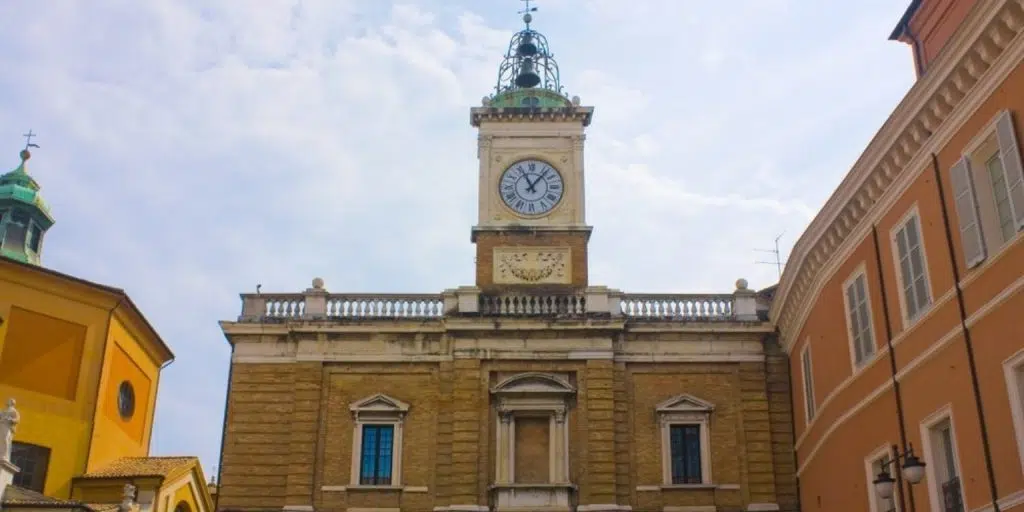
The Palazzo della Torre dell'Orologio is the palace with the clock tower on Piazza del Popolo, the main square of Ravenna. Its name simply means "palace of the clock tower", but its past is anything but plain: over the last two centuries it has been the city's customs house, Ravenna's very first cinema and, between the wars, the local headquarters of the Fascist party.
Palazzo della Torre dell'Orologio at a glance
- Where: on Piazza del Popolo in Ravenna's historic centre, a few steps from the Palazzo Merlato, the town hall.
- Built: on the remains of two churches that once stood on the square, San Marco and San Sebastiano, both long gone.
- What it is today: one of the historic palaces that frame the square, best enjoyed from the outside as part of a walk around the piazza.
- Time needed: 10 to 15 minutes for the palace and the square around it.
From two churches to customs house, cinema and party office
Piazza del Popolo took its present form in the 15th century, when Ravenna was ruled by the Republic of Venice. The Venetians rebuilt the town hall and, in 1483, set up two granite columns by the sculptor Pietro Lombardo at the edge of the square. The churches of San Marco and San Sebastiano also stood on the piazza at the time. Both disappeared, and the Palazzo della Torre dell'Orologio rose on their ruins, named after the clock tower that still marks it out.
The building's later uses read like a short history of modern Ravenna. From 1798 it housed the city's central customs office. In 1907 it became the home of Ravenna's first cinema, at a time when moving pictures were still a novelty. From 1928 to 1939 it served as the city's first Casa del Fascio, the seat of the Fascist party. Little on the facade recalls these chapters today, which is exactly why they are worth knowing before you look up at the clock.
What to look for
- The clock tower: the feature that gives the palace its name, and the quickest way to pick the building out among the palaces lining the square.
- The two columns: Pietro Lombardo's granite columns of 1483, standing on bases from Roman times. One carries Saint Apollinaris, Ravenna's first bishop; the other once held the Lion of Saint Mark, later replaced by a statue of Saint Vitalis.
- The meridian line: on one of the columns, look for the engraved line of a sundial. It was cut in 1793 to show solar noon so that the square's mechanical clock could be set by the sun.
- Palazzo Merlato: the town hall, whose name means "crenellated". It was rebuilt in 1681 and enlarged from 1761, when it took the name it carries today.
- The Prefecture: the Palazzo Apostolico, once the seat of the papal government, was renovated in 1696. A large arch links it to a neighbouring palace designed by Camillo Morigia, the architect of Dante's Tomb.
Setting the clock by the sun
Before clocks were reliable, towns checked them against the sun, and the meridian on the column shows how Ravenna did it. When the shadow touched the engraved line, it was solar noon, and whoever looked after the square's clock could correct it. Since a restoration in 1868 the line has had no gnomon to cast that shadow, so it no longer works. Still, it is a neat reminder that the clock tower and the column were once two parts of the same system for keeping the square on time.
Tips for your visit
- Come in the early evening, when Piazza del Popolo fills with people strolling and the café tables around the square are busy.
- Stand near the columns to take in the clock tower and the palaces around the square in one view.
- Look closely at the column bases and the engraved meridian; they are easy to miss when the square is crowded.
- Combine the square with Dante's Tomb and the Basilica of San Francesco, which are a short walk away.
Nearby
- Palazzo Merlato: the town hall on the same square, with its arcade at street level.
- Dante's Tomb: the small neoclassical temple by Camillo Morigia where the poet, who died in Ravenna in 1321, is buried; a few minutes' walk.
- Basilica of San Francesco: next to Dante's Tomb, with a crypt that lies below the water table, so fish swim above its old mosaic floor.
- Torre Civica: Ravenna's medieval leaning tower on Via Ponte Marino, a short walk from the square.
See Ravenna with World City Trail
Our Ravenna scavenger hunt turns the old town into a game you play on your phone. The route links 10 stops and takes around 2 hours, with about 38 minutes of walking, and includes places such as the Giardini Pubblici. You can play in English, German, French, Italian, Spanish and Dutch.
If you prefer a different format, there is also a self-guided walking tour of Ravenna and an outdoor escape game in the city.
Play the Ravenna scavenger hunt →
Take the self-guided walking tour of Ravenna →
Play the outdoor escape game in Ravenna →
Facts checked in October 2026.