
While Florence is celebrated as the birthplace of Dante Alighieri, the true final resting place of Italy’s greatest poet lies in the quiet, historic city of Ravenna. Tucked away in a small, serene “Zone of Silence,” the unassuming Dante’s Tomb is a site of profound literary and historical pilgrimage. This small, elegant temple is not just a monument but the culmination of a dramatic saga of exile, political rivalry, and a centuries-long tug-of-war for the remains of a man who gave the world the Divine Comedy.
A Poet in Exile
Dante’s story is one of a man exiled by his own city. Born in Florence in 1265, he was a key figure in the city’s political life. However, due to political conflicts between rival factions, he was exiled in 1302 and never returned. He spent the last years of his life wandering Italy, eventually finding a final, peaceful refuge in Ravenna under the protection of its lord, Guido Novello da Polenta. It was here, in 1321, that Dante completed his masterpiece and died.
His funeral was held with great honor in the nearby Basilica of San Francesco, and his remains were laid in a simple sarcophagus. But the story of Dante’s Tomb was just beginning.
The Battle for the Bones
Almost immediately after his death, Florence began to regret its treatment of its most famous son. The city made repeated attempts to reclaim his body, seeing it as a symbol of its cultural glory. This tug-of-war came to a head in 1519 when Pope Leo X, a member of the powerful Florentine Medici family, granted Florence permission to move Dante’s bones. A delegation was sent to Ravenna to retrieve them.
However, the Franciscan friars, who had become the custodians of the tomb, had no intention of surrendering their famous resident. In an act of cunning defiance, they secretly removed the bones from the sarcophagus and hid them in a wall of their monastery. When the Florentine delegation arrived and opened the tomb, they found it empty. The bones of the great poet had vanished, leaving Florence with a great cenotaph but nothing to put in it. For centuries, the friars kept the location of the bones a secret.
A Neoclassical Sanctuary
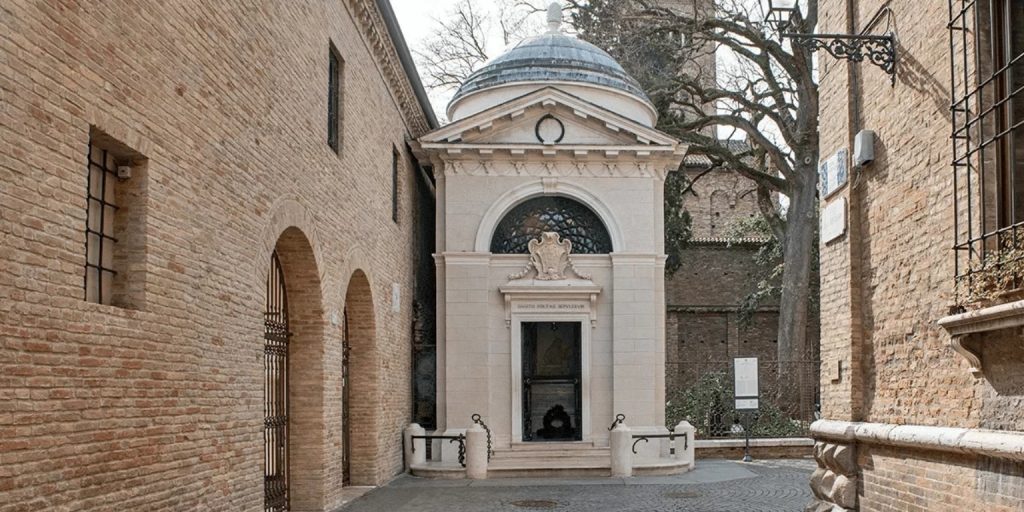
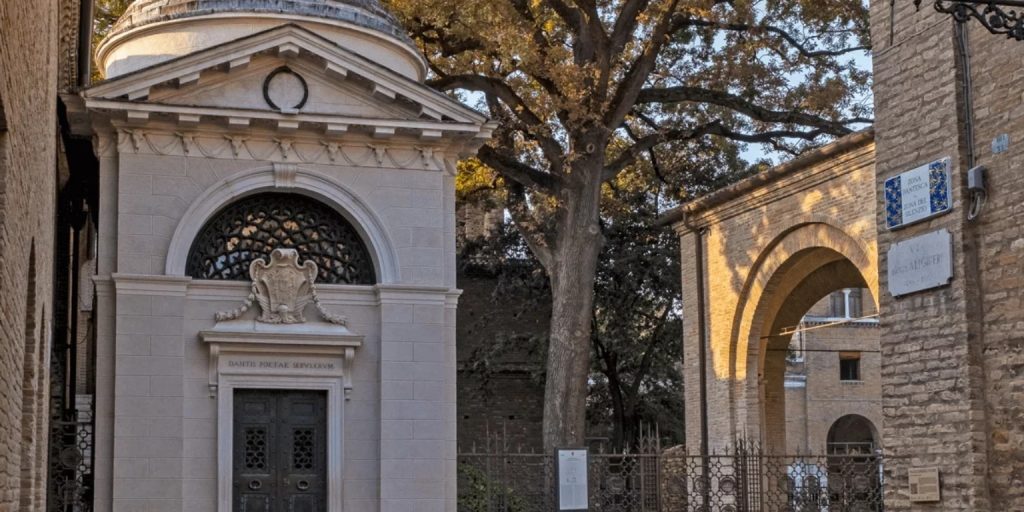
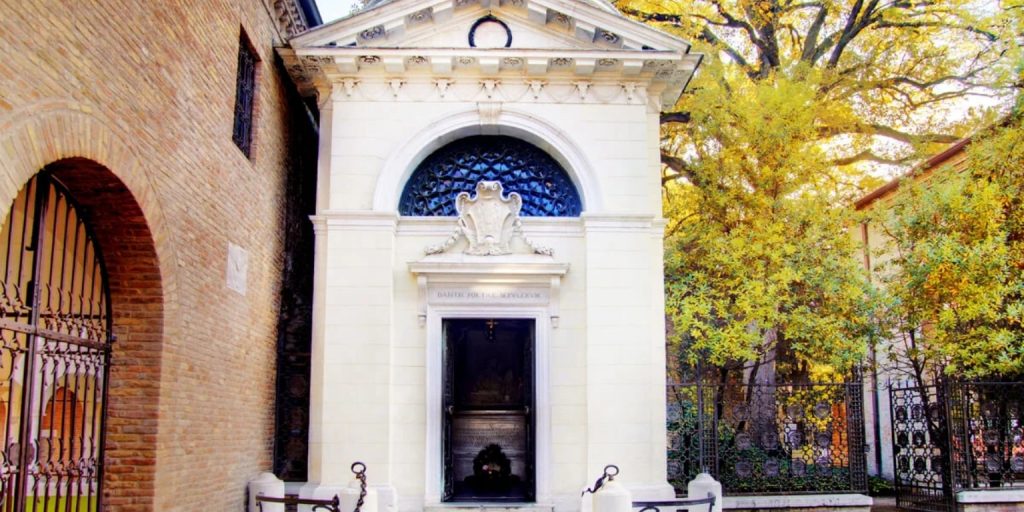
The current Dante’s Tomb is a small, exquisite neoclassical temple. Commissioned in the 18th century by Cardinal Luigi Valenti Gonzaga and designed by architect Camillo Morigia, it was intended to be a more dignified final resting place. The simple but elegant exterior gives way to a serene interior, where an ancient Roman sarcophagus sits. Inside, a 15th-century bas-relief by the sculptor Pietro Lombardo shows Dante in profile, reading at a lectern. A lamp hangs from the ceiling, its oil a symbolic gift from the city of Florence, which sends a delegation every year to keep the flame burning—a poignant truce in a centuries-old rivalry.
The “lost” bones finally resurfaced in 1865, during renovations for the 600th anniversary of Dante’s birth. A stonemason accidentally found a small wooden box hidden in the monastery wall with the inscription “Dantis ossa” (“Dante’s bones”). The remains were briefly displayed before being reburied in a new chest inside the tomb, where they remain today.
The Dante’s Tomb in Ravenna stands not only as a place of rest for Italy’s Supreme Poet but as a living monument to his story. The serene atmosphere, the echoes of a dramatic past, and the profound love for the poet that drove a city to hide his remains make this small landmark one of Italy’s most captivating and emotionally charged destinations.