
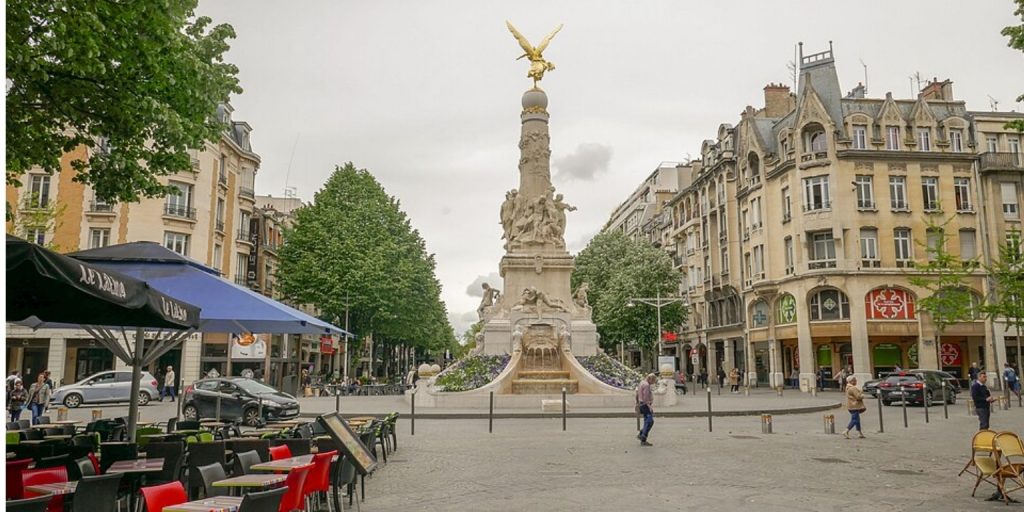
In the bustling heart of Reims, the city’s main square, Place Drouet d’Erlon, is a vibrant hub of cafes, restaurants, and social life. At its center stands a monument that beautifully encapsulates the city’s complex history: the Subé Fountain. More than just a decorative water feature, this stunning fountain is a powerful symbol of memory, destruction, and a city’s unwavering will to rebuild. A closer look reveals a story of war and peace, and of a monument that has truly earned its place as a symbol of Reims’s enduring spirit.
A Tale of Two Wars
The history of the Subé Fountain is one of profound significance and surprising resilience. It was originally built in 1906 with a generous bequest from a local industrialist, Eugène Subé, and dedicated to the memory of the French soldiers who died in the Franco-Prussian War of 1870-71. At its unveiling, the fountain was celebrated as a tribute to national sacrifice and a point of pride for the city.
However, its life was tragically cut short by the outbreak of World War I. During the heavy German bombardment of Reims from 1914 to 1918, the city was almost completely destroyed, and the fountain was no exception. It suffered immense damage, with its magnificent sculptures shattered and its core structure left in ruins. For a time, it seemed that the monument, built to honor one war, had become a casualty of another.
But the people of Reims were determined to restore their city, stone by stone. The Subé Fountain was painstakingly reconstructed using salvaged pieces and new materials. It was rededicated in 1930, returning to its place as a cherished landmark and a potent symbol of the city’s survival and its triumph over devastation.
A Confluence of Art and Allegory
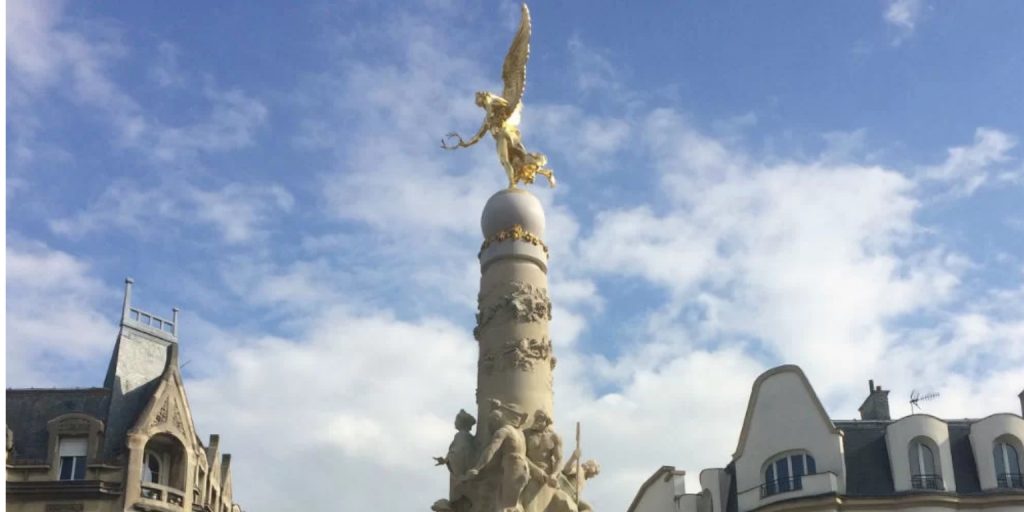
The Subé Fountain in Reims is a work of beautiful and layered symbolism. The central column, which rises majestically from the basin, is topped by a magnificent gilded bronze statue of Victory. This powerful figure, an angel with outstretched wings, holds a laurel wreath in her hand, a timeless symbol of triumph and honor. She looks out over the square, a silent guardian watching over the city that refused to be broken.
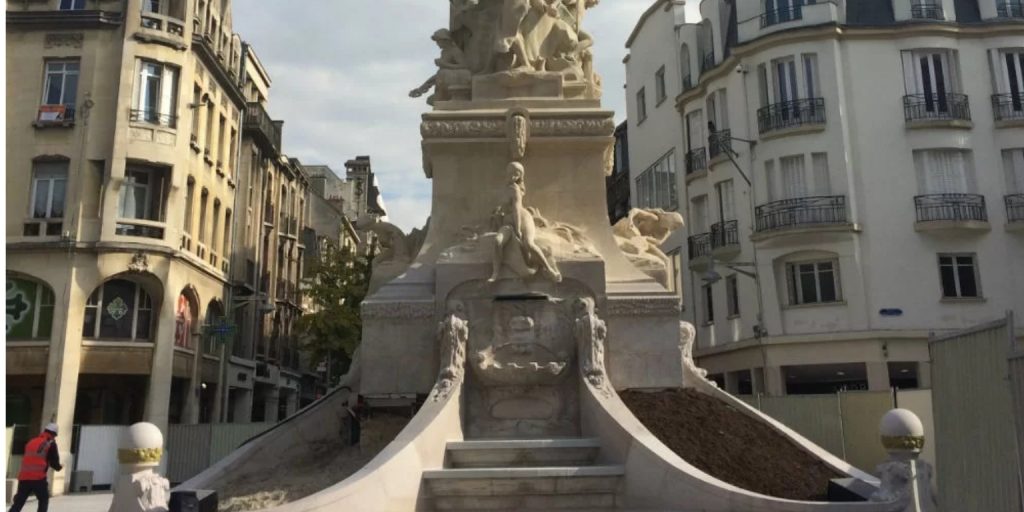
At the base of the column are four allegorical statues that represent the four continents known at the time: Europe, Asia, Africa, and America. Each figure is depicted with symbols that were representative of their regions. Europe is shown with a horse and a book, symbolizing its history and intellectual tradition. Asia holds a camel, representing trade and the exotic. Africa is accompanied by a lion, embodying the wild and untamed landscape. Finally, America is represented by a figure with a steam locomotive, a powerful symbol of progress and industrialization. These figures, crafted with remarkable detail, transform the fountain into a meditation on global connection and the aspirations of a new century.
The Heart of a Revived City
Today, the Subé Fountain serves as a central meeting point in the bustling Place Drouet d’Erlon. Its rhythmic water jets provide a refreshing oasis and a pleasing soundtrack to the lively cafes and pedestrian traffic. It is a place where locals and tourists gather to relax, meet friends, and simply enjoy the atmosphere of the city.
The Subé Fountain is a living testament to the history of Reims. It is a monument that honors the past, endures the present, and stands as a beacon of hope for the future. In a city where every corner has a story, this fountain is one of the most compelling, proving that even in the face of ruin, a beautiful and powerful symbol can rise again.